Pakistan says monitoring Taliban’s ability to fulfill promises, respond to rights’ concerns 

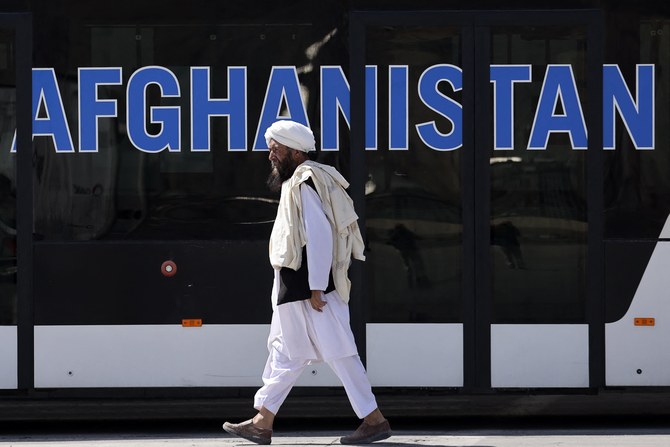
A member of the Taliban walks at the airport in Kabul on September 13, 2021. (AFP)
Short Url
Updated 14 September 2021
Follow

Pakistan says monitoring Taliban’s ability to fulfill promises, respond to rights’ concerns 

  • Islamabad wants human and women’s rights to be preserved under new Afghan government, says envoy to Washington  
  • Asad Majeed Khan says ties with US ‘important and critical’ 

ISLAMABAD: Pakistan’s Ambassador to the United States Asad Majeed Khan on Tuesday said that Islamabad was monitoring the Taliban government’s ability to fulfill promises and respond to rights’ concerns in Afghanistan. 

Over the past few weeks, United Nations officials and rights groups have noted a surge in human rights violations in Afghanistan. 

UN High Commissioner for Human Rights Michelle Bachelet said on Monday Afghanistan’s Taliban rulers had contradicted public promises on rights, including by ordering women to stay at home, blocking teenage girls from school and holding house-to-house searches for former foes. She said the country was in a “new and perilous phase,” with many women and members of ethnic and religious communities deeply worried. 

Pakistan wants human and women’s rights to be preserved under the new Afghan government, Ambassador Khan told Washington Diplomat in an interview on Tuesday. 

“We have not recognized the Taliban government,” he said. “No country has formally recognized it, but we are monitoring the ability of the new government in Afghanistan to respond to the concerns of the international community, and to deliver on the commitments and promises that they have been making over a period of time.” 

To a question about Pakistan-US ties, Ambassador Khan said they had always been “important” and “critical” for Islamabad. 

“Obviously, since 9/11, we have been essentially through the prism of Afghanistan. I can tell you that today, we are together on the same side in terms of our interests and expectations in Afghanistan,” he said. 

“The United States wants to see the conflict end; that’s also what we want. And we would like to see that the gains Afghanistan has made over the last few decades are preserved.” 

Asked how would Pakistan’s friendship with China affect its relationship with US, the Pakistani diplomat said Islamabad didn’t want its relationship “to be seen through any prism, be it Afghanistan, India or China.” 

“Yes, of course, our relations with China are close, but so is our relationship with the United States,” he replied. “As we speak, the US is the largest export destination for Pakistan, and our third largest source of remittances, around $3 billion a year.” 

The statement by the Pakistani ambassador comes after US Secretary of State Antony Blinken said Washington would reassess its ties with Pakistan over Afghanistan’s future. 

In the first public hearing in Congress about Afghanistan since the fall of Kabul, Blinken told the House of Representatives Foreign Affairs Committee that Pakistan has a “multiplicity of interests some that are in conflict with ours.” 

“It is one that is involved hedging its bets constantly about the future of Afghanistan, it’s one that’s involved harboring members of the Taliban ... It is one that’s also involved in different points cooperation with us on counterterrorism,” he said. 

The US would be looking at its relationship with Pakistan in the coming weeks to formulate what role Washington would want it play in the future of Afghanistan, Blinken said. 


Pakistan to maintain hard line on Afghanistan after strikes as Taliban vows military response

Updated 26 February 2026
Follow

Pakistan to maintain hard line on Afghanistan after strikes as Taliban vows military response

  • Islamabad blames Afghanistan’s ‘guerrilla mindset’ for escalating tensions between the two countries
  • Afghan Taliban spokesperson denies militant presence in his country, accuses Pakistan of hitting civilians

ISLAMABAD: Pakistan vowed on Wednesday to continue its current policy toward Afghanistan unless the Taliban leadership abandons its “guerrilla mindset,” days after Islamabad carried out airstrikes inside Afghan territory, sharply escalating tensions between the two neighbors once again.

Pakistan conducted intelligence-based strikes overnight into Sunday in Afghanistan’s eastern Nangarhar and southeastern Paktika provinces, saying it had targeted camps of the banned Tehreek-e-Taliban Pakistan (TTP), its affiliates and Daesh-linked fighters.

Islamabad has long accused Kabul of allowing militant groups to use Afghan soil to launch attacks on Pakistani civilians and security forces, a charge the Taliban deny. The two sides also clashed in October last year, leading Pakistan to close key border crossings for bilateral and transit trade.

State Minister for Interior Talal Chaudhry told Geo News that Pakistan had attempted dialogue but would now persist with practical measures if the Taliban failed to change course.

“They call themselves a state, but they have not yet emerged from their guerrilla mindset,” he said.

“Now, with the practical steps we are taking, we want to change their behavior and see them in the form of a state,” he added.

Pakistan blamed a string of recent suicide bombings in Islamabad, Bajaur and Bannu on militants operating from Afghan territory before launching the latest strikes.

Chaudhry said Afghanistan had been acting like “an irresponsible neighbor,” warning that his country’s current approach would continue if attacks inside Pakistan persisted.

“This war will be won, and all this will end,” he said. “If it is not resolved the straight way, then it will be completely ended by a hard-line approach.”

Meanwhile, Kabul has condemned the airstrikes as violations of its sovereignty and said civilians were killed.

In an interview with Al Arabiya, Taliban government spokesman Zabihullah Mujahid also pledged to respond militarily.

“It would be a military response, but its details are confidential and I cannot explain further,” he said.

Mujahid rejected Pakistan’s allegations that TTP or Daesh militants operate from Afghan soil, saying security problems inside Pakistan were domestic in nature.

“Afghan soil is not allowed to be used against anyone,” he said, adding that Kabul had carried out extensive operations against Daesh and eliminated its presence in Afghanistan.

The 2,600-kilometer border between the two countries remains a vital trade and transit route, but crossings have faced repeated closures amid rising tensions, disrupting commerce and humanitarian movement.

Several regional countries, including Saudi Arabia, Türkiye and Qatar, have sought to mediate between the two countries, though their military exchanges risk further destabilizing their ties.