

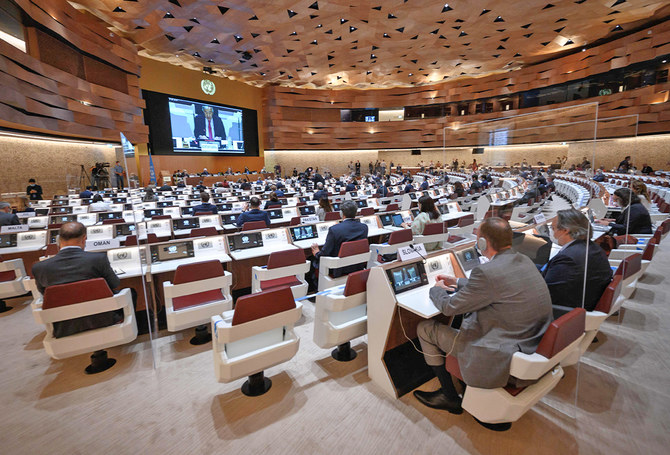

GENEVA/NEW YORK: Donors have pledged more than $1.1 billion to help Afghanistan, where poverty and hunger have spiralled since the Taliban took power, and foreign aid has dried up, raising the spectre of a mass exodus.
UN Secretary-General Antonio Guterres, speaking halfway through a UN conference seeking $606 million to meet Afghanistan’s most pressing needs, said it was too early to say how much had been promised in response to the appeal.
After decades of war and suffering, Afghans are facing “perhaps their most perilous hour,” he said.
“The people of Afghanistan are facing the collapse of an entire country — all at once.”
He said food could run out by the end of this month, and the World Food Programme said 14 million people were on the brink of starvation.
The Taliban ruled Afghanistan according to their strict interpretation of Islamic law from 1996-2001 and were toppled in an invasion led by the United States, which accused them of sheltering militants behind the September 11 attacks.
They swept back to power last month in a lightning advance as the last US-led NATO troops pulled out and the forces of the Western-backed government melted away.
With billions of dollars of aid flows abruptly ending due to Western antipathy and distrust toward the Taliban, donors had a “moral obligation” to keep helping Afghans after a 20-year engagement, several speakers in Geneva said.
Neighbours China and Pakistan had already offered help.
HUMAN RIGHTS CONCERNS
But UN human rights chief Michelle Bachelet, also in Geneva, underlined the Western misgivings. She accused the Taliban of breaking recent promises by once more ordering women to stay at home rather than go to work, keeping teenage girls out of school, and persecuting former opponents. read more
Beijing last week promised $31 million worth of food and health supplies, and on Friday said it would send a first batch of 3 million coronavirus vaccines.
Pakistan sent food and medicine, and it called for Afghan assets frozen abroad to be released. Iran said it had dispatched an air cargo of aid.
“Past mistakes must not be repeated. The Afghan people must not be abandoned,” said Pakistani Foreign Minister Shah Mehmood Qureshi, whose country has close relations with the Taliban and would most likely bear the brunt of an exodus of refugees.
Both China and Russia said the main burden of helping Afghanistan out of crisis should lie with Western countries.
“The US and its allies have a greater obligation to extend economic, humanitarian and livelihood assistance,” said Chen Xu, China’s ambassador to the United Nations in Geneva.
The United States pledged $64 million in new humanitarian assistance at the conference, while Norway pledged an extra $11.5 million.
Even before the Taliban’s seizure of Kabul last month, half the population — or 18 million people — depended on aid. That looks set to increase due to drought and shortages.
Around $200 million of the new money is earmarked for the UN World Food Programme, which found that 93 percent of the 1,600 Afghans it surveyed in August and September were not getting enough to eat.
“BRINK OF STARVATION”
WFP Executive Director David Beasley said 40 percent of Afghanistan’s wheat crop had been lost, the price of cooking oil had doubled, and most people anyway had no way of getting money.
While banks have started reopening, the queues for withdrawals are extremely long, and more importantly, no one who depended on the government for a salary — from civil servants to police — has been paid since July.
“Fourteen million people, one out of three, are marching to the brink of starvation. They don’t know where their next meal is,” Beasley said.
“If we are not very careful, we could truly, truly enter into the abyss in catastrophic conditions, worse than what we see now.”
The UN World Health Organization, also part of the appeal, wants to shore up hundreds of health facilities at risk of closure after donors backed out.
Antonio Vitorino, head of the International Organization for Migration, said the Afghan medical system was “on the verge of collapse,” and WHO director-general Tedros Adhanom Ghebreyesus said that gains made toward eradicating polio and vaccinating against COVID-19 could unravel.
UN High Commissioner for Refugees Filippo Grandi warned that there could “very soon” be far greater displacement than the estimated half a million who have already sought refuge elsewhere in Afghanistan this year.
“The physical distance between our nations and Afghanistan shouldn’t mislead us,” Turkish Foreign Minister Mevlut Cavusoglu added.
“A humanitarian and security crisis in Afghanistan will have direct implications across the globe. We should take collective action now.”


