

Pakistan says Kuwait has awarded permanent contracts to 140 of its doctors

A man takes coronavirus clearance certificate from a doctor at a health clinic in Subhan, Kuwait, on March 9, 2020. (REUTERS/File)
Short Url
Updated 14 September 2021
Follow

Pakistan says Kuwait has awarded permanent contracts to 140 of its doctors

  • Pakistan and Kuwait signed an agreement for the placement of health professionals in July 2020
  • Envoy to Kuwait says around 1,500 Pakistani paramedics currently working in Kuwait

ISLAMABAD: Kuwait’s Ministry of Health has awarded permanent contracts to nearly 140 doctors from Pakistan who were working in the emirate on a temporary basis to help fight the coronavirus pandemic, a senior official at the ministry of overseas Pakistanis and human resource development said on Monday.
The doctors previously worked under Kuwait’s “lokum” system for a period of three months, which was extended for an additional three months. Now, after the permanent appointment, they will have similar contracts and job titles as other non-Kuwaiti doctors.
Under the locum system, a doctor is hired on a temporary basis and fills a rotation gap at a hospital, clinic or practice. 
“Till date, 239 doctors have been dispatched [to Kuwait] in a total of nine batches through chartered flights since October 2020 in different specialities,” Kashif Ahmed Noor, the director-general of the Bureau of Emigration and Overseas Employment, told Arab News. “All 140 doctors till the seventh batch got permanent contracts by the ministry of health in Kuwait, out of which two doctors have come back to Pakistan due to their personal reasons.”
“Kuwait is giving batch-wise permanent contracts to Pakistani doctors,” he said, adding that all Pakistani doctors would get permanent contracts except those who did not receive adequate evaluations from their supervisors. 
He said Pakistan would send more doctors to Kuwait later in September.
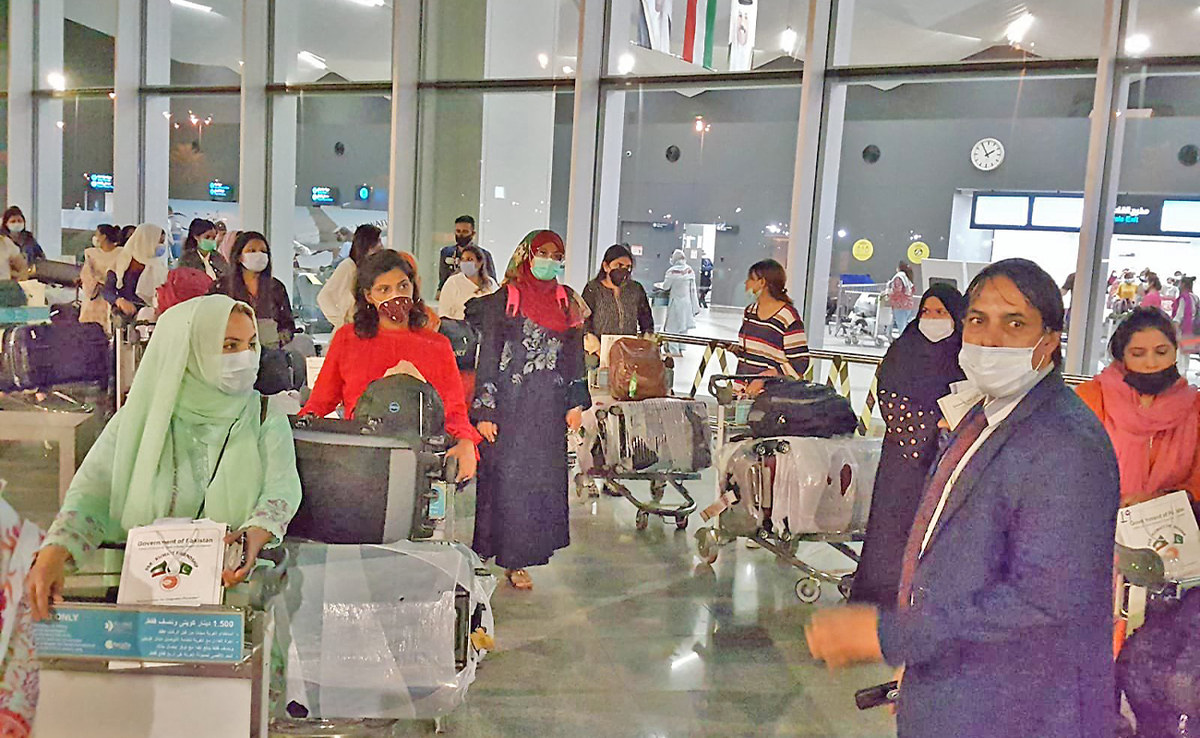


Sixth batch of Pakistani medical professionals arrive in Kuwait on June 24, 2021. (Photo courtesy: @PakinKuwait/Twitter)

Pakistan’s ambassador to Kuwait Syed Sajjad Haider said the two countries had signed an agreement on the placement of health care professionals in Kuwait in July last year.
“Under the agreement, around 1,500 paramedics staff are already working in Kuwait including doctors, nurses and technicians,” Haider told Arab News. “As our response to COVID-19 was appreciated by the World Health Organization and other entities, Kuwait was very keen to take maximum medical staff from Pakistan and they are satisfied with their performance.”
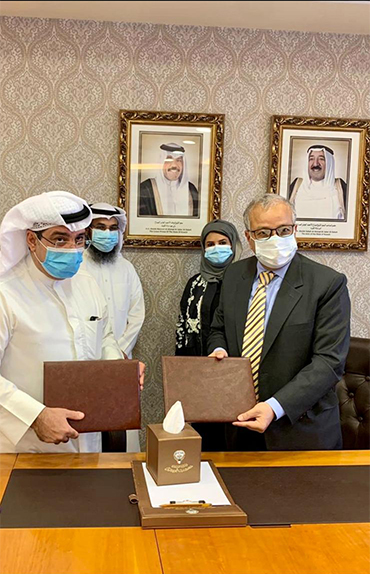


Undersecretary of Ministry of Health in Kuwait, Dr. Mustafa Reza (first left) poses for a picture with the Ambassador of Pakistan in Kuwait, Syed Sajjad Haider (first right),  after signing an agreement to send 600 Pakistani healthcare professionals to work in Kuwait, in Kuwait on July 04, 2020. ( Photo Courtesy: @PakinKuwait/Twitter)

Kuwait’s embassy in Islamabad did not respond to questions seeking comment for this story.


Pakistan reports current account surplus in Jan. owing to improved trade, remittances

Updated 4 sec ago
Follow

Pakistan reports current account surplus in Jan. owing to improved trade, remittances

  • Pakistan’s exports crossed the $3 billion mark in Jan. as the country received $3.5 billion in remittances
  • Last month, IMF urged Pakistan to accelerate pace of structural reforms to strengthen economic growth

ISLAMABAD: Pakistan recorded a current account surplus of more than $120 million in January, the country’s finance adviser said on Tuesday, attributing it to improved trade balance and remittance inflows.

Pakistan’s exports rebounded in January 2026 after five months of weak performance, rising 3.73 percent year on year and surging 34.96 percent month on month, according to data released by the country’s statistics bureau.

Exports crossed the $3 billion mark for the first time in January to reach $3.061 billion, compared to $2.27 billion in Dec. 2025. The country received $3.5 billion in foreign remittances in Jan. 2026.

Khurram Schehzad, an adviser to the finance minister, said Pakistan reported a current account surplus of $121 million in Jan., compared to a current account deficit of $393 million in the same month last year.

“Improved trade balance in January 2026, strong remittance inflows, and sustained momentum in services exports (IT/Tech) continue to reinforce the country’s external account position,” he said on X.

Pakistan has undergone a difficult period of stabilization, marked by inflation, currency depreciation and financing gaps, and international rating agencies have acknowledged improvements after Islamabad began implementing reforms such as privatizing loss-making, state-owned enterprises (SOEs) and ending subsidies as part of a $7 billion International Monetary Fund (IMF) loan program.

Late last month, the IMF urged Pakistan to accelerate the pace of these structural reforms to strengthen economic growth.

Responding to questions from Arab News at a virtual media roundtable on emerging markets’ resilience, IMF’s director of the Middle East and Central Asia Jihad Azour said Islamabad’s implementation of the IMF requirements had been “strong” despite devastating floods that killed more than 1,000 people and devastated farmland, forcing the government to revise its 4.2 percent growth target to 3.9 percent.

“What is important going forward in order to strengthen growth and to maintain the level of macroeconomic stability is to accelerate the structural reforms,” he said at the meeting.

Azour underlined Pakistan’s plans to privatize some of the SOEs and improve financial management of important public entities, particularly power companies, as an important way for the country to boost its capacity to cater to the economy for additional exports.

“This comes in addition to the effort that the authorities have made in order to reform their tariffs, which will allow the private sector of Pakistan to become more competitive,” the IMF official said.