

Gulf Cooperation Council seeks to expand relations with Pakistan

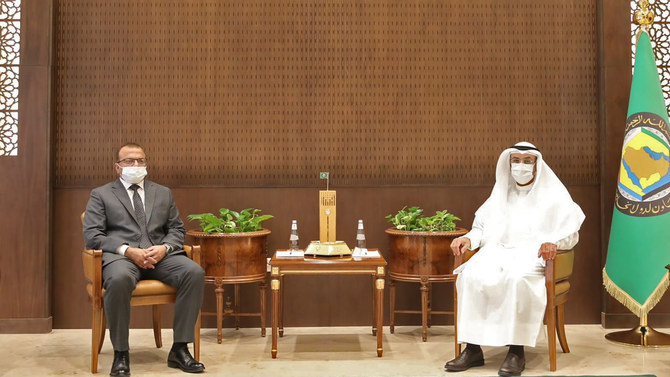
Pakistan's envoy to Saudi Arabia, Bilal Akbar, left, calls on Secretary General of the Gulf Cooperation Council (GCC) in Riyadh, Saudi Arabia, on September 12, 2021. (Photo courtesy: @GCCSG/Twitter)
Short Url
Updated 12 September 2021
Follow

Gulf Cooperation Council seeks to expand relations with Pakistan

  • GCC secretary general reviewed current cooperation with Pakistan's ambassador to Saudi Arabia on Sunday
  • In April, after a gap of 13 years, Pakistan and GCC resumed negotiations on a free trade agreement

ISLAMABAD: The Gulf Cooperation Council (GCC) said on Sunday it is planning to expand cooperation with Pakistan, the Saudi Press Agency reported.

The GCC is a regional, intergovernmental political and economic union that consists of Bahrain, Kuwait, Oman, Qatar, Saudi Arabia, and the United Arab Emirates.

The plans to tighten and further develop new areas of cooperation were discussed by GCC secretary general Nayef bin Falah Al-Hajraf and Pakistan's ambassador to Saudi Arabia, Bilal Akbar, during a meeting at the council's main headquarters in Riyadh on Sunday.

"During the meeting, they reviewed ways to enhance and develop cooperation between the Gulf Cooperation Council and the Islamic Republic of Pakistan to serve common interests, and the latest political developments in the region," the SPA reported.

"His Excellency Secretary-General reviewed with the Ambassador the relations that bind the GCC countries with the Islamic Republic of Pakistan in various fields."

In April, after a gap of 13 years, Pakistan and the GCC resumed negotiations on a free trade agreement (FTA).

Talks on the FTA started in 2004, but after two rounds of talks in 2006 and 2008, only a broader outline was reached.

The intention to resume the negotiations was declared during Saudi Crown Prince Mohammed bin Salman's visit to Islamabad in 2019, but they were further delayed by the coronavirus outbreak.


Pakistan terms climate change, demographic pressures as ‘pressing existential risks’

Updated 06 December 2025
Follow

Pakistan terms climate change, demographic pressures as ‘pressing existential risks’

  • Pakistan has suffered frequent climate change-induced disasters, including floods this year that killed over 1,000
  • Pakistan finmin highlights stabilization measures at Doha Forum, discusses economic cooperation with Qatar 

ISLAMABAD: Pakistan’s Finance Minister Muhammad Aurangzeb on Saturday described climate change and demographic pressures as “pressing existential risks” facing the country, calling for urgent climate financing. 

The finance minister was speaking as a member of a high-level panel at the 23rd edition of the Doha Forum, which is being held from Dec. 6–7 in the Qatari capital. Aurangzeb was invited as a speaker on the discussion titled: ‘Global Trade Tensions: Economic Impact and Policy Responses in MENA.’

“He reaffirmed that while Pakistan remained vigilant in the face of geopolitical uncertainty, the more pressing existential risks were climate change and demographic pressures,” the Finance Division said. 

Pakistan has suffered repeated climate disasters in recent years, most notably the 2022 super-floods that submerged one-third of the country, displaced millions and caused an estimated $30 billion in losses. 

This year’s floods killed over 1,000 people and caused at least $2.9 billion in damages to agriculture and infrastructure. Scientists say Pakistan remains among the world’s most climate-vulnerable nations despite contributing less than 1 percent of global greenhouse-gas emissions.

Aurangzeb has previously said climate change and Pakistan’s fast-rising population are the only two factors that can hinder the South Asian country’s efforts to become a $3 trillion economy in the future. 

The finance minister noted that this year’s floods in Pakistan had shaved at least 0.5 percent off GDP growth, calling for urgent climate financing and investment in resilient infrastructure. 

When asked about Pakistan’s fiscal resilience and capability to absorb external shocks, Aurangzeb said Islamabad had rebuilt fiscal buffers. He pointed out that both the primary fiscal balance and current account had returned to surplus, supported significantly by strong remittance inflows of $18–20 billion annually from the Middle East and North Africa (MENA) and Gulf Cooperation Council (GCC) regions. 

Separately, Aurangzeb met his Qatari counterpart Ali Bin Ahmed Al Kuwari to discuss bilateral cooperation. 

“Both sides reaffirmed their commitment to strengthening economic ties, particularly by maximizing opportunities created through the newly concluded GCC–Pakistan Free Trade Agreement, expanding trade flows, and deepening energy cooperation, including long-term LNG collaboration,” the finance ministry said. 

The two also discussed collaboration on digital infrastructure, skills development and regulatory reform. They agreed to establish structured mechanisms to continue joint work in trade diversification, technology, climate resilience, and investment facilitation, the finance ministry said.