


CHICAGO: Americans paused on Saturday at 8:46 a.m. (New York time) to commemorate the 20th anniversary of the terrorist attacks that took the lives of 2,977 people on Sept. 11, 2001. The start-time reflects the moment when the first hijacked commercial plane struck the North Tower of the World Trade Center.
Ceremonies were held at the three locations struck by the terrorist-hijacked commercials planes — in New York where the Twin Towers of the World Trade Center collapsed; at the Pentagon, the heart of America’s military; and in a field near Shanksville, Pennsylvania, where passengers fought the terrorists and forced the plane to crash before it could hit one of its believed targets, the White House or the US Congress.
Every major American television station broadcast the commemorations live but it was clear that despite the nation coming together to mourn, the divisive political polarization that has kept America divided could not be bridged even by one of the nation’s greatest tragedies.
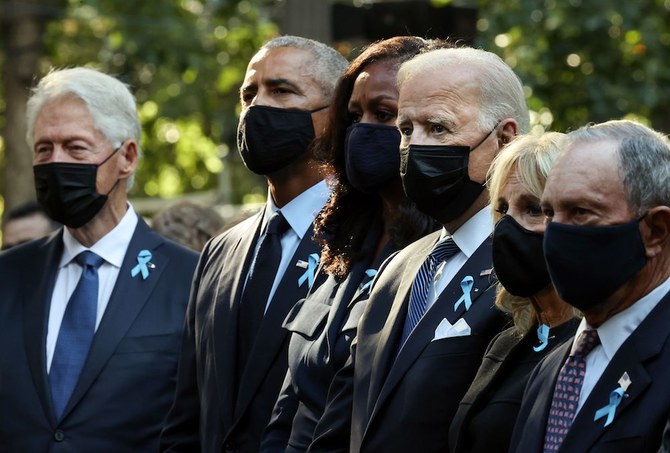
Americans watched as President Joe Biden and his wife, former President Barack Obama and his wife, and former President Bill Clinton, all wearing COVID-19 face masks, were escorted to the front of the ceremony at the 1,776 foot tall “One World Trade Center” built where the Twin Towers once stood. The height of the new building reflects the year the Declaration of Independence was issued, 1776.
Biden did not speak at the ceremonies but did release a video the evening before expressing his feelings, saying “20 years after Sept. 11, 2001, we commemorate the 2,977 lives we lost and honor those who risked and gave their lives. As we saw in the days that followed, unity is our greatest strength. It’s what makes us who we are — and we can’t forget that.”
Former President Donald Trump was scheduled to visit “Ground Zero” in New York later.
Vice President Kamala Harris was present at the Shanksville ceremonies, where she noted the tragedy suffered by “backlash victims” that took place in the weeks and months after Sept. 11, and then flew to the Pentagon to join President Biden.
Former President George W. Bush, who was in office when the terrorist attacks took place, also spoke at the Shanksville site. Bush noted how Americans reached out to embrace “people of the Muslim faith” after Sept. 11, but he acknowledged the political polarization that has gripped American politics 20 years later.
“In the weeks and months following the 9/11 attacks, I was proud to lead an amazing, resilient united people,” Bush said.
“When it comes to the unity of America, those days seem distant from our own. Maligned force seems at work in our common life that turns every disagreement into an argument and every argument into a clash of cultures. So much of our politics has become a naked appeal to anger, fear and resentment.”
The New York commemorations featured the New York Police Department Pipes and Drums band playing “Hard Times Come Again No More,” a US folk song from the 1850s, and the national anthem. Relatives of the 2,977 victims who died that day read the names of each victim, pausing to offer remembrances of those they had lost.
The ceremonies, organized by the National September 11 Memorial and Museum, included six “moments of silence” to acknowledge the times that the two World Trade Center towers was struck and fell, and the times corresponding to the attack on the Pentagon and the crash of Flight 93 near Shanksville.
Across America, local governments held 9/11 commemorations, all highlighted by a bell-tolling ceremony — sounding the bell which is rung when a firefighter dies in the line of service. A total of 344 firefighters and 77 police officers died in the terrorist attacks.
Of the 2,977 victims, not including the 19 suicide hijackers, 2,605 were US citizens, and 372 were non-US citizens from more than 90 countries.
Nearly every major Arab and Muslim American body issued statements expressing their commemoration solidarity as the nation remembered, including the American Arab Anti-Discrimination Committee.
“First and foremost, we remember the nearly three thousand innocent victims who perished on that day, and the hundreds of thousands more who lost their lives in the senseless wars that followed. We must also remember the victims of hate crimes who were killed in the immediate aftermath of the Sept. 11 attacks — individuals were attacked simply because they looked Arab or Middle Eastern,” the ADC statement said This referred to nearly two dozen individuals murdered in hate crimes in the weeks and months after Sept. 11.
“Twenty years later it’s time for America to acknowledge that Arabs, Muslims, Sikhs, and South Asians faced serious and significant backlash immediately after the attacks. Our community members were targeted simply because of their perceived race or national origin. It was only a few days after 9/11 when Balbir Singh Sodhi, a Sikh, was murdered in Mesa, Arizona – the first 9/11 backlash fatality.”


