

Saudi Arabia shooting for top 20 FIFA rank by World Cup 2034 

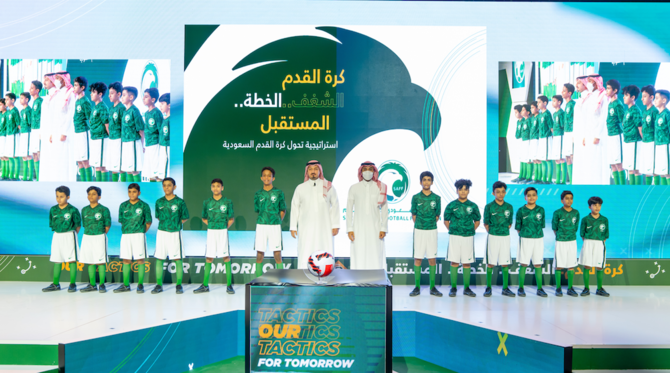
The Saudi Arabian Football Federation on Saturday revealed its strategy for the transformation of football in the Kingdom. (Supplied)
Short Url
Updated 11 September 2021
Follow

Saudi Arabia shooting for top 20 FIFA rank by World Cup 2034 

  • New Saudi Arabian Football Federation vision built on 7 pillars
  • Plans in place to develop platform for growth of women’s, youth game

RIYADH: The Saudi Arabian Football Federation on Saturday revealed its strategy for the transformation of football in the Kingdom in an exclusive event held at the Green Halls in Riyadh.

A seven-pillar strategy was announced, which aims to position the Kingdom among the elite football nations by the time the FIFA World Cup 2034 arrives.

The seven pillars of the strategy, titled “Our Tactics for Tomorrow,” are Pathway, Competitions, Women’s Football, Technology, Workforce, Global Prominence and Governance.

The plan looks to some of the world’s most successful national footballing projects for inspiration and presents a clear vision for the nation’s footballing future that capitalizes on the talent, energy and drive of the Saudi youth.

It also looks to enhance coordination between key stakeholders of the Saudi football ecosystem, such as the Ministry of Sports, MAHD Academy and the clubs, in an aim to produce the best Saudi footballing generation ever.

The event was attended by Prince Abdulaziz Bin Turki Al-Faisal, minister of sports and president of the Saudi Arabian Olympic Committee, alongside SAFF President Yasser Al-Misehal, federation members and a wide range of Saudi football stakeholders.

“Sports is an integral component of Saudi Arabia’s transformative Vision 2030, and we are thankful for the unconditional support and wise vision of our Kingdom’s leadership,” Prince Abdulaziz said. “Football contributes to all the key pillars of our holistic strategy as a ministry. It’s a game that represents a source of great passion for Saudis in general, as it promotes diversity and inclusion in our society, and supports participation, youth development and the sports economy.

He added: “We want to aim to be genuine contenders on the global stage to truly reflect the undeniable talent of our youth along with the country’s love for the game.”

According to the strategy outline, success will be achieved by supporting the development of every Saudi footballer from age six through to professional age by optimizing existing regional centers and developing new grade A centers across different regions in the Kingdom.

“Inspired by the vision of our Kingdom’s leadership and the unconditional support for the sports sector, we have massive ambitions to build on the unwavering passion of the fans and our nation’s illustrious history to transform the future of Saudi football,” Al-Misehal said. “Our comprehensive and ambitious plan will propel Saudi Arabia to become among the elite football nations through an extensive investment in player development and targeted solutions across the pathway.”

Also central to the strategy is the launch of a uniform coaching curriculum and youth structure program for the club transition phase. National centers will also be developed to serve as a home to Saudi national teams across all age levels, offering them a year-round training camp.

The plans also include the establishment of a comprehensive structure for competitions to offer talented Saudi players a bridge to professional football through greater playing opportunities across each age group. More than 50 youth competitions will be in place by 2025 spread across all Saudi regions and integrating clubs, MAHD Academy and private academies.

This pathway and competition setup will also be rolled out into women’s football, through a program that aims to create a platform for the sustainable growth of the women’s game. The strategy aims to professionalize women’s football and offer an opportunity for Saudi girls throughout the country to showcase their talent. The immediate plans include launching an inaugural local 11-a-side competition.

The strategy also plans to develop a world class football workforce on and off the pitch through targeting the development of Saudi coaches and scouts, as well as enhancing the Saudi refereeing landscape. The new tailored Saudi coaching curriculum will also be formalized and a certification system will be designed and implemented. By the year 2025, it is hoped that more than 8,000 Saudi coaches will be certified and more than 2,500 Saudi referees will go through a tailored refereeing academy program.


MESIF 2026 wraps up in Riyadh with spotlight on legacy, fans and sustainable sports growth

Updated 29 min 51 sec ago
Follow

MESIF 2026 wraps up in Riyadh with spotlight on legacy, fans and sustainable sports growth

  • A recurring theme in panel discussions was the importance of moving beyond siloed planning toward connected strategies
  • Abdullah Aldrees: I believe Saudi is a sleeping giant within the football ecosystem because of the high demand that exists

RIYADH: The sixth edition of the Middle East Sports Investment Forum concluded on Jan. 28 in Riyadh, reinforcing the need for long-term legacy planning, integrated infrastructure development and fan-centric strategies as the region’s sports ecosystem continues to mature.

Held over two days — Jan. 27-28 — at the ministry of investment headquarters and the Kingdom Arena, the forum brought together senior government officials, global sports executives, investors and technology leaders to assess how the Middle East — and Saudi Arabia in particular — can translate major event hosting and increased investment into sustainable impact.

A recurring theme in panel discussions was the importance of moving beyond siloed planning toward connected strategies that link infrastructure, finance, fan engagement and legacy from the earliest stages of project development.

Dr. Sakis Batsilas, deputy CEO of FIFA World Cup Qatar 2022, stressed that while international expertise has played a key role in the region’s rapid progress, long-term success depends on knowledge transfer and talent development.

“Yes, we do need experts and consultants and expatriates to help,” he said. “But the main, I would say, focus, is how we ensure that we transfer this knowledge and we build talent … to make sure we have the right talent.”

Drawing on his experience delivering major global events, Batsilas highlighted the need to embed legacy considerations during the bidding phase.

“Talking now from an operational point of view … I think everything starts with a bidding phase,” he said, adding that stronger legacy metrics would encourage greater long-term planning from host nations and rights holders alike.

Fan experience and commercialization also featured prominently, particularly as Saudi Arabia continues to expand its domestic leagues and host major international competitions. David Davies, chief experience officer of Catapult, said the Kingdom’s challenge lies in converting strong digital fandom into sustained in-stadium engagement.

“Saudi Arabia is … ranked consistently in the highest in the world” in terms of football fandom, Davies said. “However, attendance in-stadium is still developing.” He noted that younger, digitally native audiences require tailored engagement strategies. “The days of being able to ask them to come to you have gone,” he said.

From a government and delivery perspective, Abdullah Aldrees, chief of staff at the vice minister’s executive office at the ministry of sport, said MESIF highlighted the scale of opportunity ahead — and the importance of a joined-up approach.

“I believe Saudi is a sleeping giant within the football ecosystem because of the high demand that exists, the government support and the anchor IPs (intellectual properties — anchor sports properties and events that Saudi Arabia is hosting or investing in),” Aldrees said. “So all of this can create a lot of opportunities for football to grow in Saudi.”

He said the Kingdom has entered a critical preparation phase as it gears up for a packed calendar of major events. “We are now living in the preparation phase. We’re preparing for all these IPs, we’re preparing for all these big events coming up,” Aldrees said. “So how do you make sure that you really reap the right benefit from them and have the right legacy?”

Pointing to upcoming milestones such as the AFC Asian Cup Saudi Arabia 2027 and the FIFA World Cup 2034, Aldrees emphasized the need to think beyond hosting.

“Yes, we’re hosting World Cup. We’re hosting Asia 2027, but how do you make sure that they have a long, lasting impact on the ecosystem?” he said.

Echoing a key message from the forum, Aldrees concluded: “The effective strategy is to be looking at these things together. We no longer can be looking at them as silos and test cycles.”

The transformation of Saudi football was also highlighted as a reflection of broader cultural and structural change. Juan Esteban Gomez, a football expert specializing in digitalization and artificial intelligence, said the shift has been tangible in recent years. “The people here are breathing football,” he said, describing the Saudi league as “one of the most enjoyable competitions in the world.”

As MESIF 2026 drew to a close, participants agreed that the next phase of sports investment in the Middle East will be defined by execution — ensuring that capital, policy and innovation align to deliver measurable legacy, deeper fan engagement and resilient ecosystems capable of sustaining growth well beyond headline events.