

After Punjab, Pakistan’s Sindh ends abusive 'virginity tests' for rape victims

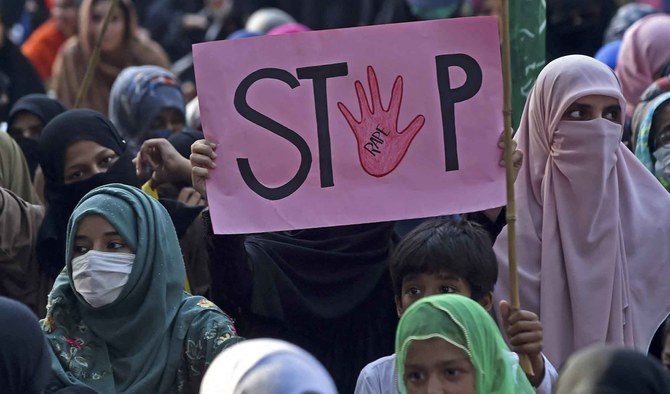
A supporter of Pakistani political party Jamaat-e-Islami (JI) holds a placard reading "Stop" during a protest against an alleged gang rape of a woman, in Lahore on September 17, 2020. (AFP/File)
Short Url
Updated 10 September 2021
Follow

After Punjab, Pakistan’s Sindh ends abusive 'virginity tests' for rape victims

  • WHO has repeatedly declared virginity tests as unscientific, harmful, and violating human rights
  • Rights activists welcome the decision with hopes it would help phase out the abusive practice

KARACHI: The government of Pakistan's Sindh province has officially abolished so-called "virginity tests" in rape examinations and is recruiting 220 female medical officers to handle rape cases, authorities confirmed in a high court hearing on Friday.

The "two-finger test" is performed by inserting one or two fingers into a woman's vagina to test the presence of a hymen — in theory to determine whether or not the woman is sexually active. The World Health Organization has debunked the test, saying it is unscientific, harmful, and a violation of women's and girls' human rights.

Sindh is the second province banning the practice, after the Lahore High Court outlawed it in Punjab in January.

Advocate Ali Lakhani, whose client's case led to the ban in Sindh, said the provincial government had filed a notification with the Sindh High Court confirming the implementation of the ban.

“Today, government of Sindh filed notification, confirming that the two-finger test has been abolished and SOPs have been finalized for examination of rape victims under consultation with Medio-Legal Reforms Committee," Lakhani told Arab News.

"They have also confirmed that 220 posts have been sanctioned for WMLOs (women medico-legal officers) across Sindh."

Rights activists welcomed the decision with hopes it would help phase out the practice, as despite a Supreme Court order declaring virginity tests unconstitutional after the Lahore verdict, which should be binding for all provinces, the practice has still been in place, including in Sindh's main city Karachi.

"We were recently told that this practice is ongoing in two major public hospitals of Karachi,” Shiraz Ahmed of War Against Rape (WAR), a Karachi-based organization working to support rape victims, told Arab News. “This judgment should be seen implemented, this practice needs to be immediately stopped."

"Virginity test is neither scientific nor medically required to establish the incidents of rape, gang rape, incest or sexual abuse," he said. "It violates bodily integrity and the privacy of rape victims and unjustifiably subjects them to further trauma."

Mahnaz Rahman, resident director of Aurat Foundation in Karachi said that besides medico-legal officers, authorities also need to employ women investigation officers.

“A woman can express herself freely in front of another woman and a woman can better understand the problems faced by another woman," she said. "We are happy that a decision has finally been taken which will take the country in right direction."


Pakistan IT minister in Kuwait to attend digital cooperation body meeting on AI risks

Updated 7 sec ago
Follow

Pakistan IT minister in Kuwait to attend digital cooperation body meeting on AI risks

  • Shaza Fatima Khawaja to attend event themed ‘Inclusive Prosperity in the Age of AI’
  • Pakistan approved National AI Policy last year, launched first locally hosted AI cloud

KARACHI: Pakistan’s Information Technology (IT) Minister Shaza Fatima Khawaja on Wednesday arrived in Kuwait on a two-day visit to hold discussions on artificial intelligence (AI) and its risks at the fifth Digital Cooperation Organization General Assembly (DCOGA), her office said.

The annual gathering brings together representatives of various states and international organizations to discuss the digital economy and the challenges associated with its growth. This year’s theme is “Inclusive Prosperity in the Age of AI.”

Pakistan has been actively developing its AI landscape, marked by the approval of the National AI Policy in July last year and the subsequent launch of its first locally hosted AI cloud in a bid to integrate AI for economic growth.

“The federal minister will participate in the General Assembly of the Digital Cooperation Organization (DCO) and hold meetings with representatives of member states,” the IT ministry said in a statement on Wednesday.

“Discussions will be held on artificial intelligence and its risks, with meetings scheduled with global policymakers.”

Khawaja will hold high-level meetings with global leaders at the event and participate in the DCO thematic ministerial roundtable comprising ministers from various countries, it added.

The development comes as Pakistan seeks to position itself as a credible participant in the global AI economy to harness AI for productivity, skills development and innovation while managing regulatory risks.

Pakistan has mainly been engaging with Gulf countries on AI. In October last year, Pakistan’s Prime Minister Shehbaz Sharif announced that Saudi Arabia has offered free training in IT and AI for Pakistani youth. Last November, Pakistan and the United Arab Emirates agreed to deepen cooperation in AI, digital governance and data innovation.

Pakistan is also hosting a week-long national AI initiative, “AI Indus Week 2026,” from Feb. 9-15 to promote the responsible use of technology and accelerate the adoption of AI across the public and private sectors.