Senate body rejects using electronic voting in next Pakistan election as government adamant

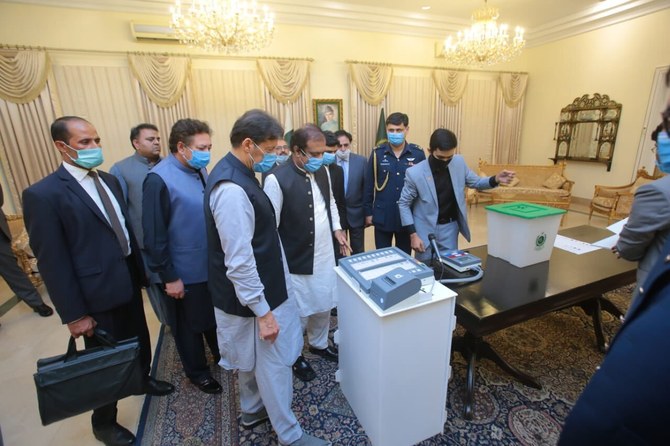
Pakistan PM Imran Khan over-looking the EVM machines in Islamabad, Pakistan on August 5, 2021. (Photo courtesy: Twitter/ @PTIOfficial)
Short Url
Updated 10 September 2021
Follow

Senate body rejects using electronic voting in next Pakistan election as government adamant

  • Election Commission earlier this week warned EMVs could jeopardize the “conduct of free, fair, credible and transparent elections”
  • Senate committee voted against the Election Act Amendment Bill after members of the ruling party walked out of the meeting

ISLAMABAD: The Pakistani senate parliamentary committee rejected on Friday a proposal by the government to use electronic voting machines (EVMs) in the next general elections.

The Election Commission of Pakistan (ECP) earlier this week submitted to the Senate Standing Committee on Parliamentary Affairs a list of 37 objections, warning that a hasty use of these devices could jeopardize the “conduct of free, fair, credible and transparent elections” in the country.

The ECP said a largescale deployment of EVMs was not possible in a short span of time, especially when they had not been properly tested and provided no ballot secrecy, voter anonymity and necessary transparency at various levels.

Despite the objections, Prime Minister Imran Khan’s special adviser on parliamentary affairs Senator Babar Awan said on Thursday the government was fully determined to do the required legislation to use these machines in the 2023 general elections.

“Prime Minister Imran Khan will not back down from e-voting and EVMs, nor will his government,” he told reporters.

During Friday’s Senate committee meeting, he accused the ECP of “shying away from fulfilling its national responsibility.”

The Senate body eventually voted against the Election Act Amendment Bill after Senate members from the ruling party walked out of the meeting to protest to the committee chairman’s refusal to hold the vote.


Pakistan bank enables Shariah-compliant digital payment facility for passengers at Islamabad airport

Updated 23 February 2026
Follow

Pakistan bank enables Shariah-compliant digital payment facility for passengers at Islamabad airport

  • Pakistan is a cash-dominated market where a significant portion of transactions in the informal sector are made without any taxes, officials say
  • The move comes amid Pakistan’s efforts to introduce a cashless model at airports under which only digital service providers can provide services

KARACHI: Aik, Pakistan’s first Islamic digital bank, has enabled fully digital payments at Islamabad International Airport to offer travelers and passengers secure, Shariah compliant digital transaction facility.

The development comes amid Pakistan’s efforts to introduce a cashless model at airports across the country, under which only digital service providers can provide services to customers.

Aik, a subsidiary of Bank Islami, said it has onboarded merchants across the Islamabad airport and integrated QR code deployments at key touchpoints to allow passengers and visitors to make secure, seamless, and Shariah-compliant digital transactions at all counters, retail outlets, and service points.

It said the implementation complies with the regulations and framework set by the State Bank of Pakistan (SBP) and is a working model for a large-scale adoption of cashless systems in public infrastructure.

“This deployment reflects our commitment to building practical digital infrastructure that improves everyday transactions,” Aik Chief Officer Ashfaque Ahmed said in a statement.

“By enabling a fully cashless environment at a major national gateway, we are supporting efficiency, transparency, and financial inclusion at scale. This is not only a project; it is a foundation for Pakistan’s cashless future.”

Pakistan is a cash-dominated market where a significant portion of transactions, particularly in the informal sector, are conducted in cash. Officials say many of these transactions are aimed at avoiding taxes.

In recent years, the SBP has taken steps to ensure a transition toward a more cashless economy so that transactions are more traceable, reducing chances of tax evasion and corruption.

By digitizing Islamabad airport, aik said it continues to invest in secure and accessible financial solutions that “expand digital participation and support national economic modernization.”