

Oil rises on US Gulf shut-in, Libyan port protests

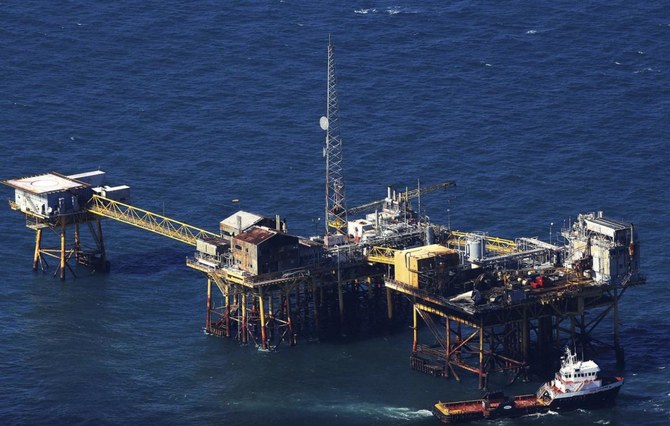
About 80 percent of Gulf of Mexico oil output remains shut-in. (Reuters)
Short Url
Updated 08 September 2021
Follow

Oil rises on US Gulf shut-in, Libyan port protests

  • Brent crude gained 1.1 percent to $72.47 while WTI added 1.3 percent to $69.25

LONDON: Oil prices advanced on Wednesday as US output continued to suffer from the aftereffects of Hurricane Ida last week and Libyan exports were disrupted by protesters.

Brent crude gained 1.1 percent to $72.47 at 6.37 p.m. Riyadh time, while WTI, the US benchmark, added 1.3 percent to $69.25.

About 80 percent of US Gulf production remained offline on Tuesday, with 79 production platforms still unoccupied, according to Reuters. About 17.5 million barrels of output has been lost thus far. The Gulf’s offshore wells make up about 17 percent of US output.

In Libya, protesters blocked oil exports at the ports of Es Sider and Ras Lanuf, an oil engineer at each port said, although other engineers said production at fields that supply the terminals was unaffected.

Globally, demand for gasoline is picking up as motorists get back behind the wheel with the resumption of the school run among other factors.

Kilometers traveled in Italy, Spain, Brazil, Chile and Mexico are all above the equivalent week in 2019, some of them for many weeks in a row, according to Atlantia Group, which operates those roads, Bloomberg reported.

The reading for France was 1.6 percent below 2019’s level, compared with a deficit of as much as 47 percent in early April, Atlantia’s traffic measurements show.

Separate government data for the US and UK show passenger car miles were between 5 percent and 2 percent below pre-pandemic levels, similar to recent weeks, while gasoline demand in those countries was 1 percent above and 4 percent below, respectively.

Researchers from University College London said even more of the world’s oil, gas and coal need to be left in the ground than previously estimated if the planet is to meet Paris Climate Agreement goals to limit global warming to 1.5 degrees Celsius above pre-industrial levels.
They now calculate that nearly 60 percent of the world’s oil and gas reserves and 90 percent of the coal reserves need to stay in the ground by 2050 to meet the Paris climate goals.


Gulf-EU value chain integration signals shift toward long-term economic partnership: GCC secretary general

Updated 03 February 2026
Follow

Gulf-EU value chain integration signals shift toward long-term economic partnership: GCC secretary general

RIYADH: Value chains between the Gulf and Europe are poised to become deeper and more resilient as economic ties shift beyond traditional trade toward long-term industrial and investment integration, according to the secretary general of the Gulf Cooperation Council.

Speaking on the sidelines of the World Governments Summit 2026 in Dubai, Jasem Al-Budaiwi said Gulf-European economic relations are shifting from simple commodity trade toward the joint development of sustainable value chains, reflecting a more strategic and lasting partnership.

His remarks were made during a dialogue session titled “The next investment and trade race,” held with Luigi Di Maio, the EU’s special representative for external affairs.

Al-Budaiwi said relations between the GCC and the EU are among the bloc’s most established partnerships, built on decades of institutional collaboration that began with the signing of the 1988 cooperation agreement.

He noted that the deal laid a solid foundation for political and economic dialogue and opened broad avenues for collaboration in trade, investment, and energy, as well as development and education.

The secretary general added that the partnership has undergone a qualitative shift in recent years, particularly following the adoption of the joint action program for the 2022–2027 period and the convening of the Gulf–European summit in Brussels.

Subsequent ministerial meetings, he said, have focused on implementing agreed outcomes, enhancing trade and investment cooperation, improving market access, and supporting supply chains and sustainable development.

According to Al-Budaiwi, merchandise trade between the two sides has reached around $197 billion, positioning the EU as one of the GCC’s most important trading partners.

He also pointed to the continued growth of European foreign direct investment into Gulf countries, which he said reflects the depth of economic interdependence and rising confidence in the Gulf business environment.

Looking ahead, Al-Budaiwi emphasized that the economic transformation across GCC states, driven by ambitious national visions, is creating broad opportunities for expanded cooperation with Europe. 

He highlighted clean energy, green hydrogen, and digital transformation, as well as artificial intelligence, smart infrastructure, and cybersecurity, as priority areas for future partnership.

He added that the success of Gulf-European cooperation should not be measured solely by trade volumes or investment flows, but by its ability to evolve into an integrated model based on trust, risk-sharing, and the joint creation of economic value, contributing to stability and growth in the global economy.

GCC–EU plans to build shared value chains look well-timed as trade policy volatility rises.

In recent weeks, Washington’s renewed push over Greenland has been tied to tariff threats against European countries, prompting the EU to keep a €93 billion ($109.7 billion) retaliation package on standby. 

At the same time, tighter US sanctions on Iran are increasing compliance risks for energy and shipping-related finance. Meanwhile, the World Trade Organization and UNCTAD warn that higher tariffs and ongoing uncertainty could weaken trade and investment across both regions in 2026.