

Israel arrests relatives of escaped Palestinian prisoners

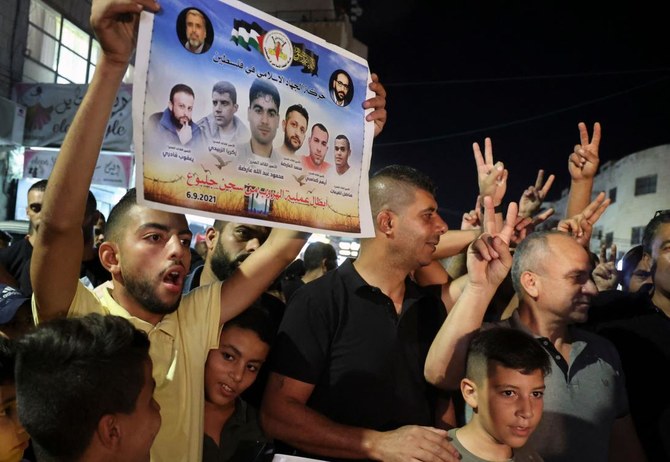
A Palestinian man flashes a poster by the militant group Islamic Jihad of 6 Palestinians who escaped from an Israeli prison, as people celebrate in the Jenin camp in the northern Israeli-occupied West Bank, on Monday. (AFP)
Short Url
Updated 08 September 2021
Follow

Israel arrests relatives of escaped Palestinian prisoners

  • ‘Hysterical’ security forces accused of collective punishment and ‘mafia-style tactics’ as manhunt fails
  • Six Palestinians fled Monday through a hole dug under a sink in a Gilboa prison cell in northern Israel

AMMAN: Israeli security forces unable to find six escaped Palestinian prisoners have arrested six of their relatives instead.

The prisoners tunnelled their way out of the high-security Gilboa jail in northern Israel on Monday, having dug a hole in the floor of their cell with a spoon.

Israel has deployed drones, road checkpoints and an army mission to Jenin, the home town in the occupied West Bank of many of the escaped prisoners, but has failed to track them down.
Instead, on Wednesday security forces arrested two brothers of Mahmoud Ardah, who masterminded the escape, Dr Nidal Ardah, another relative, two brothers of escaped prisoner Mohammad Ardah, and prisoner Munadel Infeiat’s father.

The arrests provoked anger in the West Bank. “Holding someone in order to coerce a relative to do something is a mafia-style tactic,” said Omar Shakir, Israel and Palestine director for Human Rights Watch.
Sami Shehadeh, a member of the Knesset from the Joint Arab List, told Arab News the reaction from the Israeli security forces was hysterical. “They are carrying out brutal acts of revenge against prisoners and their families. This is collective punishment, which we denounce, and we call for the immediate cessation of these acts against our people.”

Orthodox Bishop Atallah Hanna said arresting relatives of the escaped prisoners was barbaric. “This is an act of collective punishment and an inhuman act,” he said.

Opinion

This section contains relevant reference points, placed in (Opinion field)

Mohammed Rajoub, a broadcaster at Ajyal Radio in Ramallah, said the Israelis had initially delayed arresting relatives in the hope that they could trace calls with the escaped prisoners. “Now that they have failed to capture the prisoners they want to use their families as bargaining chips,” he said.

Palestinian Prime Minister Mohammad Shtayyeh said every Palestinian prisoner had the right to be free, and called on Israel to release them all.

Wadie Abu Nassar, director of the International Center for Consultations in Haifa, said the arrests were predictable. “Israeli security wants to recapture those escaped prisoners as soon as possible and they feel that the pressure on relatives will help them get valuable information about their possible whereabouts,” he said.

Amjad Shihab, a lecturer at Al Quds University, said the escape was a shock to the Israeli security apparatus.“Therefore politicians ordered oppressive measures against all prisoners, and the families of the escaped prisoners, with hopes that all this will lead to some information to help them out of the political scandal that they find themselves in.”


WHO alarmed by health workers, civilians ‘forcibly detained’ in Sudan

Updated 17 December 2025
Follow

WHO alarmed by health workers, civilians ‘forcibly detained’ in Sudan

  • The WHO counts and verifies attacks on health care, though it does not attribute blame as it is not an investigation agency

GENEVA: The World Health Organization voiced alarm Tuesday at reports that more than 70 health workers and around 5,000 civilians were being detained in Nyala in southwestern Sudan.
Since April 2023, Sudan’s regular army and the paramilitary Rapid Support Forces (RSF) have been locked in a brutal conflict that has killed tens of thousands of people, displaced 12 million more and devastated infrastructure.
“We are concerned by reports from Nyala, the capital of Sudan’s South Darfur state, that more than 70 health care workers are being forcibly detained along with about 5,000 civilians,” WHO chief Tedros Adhanom Ghebreyesus said on X.
“According to the Sudan Doctors Network, the detainees are being held in cramped and unhealthy conditions, and there are reports of disease outbreaks,” the UN health agency chief said.
The RSF and the Sudan People’s Liberation Movement-North faction allied earlier this year, forming a coalition based in Nyala.
“WHO is gathering more information on the detentions and conditions of those being held. The situation is complicated by the ongoing insecurity,” said Tedros.
“The reported detentions of health workers and thousands more people is deeply concerning. Health workers and civilians should be protected at all times and we call for their safe and unconditional release.”
The WHO counts and verifies attacks on health care, though it does not attribute blame as it is not an investigation agency.
In total, the WHO has recorded 65 attacks on health care in Sudan this year, resulting in 1,620 deaths and 276 injuries. Of those attacks, 54 impacted personnel, 46 impacted facilities and 33 impacted patients.
Earlier Tuesday, UN rights chief Volker Turk said he was “alarmed by the further intensification in hostilities” in the Kordofan region in southern Sudan.
“I urge all parties to the conflict and states with influence to ensure an immediate ceasefire and to prevent atrocities,” he said.
“Medical facilities and personnel have specific protection against attack under international humanitarian law,” Turk added.