Sea of plastic: Med pollution under spotlight at conservation meet

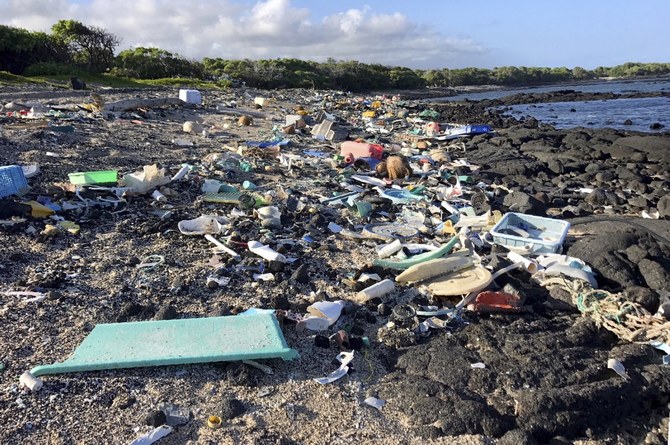
This photo provided by the Hawaii Wildlife Fund shows the beach at Kamilo Point in Naalehu, Hawaii, before a cleanup event, August 2018. (AP)
Short Url
Updated 08 September 2021
Follow

Sea of plastic: Med pollution under spotlight at conservation meet

  • Plastic waste can alter life cycles and the floating debris can even transport some species far from their habitats

MARSEILLE: Plastic packaging and discarded fishing nets bob in the tranquil waters of the Mediterranean, signs of the choking pollution that has stirred strong feelings at the world conservation congress in the French port city Marseille this week.
“The Mediterranean is the most beautiful sea in the world... and one of the most polluted,” said Danielle Milon, vice president of the Calanques National Park on the edge of the city, where the International Union for Conservation of Nature is holding its congress.
While the quantity of rubbish in the sea is well documented — the IUCN released a report on the issue last year entitled “Mare plasticum” — it is driving growing alarm among countries whose economies rely on tourism drawn to pristine beaches and sparkling waters.
At the opening of the IUCN Congress, Greek Prime Minister Kyriakos Mitsotakis and French President Emmanuel Macron pledged to greatly increase the size of conservation areas off their Mediterranean coasts — as well as the rigour with which they are preserved.
“Marine protected areas must no longer be paper parks but must have defined conservation measures,” Mitsotakis said at the opening ceremony.
“We must promote sustainable tourism (and) put biodiversity at the heart of tourist coastal planning.”
Near the coasts the main types of plastic pollution in the almost closed sea are packaging and fishing debris, said Francois Galgani, a specialist on maritime waste at Ifremer, a top marine research center in France.
“Turtles confuse the packaging with jellyfish and in some areas in the Mediterranean 80 percent of turtles have ingested plastic,” he said.
Meanwhile, nets can kill long after the fishing boats leaves them behind.
Plastic waste can alter life cycles and the floating debris can even transport some species far from their habitats.
“A Noah’s ark,” said Galgani, adding there are “no other examples of species transport of this magnitude.”
To change the situation, everyone needs to play their part, Philippos Drousiotis head of the Cyprus sustainable tourism initiative.
“I was in the tourism trade and very much liked the idea of being sustainable (but) environmentalists didn’t care about people,” he said, adding that he was driven by economic realism.
With initiatives like the “keep our sand and sea plastic free” project, his organization tries to steer tour organizers, boat rental firms and hotels to stop using single use plastics.
It has also installed water fountains on beaches to make it easier for holidaymakers to give up their plastic bottles.
“The solutions are on land and not at sea,” said Romy Hentinger of the Tara Ocean Foundation.
It is also necessary to increase knowledge of the sources of pollution and how it circulates.
The Tara Oceans schooner led an expedition in 2019 to trace plastic pollution in the major European rivers.
According to Nathalie Van Den Broeck, oceanographer and vice president of Surfrider Europe, some “80 percent of waste on beaches and in the seas comes from rivers.”
The French NGO has also launched a study using artificial intelligence to find waste in images taken on mobile phones by citizen scientists.
Volunteers have recently traveled along the banks of the Rhine, in the six countries crossed by the river.
There are a host of initiatives looking to use the Marseille congress to develop networks and partnerships.
Although Middle Eastern and North African countries from the southern shores of the Mediterranean — which often have far fewer resources — are conspicuous by their absence.
But more needs to be done, said Mercedes Munoz Canas, from the IUCN Center for Mediterranean Cooperation, who wants to bring in business interests.
We must “build a community,” she said.


US and Mideast countries seek Kyiv’s drone expertise as Russia-Ukraine talks put on ice

Updated 06 March 2026
Follow

US and Mideast countries seek Kyiv’s drone expertise as Russia-Ukraine talks put on ice

KYIV, Ukraine: The United States and its allies in the Middle East are seeking Ukraine's expertise in countering Iran's Shahed drones, according to Ukrainian President Volodymyr Zelenskyy.

Various countries, including the United States, have approached Ukraine for help in defending against the Iranian drones, Zelenskyy said late Wednesday. He said he has spoken in recent days with the leaders of the United Arab Emirates, Qatar, Bahrain, Jordan and Kuwait about possible cooperation.

Russia has fired tens of thousands of Shaheds at Ukraine since it invaded its neighbor just over four years ago, launching a swarm of more than 800 drones and decoys in its biggest nighttime barrage. Iran has responded to joint U.S.-Israeli strikes by launching the same type of drones at countries in the Middle East.

Ukrainian assistance in countering Iranian drones will be provided only if it does not weaken Ukraine's own defenses, and if it adds leverage to Kyiv's diplomatic efforts to stop the Russian invasion, according to the Ukrainian leader.

"We help to defend from war those who help us, Ukraine, bring a just end to the war" with Russia, Zelenskyy said. Later Thursday, Zelenskyy said he had received a U.S. request for support to defend against the drones in the Middle East and had given the order for equipment to be provided along with Ukrainian experts without providing further details.

"Ukraine helps partners who help our security and the protection of our people's lives," he added in a social media post.

Trump, in an interview Thursday with Reuters, said, "Certainly I'll take, you know, any assistance from any country."

Ukraine has battle-tested drone defenses

Ukraine has pioneered the development of cut-price drone killers that cost as little as $1,000, rewriting the air defense rule book and making other countries take notice.

European countries got a wake-up call last September on the changed nature of air defense when Poland scrambled multimillion-dollar military assets, including F-35 and F-16 fighter jets and Black Hawk helicopters, in response to airspace violations by cheap drones.

Ukrainian manufacturers have developed low-cost interceptor drones specifically designed to hunt and destroy Shaheds, and its rapidly expanding drone industry is producing excess capacity.

Zelenskyy announced earlier this year that Ukraine would begin exporting the battle-tested systems.

The European Union's top diplomat, Kaja Kallas, said before chairing a meeting of EU and Gulf foreign ministers via video link Thursday that the talks would look at how Ukraine's experience can help countries counter Iranian drones.

Middle East war delays Russia-Ukraine talks

The Iran war, now in its sixth day, has drawn international attention away from Europe's biggest conflict since World War II, and forced the postponement of a new round of U. S-brokered talks between Russia and Ukraine planned for this week, Zelenskyy said.

Western governments and analysts say the Russia-Ukraine war has killed hundreds of thousands of people, while there is no sign that yearlong U.S.-led peace efforts will stop the fighting any time soon.

"Right now, because of the situation around Iran, there are not yet the necessary signals for a trilateral meeting," Zelenskyy said. "But as soon as the security situation and the overall political context allow us to resume that trilateral diplomatic work, it will be done."

Zelenskyy thanked the United States for the return from Russia on Thursday of 200 Ukrainian prisoners of war. Russia's Defense Ministry also said it received the same number of prisoners from Ukraine and thanked the U.S. and United Arab Emirates for mediating.

Prisoner swaps have been one of the few tangible results of the talks. Vladimir Medinsky, a Russian negotiator, said on social media that a total of 500 prisoners from each side would be exchanged between Thursday and Friday.

Oleksandr Merezhko, the head of Ukraine's parliamentary foreign affairs committee, said Russian President Vladimir Putin is trying to drag out the negotiations so that he can press on with Russia's invasion while escaping further U.S. sanctions.

He urged the U.S. administration to look at the Russia-Ukraine war and the war in the Middle East as linked.

"In reality, Russia and Iran are close allies that act in concert — Iran supplies weapons and Russia helps Iran develop its defense industry. These are interconnected conflicts," Merezhko told The Associated Press.

Ukraine's army has recently pushed back Russian forces at some points along the roughly 1,250-kilometer (750-mile) front line, according to the Institute for the Study of War.

Localized Ukrainian counterattacks liberated more territory than Ukrainian forces lost in the last two weeks of February, the Washington-based think tank said this week, estimating the recovered land at about 257 square kilometers (100 square miles) since Jan. 1.