

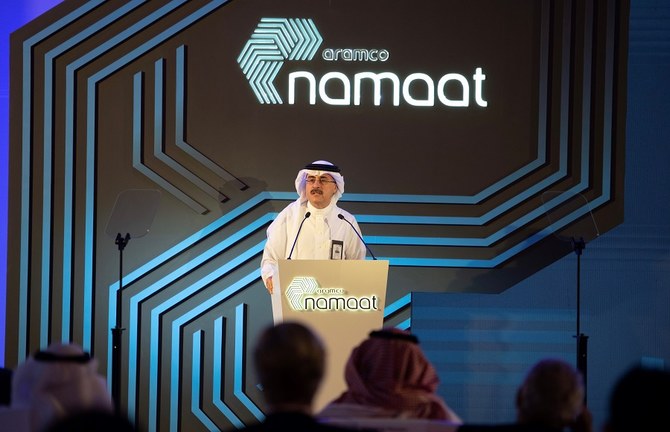

DUBAI: Saudi Aramco announced plans to expand Namaat, its industrial investment program – signing multiple deals with global companies to build capacity in critical sectors.
The Saudi-listed company said it signed 22 new memoranda of understanding (MoUs) and a joint venture agreement – all focusing on sustainability, technology, industrial and energy services, and advanced materials.
Namaat, which roughly means collective growth in Arabic, was formed to “tap into the vast opportunities in Saudi Arabia to create new value.”
Companies that signed the deals with Aramco include DHL, Samsung, Hyundai, and Honeywell, as well as British technology firm AVEVA.
“Through Namaat, we are attracting world-class partners who share our goal of continuous industrial development,” Ahmed Al-Sa’adi, the company’s senior vice president of technical services, said.
He added the Namaat program leverages a range of finance, funding, tax and regulatory incentives through the Shareek program, a government initiative aimed to boost its synergy with the private sector.
Aramco unveiled the first set of deals under the program last year, as part of its ongoing push to diversify income sources, in line with the Kingdom's economic transformation goals.
“Aramco continues to be at the forefront of enabling and enhancing the Kingdom’s industrial, technology and sustainability infrastructure through large-scale investments and key partnerships,” its chairman, Yasir Al-Rumayyan, said.
The agreements are seen to drive economic growth and diversification.
“(The initiatives) will ensure greater reliability of energy supply, effectively localize the industrial supply chain, and create better jobs and skill sets,” Al-Rumayyan added.
The 22 new MoUs signed under the Namaat program include:
- SOLVAY – an MoU with the goal to pursue the development of advanced Non Metallic Materials and localization of a composite value chain;
- DHL Supply Chain – an arrangement to evaluate the feasibility of establishing a local industrial logistics and procurement hub serving Saudi Arabia and MENA region.;
- VEOLIA – Exclusive MOU to confirm the commercial feasibility of establishing a world-class integrated waste management company, alongside a strategic IK stakeholder;
- Air Liquide & Haliburton & PIF, Baker Hughes & PIF, Linde & Schlumberger & PIF – three separate non-binding MoUs to evaluate Carbon Capture & Sequestration (CCS) opportunities and potential partnerships
- AIC Steel, GSW, McDermott, Seyang and Sendan, and NARMEL – five separate MoUs on modular construction;
- Samsung Engineering, Hyundai and Saipem - three separate MoUs on Engineering, Procurement and Construction;
- Elion and Green Groves – two separate MoUs to evaluate the feasibility of localizing nature-based solutions;
- Honeywell – an MoU with the goal to establish a JV that will develop and implement next-generation digital solutions that will improve efficiency, sustainability and enable operational excellence of industrial facilities;
- Gulf Modular Industry (GMI) – MoU to validate the feasibility of developing and using non-metallic applications in the modular building manufacturing process in the building and construction sector.
- Armorock – MoU to validate the feasibility of developing and using non-metallic polymer concrete applications in the building and construction sector.;
- Shell AMG Recycling & United Company for Industry – a trilateral MoU on Metals Reclamation and Catalyst Manufacturing;
- AVEVA – an MoU with the goal to establish a strategic alliance to localize development and deployment of various digital technologies including Artificial Intelligence (AI), Machine Learning (ML), and Digital Twin; and
- Baosteel – an MoU to conduct an engineering study and develop plans needed to build, own and operate an integrated steel plate manufacturing facility in Saudi Arabia.


