

Pakistan expects inclusive Afghan government with respect for human, women’s rights — army chief 

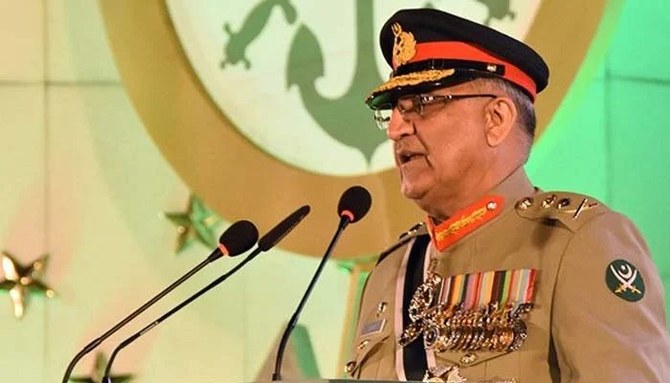
Pakistan’s army chief General Qamar Javed Bajwa addressing at an event organised on the occasion of Defence Day on Sept. 6, 2021. (Photo courtesy: Social Media)
Short Url
Updated 07 September 2021
Follow

Pakistan expects inclusive Afghan government with respect for human, women’s rights — army chief 

  • General Bajwa says Pakistan willing to cooperate with regional and world powers for government formation in Afghanistan 
  • Says situation in Afghanistan both provides opportunity for peace but could be “prelude to more threats and difficulties“

ISLAMABAD: Pakistan’s army chief has said that Islamabad was seeking an inclusive government in Afghanistan which respected human and women’s rights, as the Taliban try to set up a new regime after their lightning takeover of Kabul last month.

General Qamar Javed Bajwa also urged the United Nations and world powers to play a “positive role” for lasting peace in Afghanistan and its new rulers to resolve all issues amicably and lead the Afghan people to peace and prosperity.

The Taliban swept to the Afghan capital on August 15 after making rapid territorial gains across Afghanistan as US-led foreign forces withdrew from the country.

Since then, talks have been underway to form a new government, with Taliban spokesperson Zabihullah Mujahid saying on Monday that the group would make the announcement “in the next few days.”

“We also expect a stable and inclusive government in Afghanistan that [ensure] human rights, including women’s rights,” Bajwa told a gathering at the army’s General Headquarters in the garrison city of Rawalpindi, on the occasion of Defense Day, on Monday.

Islamabad has for long been persuading the Taliban to include representatives from its Pashtun, Hazara, Tajik, Uzbek and other ethnic groups in its new regime.

Ethnic diversity has been at the center of politics and conflicts in Afghanistan, with no single group enjoying a decisive majority in the country of 38 million people.

Bajwa said that Pakistan expects major powers of the region and the world to play a positive role in forming the new Afghan government and that Islamabad was “willing to cooperate” for this.

“While the situation [in Afghanistan] provides an opportunity for peace and stability, it could also be a prelude to more threats and difficulties,” Bajwa warned.

He added that Pakistan’s armed forces were keeping a close watch on developments in Afghanistan after the chaotic withdrawal of foreign troops in the past few weeks.

Earlier on Monday, in a meeting with Italy’s Foreign Minister Luigi Di Maio in Islamabad, Prime Minister Imran Khan said that Pakistan had “suffered enormously” due to the protracted conflict and instability in Afghanistan.

“At this critical juncture, it was vital to stabilize the security situation in Afghanistan, take steps to consolidate peace, and preclude any mass exodus of refugees,” he said.

There are officially 1.4 million Afghan refugees living in Pakistan, with the number of unregistered refugees expected to be much higher. 

“In this context, preventing a humanitarian crisis and stabilizing the economy were the most urgent priorities,” PM Khan said.


‘Fully stand with Bangladesh’: Pakistan PM backs decision to boycott India match

Updated 04 February 2026
Follow

‘Fully stand with Bangladesh’: Pakistan PM backs decision to boycott India match

  • Pakistan’s government have not allowed the national cricket team to play its World Cup match against India on Feb. 15
  • Pakistan has accused India of influencing ICC decisions, criticized global cricket body for replacing Bangladesh in World Cup

ISLAMABAD: Prime Minister Shehbaz Sharif on Wednesday backed his government’s decision to bar the national men’s cricket team from playing against India in the upcoming T20 World Cup tournament, reaffirming support for Bangladesh. 

Pakistan’s government announced on social media platform X last week that it has allowed its national team to travel to Sri Lanka for the World Cup. However, it said the Green Shirts will not take the field against India on their scheduled match on Feb. 15. 

Pakistan’s participation in the tournament was thrown into doubt after Pakistan Cricket Board (PCB) Chairman Mohsin Naqvi criticized the International Cricket Council (ICC) for replacing Bangladesh with Scotland. The decision was taken after Bangladesh said it would not let its team travel to India out of security concerns. 

During a meeting of the federal cabinet, Sharif highlighted that Pakistan has said that politics should be kept away from sports. 

“We have taken this stand after careful consideration and in this regard, we should stand fully with Bangladesh,” Sharif said in televised remarks. 

“And I believe this is a very reasonable decision.”

Pakistan has blamed India for influencing the ICC’s decisions. The global cricket governing body is currently led by Jay Shah, the head of the Board of Control for Cricket in India. Shah is the son of Indian Home Minister Amit Shah. 

Pakistan’s boycott announcement has triggered media frenzy worldwide, with several Indian cricket experts and analysts criticizing Islamabad for the decision. An India-Pakistan cricket contest is by far the most lucrative and eagerly watched match of any ICC tournament. 

The ICC has ensured that the two rivals and Asian cricket giants are always in the same group of any ICC event since 2012 to capitalize on the high-stakes game. 

The two teams have played each other at neutral venues over the past several years, as bilateral cricket remains suspended between them since 2013 due to political tensions. 

Those tensions have persisted since the two nuclear-armed nations engaged in the worst fighting between them since 1999 in May 2025, after India blamed Pakistan for an attack in Indian-administered Kashmir that killed tourists. 

Pakistan denied India’s allegations that it was involved in the attack, calling for a credible probe into the incident.