ISLAMABAD: Moving ahead with his ‘Mission Summit 14’, Pakistani climber Sirbaz Khan left the country on Monday to summit the 8,167-meter-high Dhaulagiri mountain, the world’s seventh highest peak, located in Nepal.
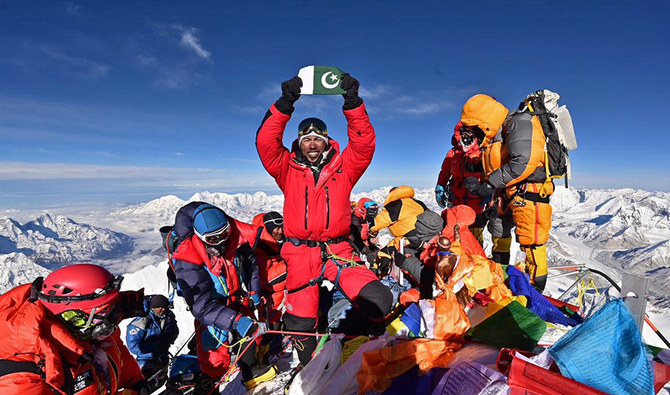
Born and raised in Ali Abad village in Pakistan’s mountainous Hunza district, Khan has already summited eight out of 14 of the highest peaks in the world, including Mount Everest.
He is the only Pakistani other than legendary climber Muhammad Ali Sadpara — killed during a K2 winter expedition this year — to have summited eight of the world’s highest peaks. K2, at 8,611 meters, is the world’s second highest and most deadly peak, often referred to as the ‘Savage Mountain.’
“I am associated with climbing for the last four years. I have summited eight peaks that stand above 8,000 meters,” Khan told Arab News on Saturday. “This expedition [of Mount Dhaulagiri] is my ninth.”
If Khan succeeds in his ascent of Dhaulagiri mountain, he will be the first Pakistani ever to have summited nine of the highest peaks in the world.
This year Khan also summited Mount Everest and Annapurna in Nepal, and Gasherbrum-II in Pakistan.
While announcing his expedition plan last week, Khan said his ‘Mission Summit 14’ was not just about getting his name into the record books but would be a matter of “pride” for his country.
“Most importantly, it is about earning respect and honor for the extraordinary yet the unsung mountaineering community of Pakistan,” he said in a Facebook post:
“When I climb on these mountains where no Pakistani has ever climbed before me, it is not just me climbing alone, it’s Pakistan climbing with me ... Each time I raise the green flag on a mountain, that piece of cloth claps in the name of respect and honor deserved by great Pakistani mountaineers – all those who came before me and those who will come after.”
Speaking to Arab News, Khan urged the Pakistani government to take steps to facilitate the nation’s mountaineers, saying there was no dearth of talent in Pakistan if only the government established mountaineering schools and offered financial support.
Speaking about his teacher Ali Sadpara, Khan said: “I know Ali Bhai since 2005. In the field of climbing, my first ever expedition of Nangaparbat was with him. He was my teacher in mountaineering and I have climbed four peaks, including K2 and Mount Manaslu, with him.”
Sadpara and his two expedition members were making their second attempt at climbing K2 this winter when they were lost.
“Now we are deprived of a legendary climber,” Khan said about Sadpara’s death.
In January this year, a team of 10 Nepali climbers made history by becoming the first to ever scale K2 in winter.
To a question about the difference between Pakistani and Nepalese climbers, Khan said Pakistani climbers were physically very strong, but technically weak as compared to the Nepalese.
“Lack of training and financial issues are the main hurdles in the way of such achievements,” he said. “That’s why no Pakistani has summited all 14 peaks.”


![]()

Ali Sadpara mentee Sirbaz Khan eyes Nepal’s Dhaulagiri peak to set new national record
Short Url
https://arab.news/2m2nx
Ali Sadpara mentee Sirbaz Khan eyes Nepal’s Dhaulagiri peak to set new national record
- If Khan succeeds in summiting Dhaulagiri, he will be first Pakistani ever to climb nine of world’s 14 highest peaks
- Khan says has climbed four peaks with legendary mountaineer Ali Sadpara who died attempting this year’s K2 winter expedition
Latest updates


© 2026 SAUDI RESEARCH & PUBLISHING COMPANY, All Rights Reserved And subject to Terms of Use Agreement.