G7 nations urge return to constitutional order in Tunisia

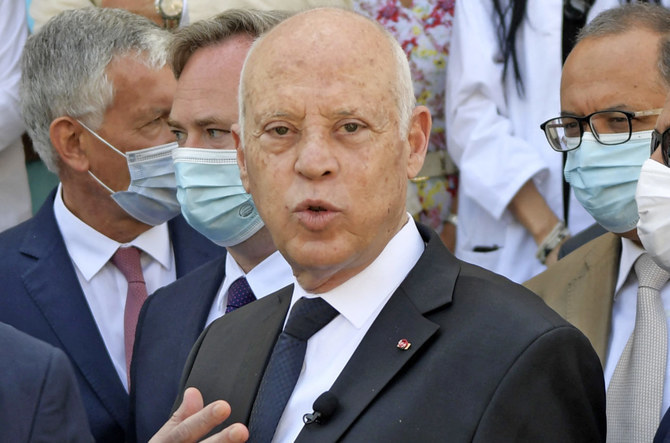
Tunisia's President Kais Saied in the capital Tunis. Ambassadors of the G7 group of advanced economies urged Saied to appoint a new head of government as a matter of urgency and return to a constitutional order. (AFP)
Short Url
Updated 06 September 2021
Follow

G7 nations urge return to constitutional order in Tunisia

  • "We underline the urgent need to appoint a new head of government to form a capable government," said the British Embassy
  • Western democracies have been among the most important donors helping to support Tunisian public finances

TUNIS: The ambassadors of the G7 group of advanced economies urged Tunisia’s president on Monday to appoint a new head of government as a matter of urgency and return to a constitutional order in which an elected parliament plays a significant role.
The statement, put out by the British Embassy on social media, is the most significant public expression of unease by major democracies since President Kais Saied seized governing powers in July in moves his opponents called a coup.
“We underline the urgent need to appoint a new head of government to form a capable government able to address the immediate economic and health crises facing Tunisia,” the statement said.
Western democracies have been among the most important donors helping to support Tunisian public finances over the past decade as the economy has slumped since the 2011 revolution that introduced democracy.
Saied, who was elected in 2019, said on July 25 he was freezing parliament, lifting the immunity of its members, dismissing the prime minister and that he would assume executive authority alongside a new premier.
He said his intervention was in line with the constitution and necessitated by a national emergency due to political paralysis, high COVID-19 rates, and protests. He has vowed that rights will not be affected.
Six weeks on, however, he has not named a prime minister or said what he plans to do, has indefinitely rolled over the emergency measures and said there can be “no going back,” while Tunisians speculate about whether he will amend the constitution.
The G7 statement said appointing a prime minister would “create space for an inclusive dialogue about proposed constitutional and electoral reforms” and added that democratic values would remain central to their relations with Tunisia.


Trump warns Iran of ‘very traumatic’ outcome if no nuclear deal

Updated 55 min 56 sec ago
Follow

Trump warns Iran of ‘very traumatic’ outcome if no nuclear deal

  • Speaking a day after he hosted Netanyahu at the White House, Trump said he hoped for a result “over the next month”

WASHINGTON: US President Donald Trump threatened Iran Thursday with “very traumatic” consequences if it fails to make a nuclear deal — but Israeli Prime Minister Benjamin Netanyahu said he was skeptical about the quality of any such agreement.
Speaking a day after he hosted Netanyahu at the White House, Trump said he hoped for a result “over the next month” from Washington’s negotiations with Tehran over its nuclear program.
“We have to make a deal, otherwise it’s going to be very traumatic, very traumatic. I don’t want that to happen, but we have to make a deal,” Trump told reporters.
“This will be very traumatic for Iran if they don’t make a deal.”
Trump — who is considering sending a second aircraft carrier to the Middle East to pressure Iran — recalled the US military strikes he ordered on Tehran’s nuclear facilities during Israel’s 12-day war with Iran in July last year.
“We’ll see if we can get a deal with them, and if we can’t, we’ll have to go to phase two. Phase two will be very tough for them,” Trump said.
Netanyahu had traveled to Washington to push Trump to take a harder line in the Iran nuclear talks, particularly on including the Islamic Republic’s arsenal of ballistic missiles.
But the Israeli and US leaders apparently remained at odds, with Trump saying after their meeting at the White House on Wednesday that he had insisted the negotiations should continue.

- ‘General skepticism’ -

Netanyahu said in Washington on Thursday before departing for Israel that Trump believed he was laying the ground for a deal.
“He believes that the conditions he is creating, combined with the fact that they surely understand they made a mistake last time when they didn’t reach an agreement, may create the conditions for achieving a good deal,” Netanyahu said, according to a video statement from his office.
But the Israeli premier added: “I will not hide from you that I expressed general skepticism regarding the quality of any agreement with Iran.”
Any deal “must include the elements that are very important from our perspective,” Netanyahu continued, listing Iran’s ballistic missile program and its support for armed groups such as the Palestinian movement Hamas, Yemen’s Houthi rebels and Hezbollah in Lebanon.
“It’s not just the nuclear issue,” he said.
Despite their differences on Iran, Trump signaled his strong personal support for Netanyahu as he criticized Israeli President Isaac Herzog for rejecting his request to pardon the prime minister on corruption charges.
“You have a president that refuses to give him a pardon. I think that man should be ashamed of himself,” Trump said on Thursday.
Trump has repeatedly hinted at potential US military action against Iran following its deadly crackdown on protests last month, even as Washington and Tehran restarted talks last week with a meeting in Oman.
The last round of talks between the two foes was cut short by Israel’s war with Iran and the US strikes.
So far, Iran has rejected expanding the new talks beyond the issue of its nuclear program. Tehran denies seeking a nuclear weapon, and has said it will not give in to “excessive demands” on the subject.