ISLAMABAD: A murder trial involving the grisly July beheading of Noor Mukadam, the 27-year-old daughter of a former Pakistani diplomat, will begin in an Islamabad court on Wednesday, September 8, a judicial magistrate said on Monday.
Mukadam was found beheaded at a residence in Islamabad’s upscale F-7/4 neighborhood on July 20 in a case that has sparked public outrage and grabbed media attention unlike any other recent crime against women.
Key suspect Zahir Jaffer was arrested from the crime scene on the day of the murder. He was initially on police remand but was moved to Adiala Jail in the city of Rawalpindi on judicial remand in early August. His parents and three members of household staff are also under arrest for a range of charges, including abetment and hiding evidence.
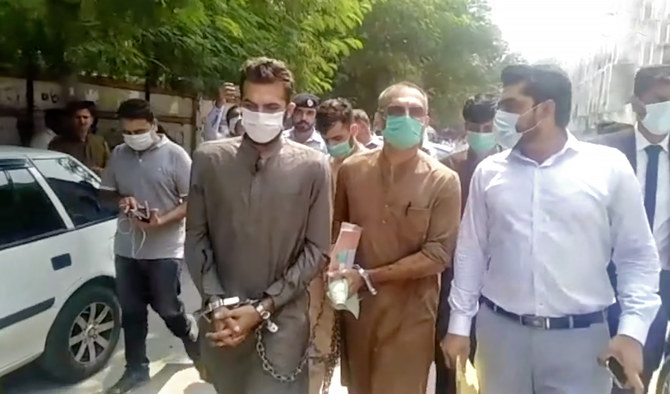
On Monday, the six accused, which include Jaffer, his parents, and the staff members, were presented before Judicial Magistrate Shoaib Akhtar in Islamabad.
“We have received your [police] challan [charge-sheet] in the case for all six and are fixing September 8 for next hearing,” the judge said. “Let’s see how the trial proceeds in the case.”
The prime accused, who was wearing shalwar-kameez and had cut his previously long, ponytailed hair, asked police for “privacy” as media gathered around him to seek comment outside the court.
“Can we have some privacy,” Jaffer said, asking police officers to remove journalists from the scene.
“Stop them from filming us,” his mother said as police requested journalists to turn off their cameras.
This was the first time the six accused were brought before the judge in an open court.
Jaffer, who is a US national and belongs to an upper-class family, had reportedly been practicing as a psychotherapist after enrolling in a certification course with Islamabad-based facility, Therapy Works.
Last week, Jaffer was moved to a separate cell after “arguments” with fellow inmates, Arshad Warriach, the superintendent of Adiala Jail where he is being held, told Arab News.
“His [Jaffer’s] behavior was not right with his cellmates so now we have put him alone,” Warriach said in an interview. “He wasn’t getting along [with them].”
In August, reports that Jaffer was taken to a local hospital after he complained of a headache, that he was receiving home cooked food in jail and that he always appeared before the magistrate bathed and in a fresh set of clothes unleashed widespread condemnation in Pakistan. Social media users, journalists and activists raised concerns that the suspect was being given special treatment because he belonged to a wealthy family and was a US national.
This prompted then Punjab prisons minister Fayyaz ul Hassan Chohan to order prison authorities to stop with “immediate effect” any preferential treatment for Jaffer at Adiala Jail.
In a July 27 Twitter post, the US Embassy in Islamabad clarified that US citizens in a foreign country were subject to local laws and while the embassy could check on their well-being and provide a list of lawyers if they were arrested abroad, it couldn’t provide legal advice, participate in court proceedings or effect their release.
In early August, during a live Q&A session with the nation, Prime Minister Imran Khan assured the public: “If someone thinks he [Jaffer] is a dual national and has US citizenship and will escape, let me tell you all that no one will be spared.”


![]()

Noor Mukadam murder trial to begin in Islamabad on Wednesday
Short Url
https://arab.news/g5w8q
Noor Mukadam murder trial to begin in Islamabad on Wednesday
- Court receives charge-sheet from police against key suspect Zahir Jaffer, parents, three members of household staff
- Mukadam, 27, was found beheaded in Islamabad on July 20 in a case that has since sparked widespread public outrage
Latest updates


Recommended


© 2026 SAUDI RESEARCH & PUBLISHING COMPANY, All Rights Reserved And subject to Terms of Use Agreement.