

‘Fake news’ flourished on Facebook during 2020 US presidential election: study

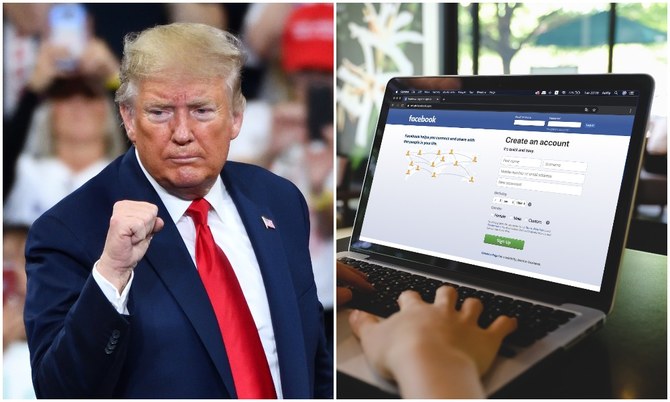
The phrase “fake news” took shape in mid-2016 during Donald Trump’s run to the presidency and essentially morphed into an angry political slur during Trump’s first term. (Shutterstock/File Photos)
Short Url
Updated 06 September 2021
Follow

‘Fake news’ flourished on Facebook during 2020 US presidential election: study

  • Misinformation posts on the social media platform were clicked on six times more often than traditional news sources
  • Study was conducted by New York University and Université Grenoble Alpes in France as it focused on Facebook user behavior

LONDON: Social media posts that push misinformation, spin, lies, and deceit — otherwise known as “fake news” — generated six times more clicks, likes, shares, and interactions on Facebook compared to traditional news sources between August 2020 to January 2021, according to a study.

The forthcoming peer-reviewed study was jointly conducted by New York University and Université Grenoble Alpes in France as it focused on user behavior on Facebook around the 2020 US presidential election.

The phrase “fake news” took shape in mid-2016 during Donald Trump’s run to the presidency and essentially morphed into an angry political slur during Trump’s first term and his unsuccessful re-election campaign four years later.

Facebook is certainly not the only social media platform to benefit from the exploration of “fake news” as the phrase has quickly become part of America’s lexicon. 

“This report looks mostly at how people engage with content, which should not be confused with how many people actually see it on Facebook,” Joe Osborne, company spokesman, said. 

“When you look at the content that gets the most reach across Facebook, it is not at all like what this study suggests.”

However, the number of people who actually view a certain post, known as impressions, is not available to researchers or the public. 

According to Osborne, Facebook has fact-checkers who limit posts that include misinformation.

In early August, Facebook reportedly shut down the personal accounts of the NYU researchers involved in the study, citing that the group was publishing academic studies about the platform at “the expense of people’s privacy.”

According to experts, however, this study will validate the criticism that Facebook’s algorithms fuel the spread of misinformation and “fake news” over more trustworthy information. 

Facebook and other social media companies have recently been attempting to increase their scrutiny over misinformation and disinformation shared on the platforms. In August, Facebook announced it had dismantled 53 accounts and 51 pages sharing misinformation on its site. 

The multinational technology company, based in Menlo Park, Calif., was founded in 2004 by Mark Zuckerberg and four other students at Harvard College. Today Zuckerberg serves as the CEO, chairman, and controlling shareholder of Facebook.

“It is clear now that we did not do enough to prevent these tools from being used for harm as well,” Zuckerberg said when he testified before a joint US Senate Committee nearly two years before the 2020 presidential election.

“That goes for fake news, foreign interference in elections, and hate speech, as well as developers and data privacy. We did not take a broad enough view of our responsibility, and that was a big mistake. It was my mistake, and I am sorry. I started Facebook, I run it, and I am responsible for what happens here.”


Israeli court overturns conviction of officer who assaulted Palestinian journalist, citing ‘Oct. 7 PTSD’

Updated 25 February 2026
Follow

Israeli court overturns conviction of officer who assaulted Palestinian journalist, citing ‘Oct. 7 PTSD’

  • Judge sentenced Yitzhak Sofer to 300 hours of community service, saying officer “devoted his life to Israel’s security” and conviction was “disproportionate to severity of his actions”
  • Footage shows Sofer throwing photojournalist Mustafa Alkharouf to the ground, and repeatedly beating and kicking him while he covered Palestinian gatherings near Al-Aqsa Mosque

LONDON: An Israeli court overturned the conviction of a border police officer who assaulted a Palestinian journalist, ruling his actions were influenced by post-traumatic stress disorder from serving during the Oct. 7 2023 attacks.

On Tuesday, the Jerusalem Magistrate’s Court sentenced officer Yitzhak Sofer to 300 hours of community service for assaulting Anadolu Agency photojournalist Mustafa Alkharouf in occupied East Jerusalem in December 2023.

Footage shows Sofer and other officers drawing weapons, throwing Alkharouf to the ground, and repeatedly beating and kicking him while he covered Palestinian gatherings near Al-Aqsa Mosque amid heavy restrictions.

Alkharouf was hospitalized with facial and body injuries. His cameraman, Faiz Abu Ramila, was also attacked.

Sofer had been convicted in September 2024 of assault causing bodily harm (acquitted of threats) and initially faced six months’ community service, as recommended by Mahash, the Justice Ministry’s police misconduct unit.

Judge Amir Shaked accepted the defense request to cancel the conviction, replacing it with community service.

He cited Sofer’s PTSD from responding to the Oct. 7 Hamas-led attack, noting the officer had “no prior criminal record” and had “devoted his life to Israel’s security.”

“The court cannot ignore this when considering whether the defendant’s conviction should stand,” he said, adding that while the incident is “serious and does cross the criminal threshold,” the conviction in place could cause Sofer harm “disproportionate to the severity of his actions.”

The ruling comes amid surging attacks on journalists in the West Bank, East Jerusalem and Gaza since Israel’s war on Gaza began.

The Committee to Protect Journalists reported Israel responsible for two-thirds of the 129 media workers killed worldwide in 2025, the deadliest year on record, citing a “persistent culture of impunity” and lack of transparent probes.

Reporters Without Borders called the Israeli army the “worst enemy of journalists” in its 2025 report, with nearly half of global reporter deaths in Gaza.

Foreign journalists face raids, arrests and intimidation. In late January 2026, Israel’s Supreme Court granted a delay on ruling a ban on foreign media access to Gaza.