France’s TotalEnergies signs $27bn oil, gas, solar deal in Iraq

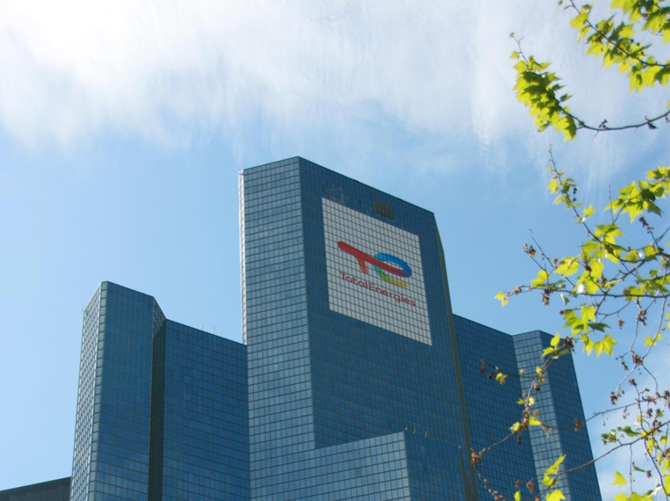
France’s former Total, which has renamed itself TotalEnergies to symbolize a diversification into cleaner sources of power, is one of the world’s top five energy companies. File
Short Url
Updated 05 September 2021
Follow

France’s TotalEnergies signs $27bn oil, gas, solar deal in Iraq

BAGHDAD: French energy giant TotalEnergies has signed a $27-billion contract to invest in oil, gas and solar energy production in Iraq, the country’s oil minister said on Sunday.
The announcement of the deal, supposed in part to reduce Iraq's reliance on fossil fuels, came as minister Ihsan Ismail signed the contract at a Baghdad ceremony with TotalEnergies chief Patrick Pouyanne.
TotalEnergies has not directly confirmed to AFP the value of the contract.
“This is the largest investment in Iraq by a Western company,” Ismail said. “Implementing these projects is the challenge we face now.”
Iraq has immense reserves of oil and gas.
But despite being the No.2 producer in the Organization of the Petroleum Exporting Countries, it is experiencing an acute energy crisis and chronic blackouts that fuel social discontent.
Officials justify the lack of investment and the dilapidated state of its energy network by citing falling oil prices, which represent more than 90 percent of state revenue.
The country is highly dependent on neighboring Iran, which supplies it with a third of its gas and electricity needs.
However, Baghdad currently owes Tehran $6 billion for energy already supplied.
The contract inked on Sunday with TotalEnergies covers four projects, an Iraqi Oil Ministry source said ahead of the signing ceremony.
One of these aims to pipe seawater from the Gulf to southern Iraqi oilfields. Water is used to extract oil from subterranean deposits.
Two projects focus on extracting and exploiting gas in southern Iraq, which is rich in fossil fuel deposits.
The fourth project will see the installation of a solar farm in Artawi, near the southern port of Basra.
The Iraqi source said that ultimately, the solar panels should produce “1,000 MW” of electricity, the equivalent of the energy produced by a nuclear reactor.
“Iraq will not pay anything,” the source added.
France’s former Total, which has renamed itself TotalEnergies to symbolize a diversification into cleaner sources of power, is one of the world’s top five energy companies.
While still focused on oil and gas, the company has indicated that this year it will devote 20 percent of its growth investments to electricity and renewable energies.


Implementation of the direct Gulf electrical interconnection project with the Sultanate of Oman begins

Updated 6 sec ago
Follow

Implementation of the direct Gulf electrical interconnection project with the Sultanate of Oman begins

RIYADH: The Gulf Cooperation Council Interconnection Authority has announced the commencement of implementing the direct interconnection project between its system and the Sultanate of Oman's network, marking a strategic step that reflects the evolution of Gulf integration pathways in the energy sector and the strengthening of regional infrastructure.

Undersecretary of the Ministry of Energy and Minerals and Chairman of the Board of the Gulf Cooperation Council Interconnection Authority, Mohsen Al-Hadhrami, confirmed that the direct electrical interconnection project with the Sultanate is not merely a technical expansion of an electricity network, but rather represents an extension of a long-term strategic vision laid down by Their Majesties and Highnesses, the leaders of the Gulf Cooperation Council.

He noted that this vision was approved when the Gulf electrical interconnection project was adopted as one of the pillars of Gulf integration in infrastructure, stemming from the leaders’ belief that energy security constitutes a fundamental pillar for the stability of states, the growth of their economies, and the sustainability of their development.

He pointed out that the Gulf electrical interconnection has proven, over more than two and a half decades, to be one of the most successful models of joint Gulf action, as it has contributed to enhancing the reliability of electricity networks and achieving significant economic savings for the GCC states.

Al-Hadhrami added that the direct interconnection project with the Sultanate of Oman enhances the depth of the Gulf grid, increases its operational flexibility, and embodies an advanced model of Gulf partnership in financing vital infrastructure projects.

For his part, Ahmed Al Ibrahim, CEO of the Gulf Cooperation Council Interconnection Authority, explained that the project is considered one of the largest expansion projects in the authority’s history.

It aims to enhance the capacity of the Gulf grid to accommodate the rapid growth in electricity demand, in light of the expansion of internal networks in GCC states, major changes in electrical loads, and increased electricity generation, in addition to supporting renewable energy projects and raising the readiness of networks to face emergency situations.

The direct interconnection project with the Sultanate of Oman is considered a strategic step to enhance the integration of Gulf and regional energy networks, increase the reliability and sustainability of electricity systems, and support the objectives of GCC states in energy transition and reducing carbon emissions, thereby reinforcing the position of the Gulf electrical interconnection as a global model for regional integration in the energy sector.