

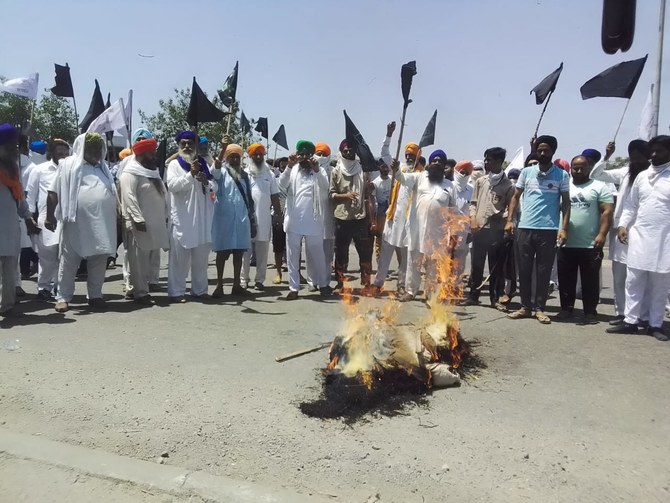

NEW DELHI: Farmers in the Indian capital New Delhi and surrounding areas observed a “black day” on Wednesday to mark six months of protests against agricultural laws they say favor private businesses at the expense of the growers they buy from.
Thousands of farmers from the mostly rural states of Punjab, Haryana, Uttar Pradesh and Rajasthan have set up camp in the outskirts of the capital to protest against three laws that were passed in September.
A few weeks into the protests, which began in late November, their numbers rose to about 300,000 and peaked in January, when nearly a million arrived from across the country, braving scorching heat and fears of coronavirus.
Farmers say the new laws will hit their incomes and leave them at the mercy of corporations because the legislation clears the way for the unregulated entry of private companies into the farming sector, which provides employment for more than 50 percent of the country’s population.
Despite a spike in COVID-19 cases in recent weeks as a second wave of the coronavirus pandemic rages across the country, hundreds converged on Delhi and its surrounding areas on Wednesday to take part in the “black day” demonstrations. Some chanted slogans and burned effigies of Prime Minister Narendra Modi in a show of anger, amid complaints that their concerns have been ignored.
“For six months we have been sitting at the protest site but the government has not been listening to us,” Anil Kasana, a leader of the Indian Farmers’ Union in Greater Noida, in the suburbs of Delhi, told Arab News. “We will continue agitating against the three farm laws until they are withdrawn.”
Farmers fear the laws will usher in the privatization of traditional agricultural markets, leading to market-driven pricing of produce and the elimination of the minimum support prices the government sets each year for certain produce.
The government held 10 rounds of talks with farmers and offered to postpone the implementation of the new laws for 15 months in an effort to reach an agreement. However the protesters rejected the offer and continue to demand the laws be revoked. Farmers said that if they continue to put pressure on the authorities, the government will be forced to given in to their demands.
“This is our way to tell the government that despite the pandemic, the farmers’ movement is alive and it has the widespread support of the people,” said Sarwan Singh Pandher, general secretary of the Kisan Mazdoor Sangharsh Committee, a farmers’ group in Punjab.
At least 40 groups and unions that represent farmers across the country are protesting under the banner of Samyukta Kisan Morcha, or the Joint Farmers’ Forum. On Friday, the group wrote to Modi demanding his “intervention to resume talks” and warning that the failure of the government to give a “constructive response” would lead to “intensified” protests.
Pandher told Arab News: “We knew there wouldn’t be any response from the government. We expressed our intention for talks and if the government does not respond, then it will have to answer to the people. They will have to go to the people sooner or later. Agitation is the only option left to us.”
The Bharatiya Janata Party (BJP) government continues to stand firm on the new laws and said it is up to the farmers to find a way to move forward in the negotiations.
“The unions should either be positive to our offer or provide us with an alternative,” Agriculture Minister Narendra Singh Tomar said on Saturday, the day after the farmers delivered their renewed offer of talks to Modi.
Political analysts described the government reaction as “unpragmatic.”
“Farmers are in for a long haul,” Nilanjan Mukhopadhyay, a political analyst in New Delhi, told Arab News. “The government of India has made this a matter of the prestige of the prime minister. I don’t think there has been any government that has been so unpragmatic.”
Devinder Sharma, a Punjab-based expert on agriculture, echoed this view and urged the government to be more “magnanimous” and understand the “pain of the farmers.”
“The government should withdraw the laws so that farmers can go home,” he told Arab News. “What is so sacrosanct about these laws?
“If the farmers have put their lives at stake and are protesting for six months, that shows they have a pain that is severe, they have a pain we need to understand, which the nation needs to understand.”
Wednesday’s protests coincided with the seventh anniversary of Modi becoming prime minister.
However Mukhopadhyay said that Modi’s “shortsightedness” in his handling the protests could prove to be “politically costly for him even if he manages to send the farmer back home.”
He explained: “Modi might win the battle against the farmers but he has lost the war to regain their support. The farming communities in Punjab, Haryana, Uttar Pradesh and Rajasthan hold sway over 100 parliamentary constituencies, and the BJP will feel the impact in the next elections.”


