

Sri Lanka cracks down on food hoarders as prices soar during economic crisis

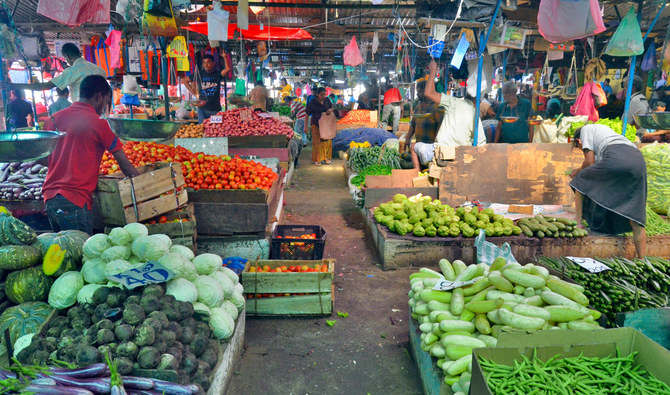
Officials said they have already seized large amounts of sugar and other staple goods from rogue traders. (Shutterstock)
Short Url
Updated 01 September 2021
Follow

Sri Lanka cracks down on food hoarders as prices soar during economic crisis

  • Authorities fix low prices for basic goods, including rice and sugar, in attempt to control inflation; profiteers face six months in jail
  • ‘The government has seized more than 5,000 metric tonnes of hoarded sugar from errant traders,’ minister told Arab News

COLOMBO: Sri Lankan authorities took action on Wednesday to control rapidly rising costs of basic goods by fixing prices and confiscating stocks. It came a day after they declared an economic emergency triggered by a sharp fall in the value of the country’s currency as a result of a foreign-exchange crisis.

President Gotabaya Rajapaksa announced wide-ranging emergency regulations on Tuesday. They apply to the supply, hoarding and pricing of staple foods such as rice and sugar, in an effort to control rising inflation. Private banks are running out of foreign-exchange reserves to finance imports following a steep decline in the value of the Sri Lankan rupee, which has fallen by 7.5 percent against the dollar this year.

Officials said they have already seized large amounts of sugar and other staple goods from rogue traders, and urged all suppliers to comply with the new fixed prices.

“The government has seized more than 5,000 metric tonnes of hoarded sugar from errant traders,” Janaka Wakkumbura, the state minister for small plantation crops, told Arab News.

He added that authorities have “enough stocks for the next five months,” and have capped the price of sugar, for example, at 130 rupees ($0.65) a kilogram, almost half the pre-crisis cost of 240 rupees. There are stiff penalties for those who ignore the new rules and continue to charge higher prices.

“Violators could face up to six months in prison and have their goods taken,” Wakkumbura said.

Rajapaksa appointed a retired army officer, Maj. Gen. M. S. P. Nivunhella, as commissioner general of essential services to coordinate the supply of basic goods and oversee operations.

“The authorized officers will be able to take steps to provide essential food items at a concessionary rate to the public by purchasing stocks of essential food items,” Rajapaksa said on Tuesday before declaring the economic emergency.

“These items will be provided at government-guaranteed prices, or based on the customs value on imported goods, to prevent market irregularities.”

Lasantha Alagiyawanna, the state minister for consumer protection, said legal action will be taken against unregistered traders by next week.

“To control the price of sugar and rice, a special order was issued on June 11, 2021, authorizing the registration of paddy (unprocessed rice), rice and wheat flour stores under the Consumer Affairs Authority Act,” he said. “Still, middlemen were hoarding stocks of rice and creating an artificial shortage.”

His ministry has closed 52 unregistered paddy storage facilities during raids in the past week in the North Central Province, he added.

The shortages have resulted in long queues outside stores in recent days as people scramble to buy food and other commodities. This is despite a strict 16-day curfew, which ends on Monday, to curb a surge in COVID-19 cases, as the country of 21 million struggles to contain an outbreak that is claiming more than 200 lives a day.

Schoolteacher Shaheera Rozmin told Arab News that the prices of food and other items are “fluctuating daily.”

“Some imported medicines are being sold at a 50 percent increase, citing the new dollar rate,” she said. “I hope these new rules will do some good for consumers.”

Retailers said the price increases were solely the result of “artificial demand created by traders who hoard important food stocks.”

Mohammed Fazeel, general manager of the Mutti-Rice Wholesale Center in Colombo, told Arab News: “The hoarders buy the paddy at a higher rate from the farmers than from the government and resell it at exorbitant prices.”

He added that despite the government fixing the price of rice at 98 rupees per kilo and onions and potatoes at 120 rupees, the rules “are not strictly followed.”

In an attempt to ease the financial crisis in Sri Lanka, the International Monetary Fund, the Bank of China and the Bank of Bangladesh on Wednesday pledged more than $1.2 billion in loans to strengthen the island nation’s foreign reserves.


Pakistan killed over 80 militants in strikes on TTP camps in Afghanistan — official

Updated 23 February 2026
Follow

Pakistan killed over 80 militants in strikes on TTP camps in Afghanistan — official

  • Saturday’s airstrikes followed a series of attacks inside Pakistan amid a surge in militancy
  • The Afghan Taliban authorities accuse Pakistani forces of killing civilians in the airstrikes

ISLAMABAD: Pakistan’s airstrikes in Afghanistan destroyed seven Tehreek-e-Taliban Pakistan (TTP) camps and killed over 80 militants, a Pakistani security official said on Sunday, with the Afghan Taliban accusing Pakistani forces of killing civilians in the assault.

Saturday’s airstrikes followed a series of attacks inside Pakistan amid a surge in militancy. Authorities say the attacks, particularly in Khyber Pakhtunkhwa province and the Pakistani capital of Islamabad, were carried out by the TTP and allied groups that Islamabad alleges are operating from sanctuaries in Afghanistan. Kabul denies this.

According to Pakistan’s information ministry, recent incidents included a suicide bombing at a Shiite mosque in Islamabad, separate attacks in Bajaur and Bannu, and another recent incident in Bannu during the holy month of Ramadan, which started earlier this week. The government said it had “conclusive evidence” linking the attacks to militants directed by leadership based in Afghanistan.

“Last night, Pakistan’s intelligence-based air strikes destroyed seven centers of Fitna Al-Khawarij TTP in three provinces of Nangarhar, Paktika and Khost, in which more than eighty Khawarij (TTP militants) have been confirmed killed, while more are expected,” a Pakistani security official, who spoke on condition of anonymity, told Arab News.


An earlier statement from Pakistan’s information ministry said the targets included a camp of a Daesh regional affiliate, the Islamic State Khorasan Province (ISKP), which claimed a suicide bombing at an Islamabad Shiite mosque that killed 32 people this month.

In an X post, Afghan government spokesperson Zabihullah Mujahid said Pakistani forces had violated Afghan territory.

“Pakistani special military circles have once again trespassed into Afghan territory,” Mujahid said. “Last night, they bombed our civilian compatriots in Nangarhar and Paktika provinces, martyring and wounding dozens of people, including women and children.”

 The Afghan Taliban’s claims of civilian casualties could not be independently verified. Pakistan did not immediately comment on the allegation that civilians had been killed in the strikes.

In a post on X, Afghanistan’s foreign ministry said it had summoned Pakistan’s charge d’affaires to Afghanistan Ubaid-ur-Rehman Nizamani and lodged protest through a formal démarche in response to the Pakistani military strikes.

“IEA-MoFA (The Islamic Emirate of Afghanistan’s Ministry of Foreign Affairs) vehemently condemns the violation of Afghanistan’s airspace and the targeting of civilians, describing it as a flagrant breach of Afghanistan’s territorial integrity & a provocative action,” it said in a statement.

“The Pakistani side was also categorically informed that safeguarding Afghanistan’s territorial integrity is the religious responsibility of the Islamic Emirate of Afghanistan; henceforth, the responsibility for any adverse consequences of such actions will rest with the opposing side.”

Tensions between Islamabad and Kabul have escalated since the Afghan Taliban returned to power in 2021. Pakistan says cross-border militant attacks have increased since then and has accused the Taliban of failing to honor commitments under the 2020 Doha Agreement to prevent Afghan soil from being used for attacks against other countries. The Taliban deny allowing such activity and have previously rejected similar accusations.

Saturday’s exchange of accusations marks one of the most direct confrontations between the two neighbors in recent months and risks further straining already fragile ties along the volatile border.