

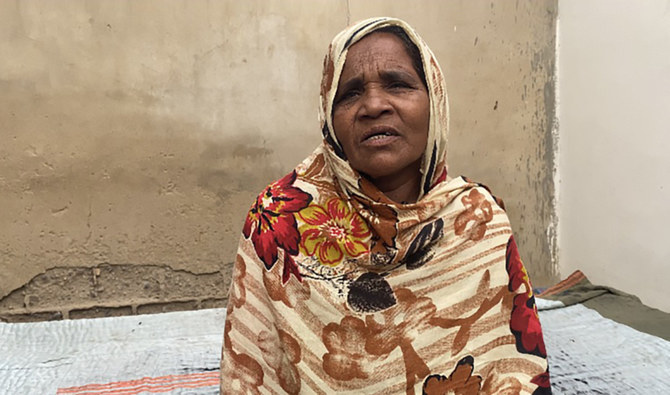

KARACHI: A woman from Bangladesh who was sold as a slave bride in Pakistan in 1983 and flew to Dhaka last week said on Wednesday she wished her father were still alive to see her return to her homeland and be reunited with her family.
Zahida, 61, who goes by the name Ruqayya Begum in Pakistan, was 23 years old when she was kidnapped from Bangladesh’s Jhenaidah district and sold as a bride to an elderly man in Pakistan’s Sindh province. Her husband, who never allowed her to contact her family, died in 2014. Four years later, Waliullah Maroof, a seminary student whose family knew Begum’s, searched for her on social media and managed to connect her with her family.
Last Saturday, Begum left Karachi, where she now lives, for Dhaka on an Emirates flight. She has a six-month visa and plans to stay in Bangladesh for at least three months.
“It was the best moment of my life when I met my mother and siblings,” she told Arab News on the phone from her ancestral village of Butyar Gathi in Jhenaidah district. “But I wish my father had stayed alive a few more years so I could have met him.”
As the years passed after her kidnapping, Begum said, everyone in her family lost hope of seeing her again - everyone but her father, Abdul Jabbar, who remained convinced until his death that his daughter was safe and would return home one day.
But by the time Begum established contact with her family in October 2018, her father had passed away - just a month earlier.
“Jabbar loved her a lot,” her mother Razia told Arab News in a phone interview. “He always remembered her on every occasion. Even when he was on his deathbed, he repeatedly took her name and told me: ‘It seems that I will not be able to see my daughter, but I can assure you she will return and meet you one day, though she will not find me here.’”
Her mother said she could vividly recall every moment of Zahida’s life, from her birth till the time she went missing.
“She is the eldest among her siblings,” Razia said. “I used to see her in my dream as a child who was tightly holding me.”
She said she had kept Zahida’s belongings with her for years and would think of her a lot, especially on family events and celebrations.
“One such moment was the wedding of her sister, Shahida, and another one when her father constantly started taking her name before he passed away,” she said. “I wished she had been there by his side when he died.”
Pakistan has long been a destination country for men, women, and children subjected to forced labor – particularly from Afghanistan, Bangladesh, and Sri Lanka.
Latest data on the trafficking of women from Bangladesh to Pakistan was not available but an April 2000 report by ActionAid Pakistan said 200,000 women and girls aged 12 and 30 had been trafficked from Bangladesh to Pakistan between 1990 to 1999. The numbers have increased by many more thousands now, said Zia Awan, president of the Lawyers for Human Rights & Legal Aid (LHRLA).
Most of the women, Awan said, never found their way back home. But Begum has been lucky.
“I had almost forgotten happiness,” she said, adding that she forgot the wounds of the last four decades the moment she was reunited with her family. “My heart was content when I saw my mother and siblings after such a long time. I am very happy now and want to enjoy every moment before I return to Pakistan to join my daughter and other relatives.”
“A few years after I was kidnapped, I had a feeling that I would never be able to return to my home and meet my parents and relatives,” Begum said. “But Allah brought me back.”


