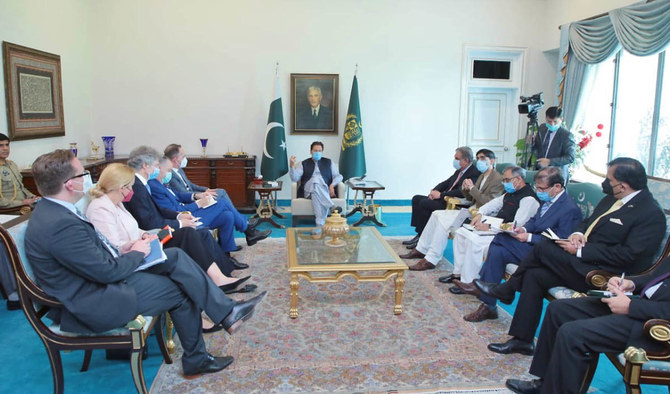

ISLAMABAD: German Foreign Minister Heiko Maas met Pakistani Prime Minister Imran Khan on Tuesday, with both leaders vowing to work closely for regional peace.
Maas said on Tuesday it was important for his country that all Afghan factions were represented in the future political setup in Kabul, adding it remained to be seen if the Taliban would allow an "inclusive" administration.
The German official issued the statement during a joint news conference with his Pakistani counterpart Shah Mahmood Qureshi in Islamabad.
The German leader's visit to the region comes a day after US and NATO forces completed their pullout from Afghanistan after fighting a war that lasted about two decades.
“The Prime Minister underscored that both Pakistan and Germany should work closely for the promotion of shared interests relating to regional peace and stability,” PM Khan said in a tweet.
During a presser with Qureshi, Maas said the Taliban were “going to present a new government and it remains to be seen if this government is as inclusive as we demanded it to be.”
“It is important for us that all Afghans, Afghans who do not support the Taliban, are represented by this government, and it remains to be seen if the Taliban will take this into account,” the German FM said.
He thanked Pakistan for playing a constructive role in the evacuation of German citizens along with vulnerable Afghan nationals from the war-torn country in the last two weeks.
“Pakistan as a neighbor of Afghanistan is fully experiencing the effect of this crisis,” Maas acknowledged, adding that Germany had already provided one million euros in humanitarian assistance and pledged further 500 million euros for projects and measures in Afghanistan’s neighboring countries for projects like preventing extremism.
He said that some German nationals were still stuck in Afghanistan and his government was closely coordinating with Pakistan for their safe evacuation.
“We are also preparing in close cooperation with others to organize charter flights as soon as Kabul airport is operable again,” he said. “We need procedures to bring these people to Germany if they are eligible for admission.”
Maas said the Taliban had promised to allow civilians to leave Afghanistan on flights from Kabul airport, but it was yet to be seen if their “commitments are reliable.”
Pakistan’s foreign minister, meanwhile, urged the international community not to abandon Afghanistan and allow humanitarian assistance to ensure peace and stability in the war-ravaged country.
“This is a pivotal moment in Afghanistan’s history,” he said. “The international community must remain engaged … Don’t let the economic collapse in Afghanistan take place as vacuum and instability is in nobody’s interest,” he added.
Germany was one of Pakistan’s largest trading partners in the European Union, Qureshi said while urging his German counterpart to enhance bilateral trade and develop economic linkages in areas like renewable energy, housing and electric vehicles.
Qureshi also said Pakistan had helped evacuate over 10,000 people safely from Afghanistan between August 15 and August 30.
He also warned the international community against the role of "spoilers" in Afghanistan and said a governance vacuum was not favorable, hoping the Taliban would announce the formation of a government in the next few days.
Maas also met Pakistani army chief General Qamar Javed Bajwa on Tuesday.
“During the meeting, matters of mutual interest, overall regional security situation including latest developments in Afghanistan and bilateral cooperation in various fields were discussed,” the army’s media wing said. “The German dignitary acknowledged Pakistan’s continuous efforts for peace and stability in the region and thanked the COAS [army chief] for assistance rendered by Pakistan during evacuations from Kabul.”