

Israeli minister travels to Ramallah for rare talks with Palestinian leader

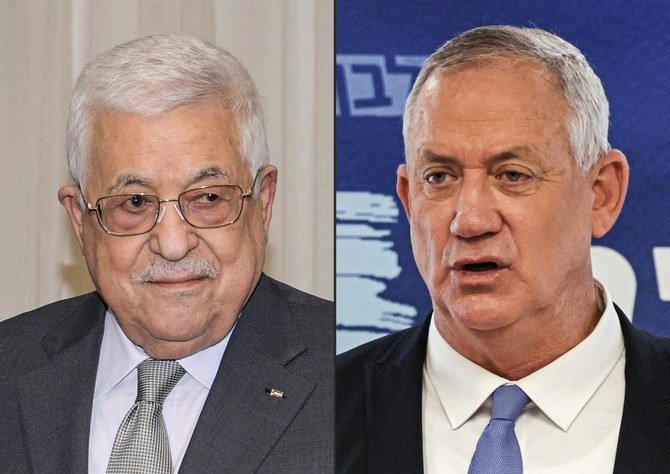
Palestinian president Mahmud Abbas (L) and Israeli Defense Minister Benny Gantz held a rare high-level meeting. (File/AFP)
Short Url
Updated 31 August 2021
Follow

Israeli minister travels to Ramallah for rare talks with Palestinian leader

  • Israel to lend Palestinian Authority $155m to ease financial crisis
  • Meeting follows Naftali Bennett’s visit to the White House

AMMAN: Israeli Defense Minister Benny Gantz has travelled to Ramallah for talks with Palestinian President Mahmoud Abbas in the highest-level meeting since Israel’s new government took office in June.

The meeting is thought to have taken place at the urging of US President Joe Biden, who met Israeli Prime Minister Naftali Bennett at the White House last week.

It also included the head of the Israeli military branch responsible for civil affairs in the occupied Palestinian territories, Ghasan Alyan, senior Palestinian Authority’s official Hussein Al Sheikh and Palestinian intelligence chief Majid Faraj.

Abbas and Gantz discussed Israel’s legal obligations and commitments, a senior Palestinian source told Arab News. “We are demanding the return of Palestinians' security to the border crossing as it was before October 2000, the reopening of the airport in Gaza, allowing for freedom of movement between Gaza and the West Bank, family reunification, resolving the many financial obligations that Israel owes us, and the right to build in all of the occupied territories,” the source said.

“We are not obliged to make any concessions for these Israeli obligations, which are in signed agreements to which the US is a witness.”

Hanan Ashrawi, a former member of the PLO executive committee, told Arab News the meeting had been focused on economic cooperation and maintaining the Palestinian Authority’s security role. “This is not political, it’s manipulating the occupation to serve Israeli interests by stressing the functional role of the PA,” she said.

Najeeb Qadoumi, a member of the Palestine National and Central Council, told Arab News the timing of the meeting was aimed at giving a false sense of movement, but in reality nothing of substance was changing.

“They are still looking at the Palestinians from the security prism and not from the prism of national rights and the right to national self-determination,” he said.

Opinion

This section contains relevant reference points, placed in (Opinion field)

Qadoumi said the Palestinians and the world should have no serious expectations from the Biden administration. “Sure, he is different from Trump, but he has given the Palestinians nothing on the settlements or Jerusalem, and is only paying lip service to the idea of a two-state solution.”

Dina Buttu, former legal adviser to the Palestinian negotiating team, said: “The equation is always the same — the occupied must give the occupier a safe space to carry out war crimes. In exchange we get bread.”

Fadi Elsalaameen, a senior fellow at the American Security Project, said the meeting was part of a strategy to bolster Abbas as a ruler in the West Bank, in the hope that somehow with Israeli support Abbas can turn things around for himself and Israel. “Anyone with common sense knows this is a failed strategy,” he said.

“Abbas’s future as a leader is already behind him.”

After the meeting, Israel said it would lend the PA more than $150 million to ease the authority’s financial crisis, but analysts pointed out that Israel was effectively lending the Palestinians their own money. Last month the Israeli government withheld $180 million from 2020 tax revenues it collected on behalf of the PA.


Syrian foreign minister: National interest and the welfare of the people top priority

Updated 13 sec ago
Follow

Syrian foreign minister: National interest and the welfare of the people top priority

  • Hassan Al-Shaibani highlights reconstruction efforts, internal reforms during Munich discussion

MUNICH: The Syrian Arab Republic Foreign Minister Asaad Hassan Al-Shaibani spoke on the sidelines of the Munich Security Conference about the country’s ongoing recovery, internal reforms, and the impact of Israeli military actions.

“We are satisfied with the achievements we have made, but we continue striving to deliver the best for our people,” Al-Shaibani said.

“We will not tire or give up and will work day and night to build the Syria we aspire to, together with our citizens.”

In the Syrian Arab News Agency report the minister stressed that the Syrian state had not shirked its responsibility for what happened in Sweida and other areas, noting that “the national interest and the welfare of the people have always been our top priority.”

He emphasized that the diversity in Syria is a source of strength.

We live in a country exhausted by war and by the mismanagement inherited from the deposed regime.

Foreign Minister, Asaad Hassan Al-Shaibani

“We share national interests, including the unity and territorial integrity of the country, and we operate within the framework of the law,” he added.

Al-Shaibani highlighted progress in rebuilding state institutions and restoring trust between the government and the public.

“We live in a country exhausted by war and by the mismanagement inherited from the deposed regime,” he said. “Syrian society remains fragmented, both inside the country and abroad, and continues to face humanitarian and infrastructure challenges.”

He emphasized that efforts to unify the country include consolidating state control over weapons, a principle established after the revolution’s victory.

The minister also highlighted the role of Syrian citizens in the recovery process.

“What we rely on is our people, who possess determination and ambition,” he said, adding that “lifting sanctions is the key to reconstruction.”

He noted that there are still displacement camps in the country and that many refugees continue to live abroad.

Turning to external issues, he expressed concern over Israeli military activity.

“Since Dec. 8, 2024, Syria has faced more than 1,000 airstrikes, the occupation of new areas in southern Syria, and over 500 ground incursions,” he said, adding that the Syrian state has pursued a realistic approach toward Israel, prioritizing reconstruction and national recovery.

He noted, however, that the policy might not have been acceptable to Israel, which “continues to seek regional conflicts.”

Al-Shaibani emphasized that negotiations should result in Israel withdrawing from the areas it occupied after Dec. 8, respecting Syrian sovereignty and airspace.

Syria’s deputy interior minister met with Germany’s interior minister on the sidelines of the Munich Security Conference.

They discussed security developments and prospects for cooperation, according to a statement from the interior ministry.

Maj. Gen. Abdulkader Al-Tahhan held talks with German Interior Minister Alexander Dobrindt during the annual conference.

The Syrian Interior Ministry said the meeting included a review of current developments in Syria and their impact on security and humanitarian issues.

It added that both sides stressed the importance of coordination and information-sharing in support of regional and international stability.

The statement said the officials also discussed possible cooperation between the two interior ministries, including training, capacity-building and the exchange of expertise.