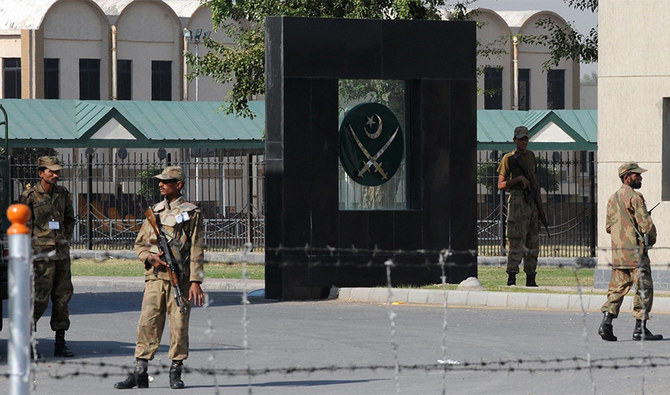
ISLAMABAD: Pakistan’s military will brief a group of lawmakers on the humanitarian crisis unfolding in Afghanistan, two weeks after the Taliban’s takeover, at the army’s headquarters in Rawalpindi on Monday, a local media report said.
Nearly 50 members from both houses of parliament, the Senate and the National Assembly, will participate in the army’s first security briefing since the Taliban’s return to power and the sudden collapse of the Western-backed Kabul government on Aug. 15, English daily Dawn reported.
It follows calls by the country’s two major opposition parties — the Pakistan Muslim League-Nawaz (PML-N) and the Pakistan Peoples Party (PPP) – urging the government to brief lawmakers on the situation and develop a national consensus on Afghanistan.
The “five to six hours” briefing will include a two-hour “interactive session” with army chief Gen. Qamar Javed Bajwa.
Since Kabul fell to the Taliban, the city’s airport has witnessed scenes of chaos, with diplomats, foreign aid workers and thousands of Afghans desperate to flee the country.
Hundreds of Afghan families have also been camping near the airport, waiting to be evacuated, fearing a return of the Taliban’s harsh and repressive policies imposed during its former rule from 1996 to 2001, before it was toppled from power in a US-led invasion.
Nearly 170 people were killed in a suicide bombing near the Kabul airport on Thursday, with US President Joe Biden warning of another attack being “highly likely.”
Evacuations were resumed soon after, with many foreigners using Islamabad as a transit facility before departing to their respective countries.
In a press briefing on Friday, Pakistan’s interior minister Sheikh Rashid Ahmed said the government had “decided to grant 21-day transit visa [to foreigners], and they will be able to live in hotels on their own expense.”
It followed a request by the US and other NATO countries for Pakistan to allow transit flights for other countries to complete evacuation measures from Kabul.
As Afghanistan’s immediate neighbor, sharing a 2,600 km long, porous border, Pakistan hosts over 4 million Afghan refugees who relocated to the country in the past several years.
Pakistan has said it will not accept more refugees from Afghanistan but has kept the land crossing between Spin Boldak and Chaman for trade and economic activity.
In July, Pakistani military’s top brass, including Gen. Bajwa and Inter-Services Intelligence (ISI) Director-General Lt. Gen. Faiz Hameed, briefed the Parliamentary Committee on National Security on Afghanistan as US-led foreign troops withdrew from the country after 20 years – ending Washington’s longest overseas war.
Since returning to power, the Taliban have said they want to maintain “good relations” with the international community, form “an all-inclusive” future government, vowing not to allow the Afghan territory to be used in attacks against any other country.
In the past two weeks, Islamabad has also pushed for continued engagement by the international community, saying it was critical to achieving durable peace, security and development in Afghanistan.


![]()

Pakistan army to brief lawmakers on Afghanistan today
Short Url
https://arab.news/ygdf8
Pakistan army to brief lawmakers on Afghanistan today
- Marks the first such meeting by the military since the Taliban took control of Kabul over two weeks ago
- Islamabad international community to remain engaged in Afghanistan for durable peace, security
Latest updates


Recommended


© 2026 SAUDI RESEARCH & PUBLISHING COMPANY, All Rights Reserved And subject to Terms of Use Agreement.