

UAE to resume tourist visas for vaccinated travelers including from Pakistan

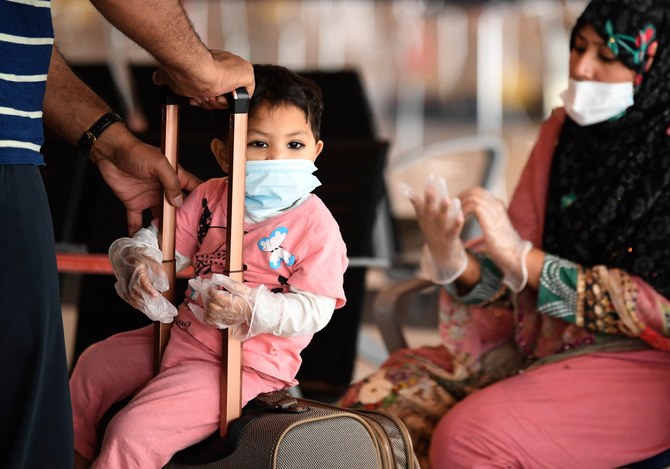
Members of a Pakistani family wait at the Dubai International Airport before leaving the Gulf Emirate on a flight back to their country, on May 7, 2020, amid the novel coronavirus pandemic crisis. (AFP)
Short Url
Updated 29 August 2021
Follow

UAE to resume tourist visas for vaccinated travelers including from Pakistan

  • Permits to be issued from Monday to travellers from all countries if they are fully vaccinated with WHO-approved vaccines
  • UAE temporarily suspended flights from Pakistan and other countries earlier this year to stem coronavirus spread

ISLAMABAD: The United Arab Emirates has said it will resume issuing tourist visas to vaccinated travelers from Monday, according to the state news agency (WAM).

The move applies to citizens of all countries, including those arriving from previously banned countries such as Pakistan, India, Nepal, and more, "provided they are fully vaccinated with one of the WHO-approved COVID-19 vaccines."

So far, the WHO has given emergency approval to vaccines from Pfizer-BioNTech, AstraZeneca, Johnson & Johnson, Moderna, Sinopharm and Sinovac.

“The Federal Authority For Identity and Citizenship (ICA) and the National Emergency Crisis and Disasters Management Authority (NCEMA) have jointly announced that starting from 30th August, application for tourist visas will be open to people from all countries," the WAM statement said.

All visitors are also required to take a COVID-19 test on arrival, it added.

The UAE, which is a major international travel and transit hub, had banned passengers from many South Asian and African states earlier this year to curb the COVID-19 outbreak.

However, on Aug. 5, it lifted a ban on transit passenger traffic from Pakistan, India, Nigeria and other countries but requires travelers to present negative COVID-19 tests not more than four hours before departure.

The UAE's decision to allow vaccinated travelers from across the globe is part of a “strategy to create a balance between public health and the activities of vital sectors, and in support of the national efforts to achieve sustainable recovery and economic growth,” the WAM statement said.

On Saturday, national flag carrier Pakistan International Airlines (PIA) increased its flights to the UAE with new routes to the emirate of Ras Al Khaimah.

PIA's new flights to the northern emirate from Islamabad, Peshawar, Lahore and Karachi will help more Pakistani expatriates return to work in the Gulf state after months of passenger flight suspensions by UAE authorities.

PIA already operates flights from all major Pakistani cities to different emirates of the UAE, including Abu Dhabi, Dubai and Sharjah.

The UAE is Pakistan’s largest trading partner in the Middle East and home to more than 1.6 million Pakistani nationals.


Pakistan air chief highlights modernization as PAF marks seven years since India aerial clash

Updated 27 February 2026
Follow

Pakistan air chief highlights modernization as PAF marks seven years since India aerial clash

  • Swift Retort was launched in 2019 after India attempted airstrikes following a Kashmir suicide bombing
  • Air chief’s remarks come amid fierce clashes between Pakistan and Afghanistan over cross-border militancy

ISLAMABAD: Pakistan’s air chief said on Friday the country’s air force had undertaken “comprehensive modernization and indigenization” in recent years, as he addressed a ceremony at Air Headquarters to mark seven years since an aerial confrontation with India.

Operation Swift Retort was launched on Feb. 27, 2019, a day after India attempted airstrikes inside Pakistan following a suicide bombing in Indian-administered Kashmir that killed at least 40 Indian paramilitary troops.

Pakistan responded with aerial strikes across the Line of Control and shot down an Indian fighter jet in a subsequent dogfight, capturing one pilot who was later returned in what Islamabad called a gesture of de-escalation.

“PAF has pursued comprehensive modernization and indigenization to transition into a Next Generation Air Force,” Air Chief Marshal Zaheer Ahmed Baber Sidhu said, according to a statement circulated by the military’s media wing, the Inter-Services Public Relations.

He added that the force had recalibrated its operational doctrine and rapidly inducted advanced combat and support capabilities, including indigenously developed unmanned systems, electronic warfare, space and cyber assets, establishing what he described as a “home-grown multi-domain kill chain.”

Sidhu said Pakistan remained committed to peace but would respond decisively to violations of its sovereignty.

“Pakistan is a responsible country which desires peace with honor,” he continued.

The remarks come amid renewed security tensions on Pakistan’s western frontier.

Islamabad earlier this week launched airstrikes inside Afghanistan targeting what it described as hideouts of Tehreek-e-Taliban Pakistan (TTP) and Daesh militants. Afghan authorities condemned the strikes and subsequently launched their own military response that led to fierce clashes between the two sides overnight.

Pakistan has frequently accused Kabul of allowing militant groups to use Afghan territory to carry out cross-border attacks on Pakistani civilians and security forces, an allegation denied by Afghan officials.

Pakistani authorities said earlier in the day small drones launched from the Afghan side were intercepted and brought down by the country’s air defense systems.

Sidhu said the PAF would continue to maintain a vigilant yet responsible defense posture to safeguard national sovereignty.