

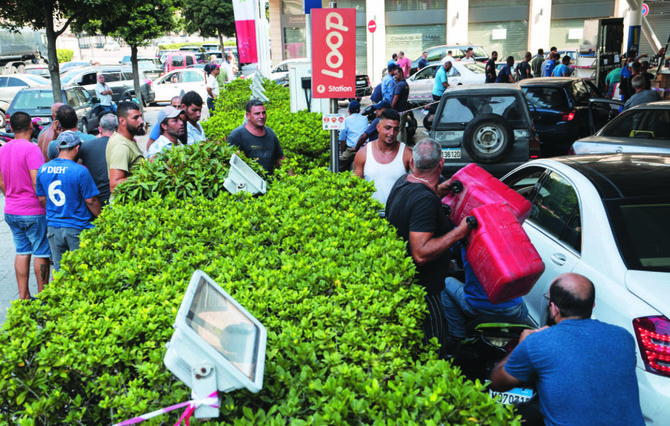
Fuel clashes see Lebanon ramp up security

Lebanon is struggling amid a 20-month-old economic crisis that has led to shortages of fuel and basic goods like baby formula, medicine and spare parts. (AP)
Short Url
Updated 29 August 2021
Follow

Fuel clashes see Lebanon ramp up security

  • Drivers enduring 10-hour gas station queues as street brawls erupt

BEIRUT: Security measures were increased in several Lebanese regions following violent clashes over fuel disputes in gas stations, where sticks, knives and other weapons were used.

On Saturday, Baalbek and neighboring towns were plunged into darkness due to a decrease in production of the Al-Zahrani thermal plant by almost 150 megawatts.

It came after the country’s diesel shortage led to severe rationing by private generator owners. Subscription prices for small local generators now exceed 7 million Lebanese pounds ($4,600) per month.

Jihad Salem Al-Husseini, a dentist, said: “My work has worsened a lot. I bought a private generator and put it on the roof of the building in which my clinic is located in Beirut, after the owner of the generator with whom I was subscribed asked me to pay 7 million Lebanese pounds per month. He refused to provide me with electricity during the day, saying that he decided to run his generator only at night due to the diesel shortage.

“The crisis is affecting everything. The loss of electricity is one of the crises.”

The electricity crisis has hit many businesses, including barber shops. In light of the power outages that led to the disuse of air conditioners, scenes of customers sitting on chairs in front of barber shops have become common. Many barbers have moved their morning shifts to the evening.

Hair stylist Mohammed Issa said: “Due to power outages, I had to raise my prices from 5,000 to 25,000 Lebanese pounds for a blow dry. The situation is very difficult.”

HIGHLIGHTS

• On Saturday, Baalbek and neighboring towns were plunged into darkness due to a decrease in production of the Al-Zahrani thermal plant by almost 150 megawatts.

• It came after the country’s diesel shortage led to severe rationing by private generator owners.

• Subscription prices for small local generators now exceed 7 million Lebanese pounds per month.

• Growing tensions resulting from the acute cost-of-living crisis Lebanon is facing have begun to threaten security stability and civil coexistence.

• Violence erupted between residents of two southern towns, which led to the injury of six people as a result of a dispute over fuel.

Meanwhile, growing tensions resulting from the acute cost-of-living crisis Lebanon is facing have begun to threaten security stability and civil coexistence. Violence erupted between residents of two southern towns, which led to the injury of six people as a result of a dispute over fuel.

Commenting on the violence, Raif Younan, mayor of Maghdouche, a predominantly Christian town east of Sidon, said: “No one will be allowed to harm the people or their properties.” The head of the Lebanese Forces party, Samir Geagea, called on the national army to “maintain security in the villages east of Sidon.”

The price of one fuel gallon has risen by 65 percent after the gradual lifting of subsidies. The price of one gallon of diesel has increased by 69 percent, while the price of a fuel gallon on the black market recently reached about 600,000 Lebanese pounds. Fuel is more commonly sold at stations for 133,000 pounds, after regular 10-hour waiting periods.

On Saturday, tensions also erupted in front of a gas station in Akkar, which led to vehicular collisions. Fights also broke out in front of a gas station in Tripoli. On the Abbasiya highway, three people were injured during a fight.

According to a statement by the Lebanese Army, “two citizens who were causing trouble in front of gas stations in the towns of Taalbaya and Bar Elias in central Bekaa were arrested. Weapons and ammunition were seized in their possession.”


Syrian Alawites protest in coastal heartland after mosque bombing

Updated 59 min 20 sec ago
Follow

Syrian Alawites protest in coastal heartland after mosque bombing

  • Syrian Alawites took to the streets on Sunday in the coastal city of Latakia to protest after a mosque bombing that killed eight people in Homs two days before

LATAKIA: Syrian Alawites took to the streets on Sunday in the coastal city of Latakia to protest after a mosque bombing that killed eight people in Homs two days before.
The attack, which took place in an Alawite area of Homs city, was the latest against the religious minority, which has been the target of several episodes of violence since the December 2024 fall of longtime ruler Bashar Assad, himself an Alawite.
Security forces were deployed in the area, and intervened to break up clashes between demonstrators and counter-protesters, an AFP correspondent witnessed.
“Why the killing? Why the assassination? Why the kidnapping? Why these random actions without any deterrent, accountability or oversight?” said protester Numeir Ramadan, a 48-year-old trader.
“Assad is gone, and we do not support Assad... Why this killing?“
Sunday’s demonstration came after calls from prominent spiritual leader Ghazal Ghazal, head of the Islamic Alawite Council in Syria and Abroad, who on Saturday urged people to “show the world that the Alawite community cannot be humiliated or marginalized.”
“We do not want a civil war, we want political federalism. We do not want your terrorism. We want to determine our own destiny,” he said in a video message on Facebook.
Protesters carried pictures of Ghazal along with banners expressing support for him, while chanting calls for decentralized government authority and a degree of regional autonomy.
“Our first demand is federalism to stop the bloodshed, because Alawite blood is not cheap, and Syrian blood in general is not cheap. We are being killed because we are Alawites,” Hadil Salha, a 40-year-old housewife said.
Most Syrians are Sunni Muslim, and the city of Homs — where Friday’s bombing took place — is home to a Sunni majority but also has several areas that are predominantly Alawite, a community whose faith stems from Shiite Islam.
The community is otherwise mostly present across their coastal heartland in Latakia and Tartus provinces.
Since Assad’s fall, the Syrian Observatory for Human Rights monitor and Homs province residents have reported kidnappings and killings targeting members of the minority community.
Alawite massacres 
The country has also seen several bloody flare-ups of sectarian violence.
Syria’s coastal areas saw the massacre of Alawite civilians in March, with authorities accusing armed Assad supporters of sparking the violence by attacking security forces.
A national commission of inquiry said at least 1,426 members of the minority were killed, while the Syrian Observatory for Human Rights monitor put the toll at more than 1,700.
Late last month, thousands of people demonstrated on the coast to protest fresh attacks targeting Alawites in Homs and other regions.
Before and after the March bloodshed, authorities carried out a massive arrest campaign in predominantly Alawite areas, which are also former Assad strongholds.
Protesters on Sunday also demanded the release of detainees.
On Friday, Syrian state television reported the release of 70 detainees in Latakia “after it was proven that they were not involved in war crimes,” saying more releases would follow.
Despite assurances from Damascus that all Syria’s communities will be protected, the country’s minorities remain wary of their future under the new Islamist authorities, who have so far rejected calls for federalism.