KARACHI: Zahida was twenty-three years old in 1983 when she was kidnapped from her village in southwestern Bangladesh and trafficked to Pakistan.
Since then, the now 61-year-old woman who goes by the name Ruqayya Begum, could only dream of being reunited with her family in Bangladesh’s Jhenaidah district but had no hope it would ever happen. After nearly four decades, her dream has come true: on Saturday, Begum left for Dhaka on an Emirates flight after finally getting a six-month visit visa.
“My father never stopped buying my Eid dresses,” Begum, who works as a helper at a private school in Karachi’s Manghopir area, told Arab News at her residence this week. “At one point, when my sister-in-law reminded him that my whereabouts were not known and I could even be dead, he said his heart told him that I was still alive.”
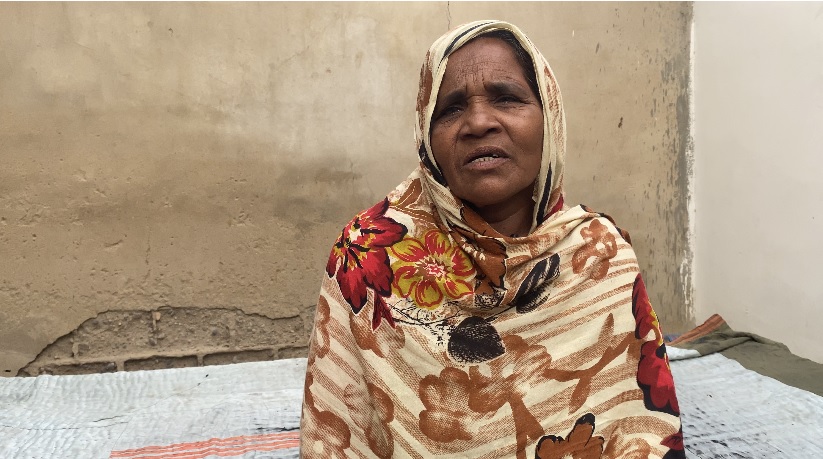
Ruqayya Begum is speaking to Arab News at her residence in Manghopir, Karachi, on July 7, 2021. (AN Photo)
By the time Begum finally made contact with her family in October 2018, her father had passed away.
Pakistan has long been a destination country for men, women, and children subjected to forced labor – particularly from Afghanistan, Bangladesh, and Sri Lanka.
Latest data on the trafficking of women from Bangladesh to Pakistan was not available but an April 2000 report by Action Aid Pakistan said 200,000 women and girls aged 12 and 30 had been trafficked from Bangladesh to Pakistan between 1990 to 1999. The numbers have increased by many more thousands now, said Zia Awan, president of the Lawyers for Human Rights & Legal Aid (LHRLA).
“Still thousands of Bangladeshi and Rohingya women and girls are trafficked,” Awan told Arab News, explaining that most of the trafficked women came from poor families in remote villages and were sold off as slave brides or for prostitution and housework.
Most of the women, Awan said, never found their way back home. But Begum has been lucky.
Waliullah Maroof, a seminary student whose family knew Begum’s, learnt about her through his mother, who told him to try and look for her on social media.
“She [Begum] is known as naani [maternal grandmother] in our neighborhood,” Maroof told Arab News. “My mother asked me to make constructive use of my time on social media and help find her family. When I wrote a post about her, it was widely circulated and we eventually succeeded in contacting her.”
Muhammad Haseebullah Raja, another Pakistani man working in China, also pitched in.
“I have a huge network of Bangladeshi friends and it took us two weeks to locate the family through local contacts,” he told Arab News.
Maroof said it was an “extremely emotional” moment when the family reunited over a video call.
Begum then told them her story.
She was lured to a bazaar by an old woman who asked her to accompany her there.
“I acted out of kindness and went with her,” Begum said. “I was drugged and when I regained consciousness, I was somewhere else.”
“‘We have bought you,’ a man told me.”
From there, Begum was sold to a man from a rural area in Pakistan’s southern Sindh province who was looking for a bride for his uncle.
“I was then taken to the Rasool Goth village in Sindh’s Dadu district and married off to an old man,” she said.
Her husband did not allow her to make any contact with her family. As time passed, she forgot her address. She has two children, she said, a daughter who was married to a man with polio, and a son who had become a drug addict and died in 2014.
Begum said she had little to look forward to in life until she made contact with her family. Now she said she was excited at the prospect of staying with her mother and brothers in Bangladesh for nearly three months. But she would return to Pakistan, she said, to her daughter and neighbors, whom she considered family.
“I am [now] a Pakistani and have a daughter and her husband is disabled. I have to come back for them,” Begum said.
Her mother, Razia Begum, had appealed in a video message posted on Facebook for people to help her daughter arrange her travels to Bangladesh.
“I’m Zahida’s mother. After the independence of Bangladesh, we lost Zahida,” Razia said. “We searched for her a lot but couldn’t find her. I’m very unwell now, and I wish to see my daughter. If you all can please support her, I’d be able to see her.”
Maroof and his contacts also helped raise funds for Begum’s flight to Bangladesh.
The woman said her mother broke down with joy, when she informed her that she had finally bought a ticket.
“I am very happy that I’ll be meeting her soon,” she said. “Although my mother asked me not to bring anything for her, I will buy her a new suit as I am meeting her after a long time. We will talk and recall the happy moments.”
Bangladesh’s high commission in Pakistan did not respond to questions seeking comment for this story.