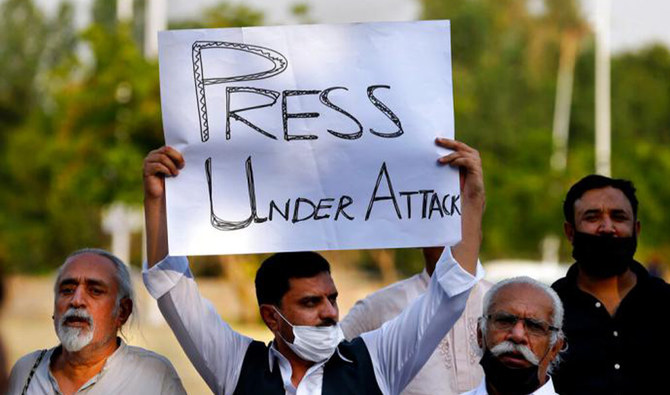
ISLAMABAD: Pakistani journalists and civil society activists have unanimously rejected a proposed media law that seeks to create a new regulator and under it set up special tribunals to try media cases, while the information minister said the process was still in the consultation phase and the ordinance had not yet been finalized.
The government announced in June it was planning to dissolve existing regulators and censor boards and form a singular Pakistan Media Development Authority (PMDA) to oversee films and electronic, print and digital media, including Web TV, over-the-top content platforms and news websites. The proposal has rattled journalists and rights advocates who fear it will be used to stifle dissent and institutionalize censorship.
Pakistan currently ranks 145 on the World Press Freedom Index, an annual listing of countries published by Reporters Without Borders.
“We have rejected this draconian law and are not prepared to have any negotiations on it with the government,” Nasir Zaidi, secretary general of the Pakistan Federal Union of Journalists (PFUJ), told Arab News on Wednesday, adding that the government wanted to introduce a “new censorship regime” in the country through the proposed regulator.
“The proposed authority is designed to further tighten the government’s grip on all forms of media which not only include print and electronic but also Internet and digital media,” Zaidi said. “Even films and dramas can be affected by the proposed legislation.”
According to a copy of the draft law seen by Arab News, the ordinance aims to create an “independent, efficient, effective, and transparent” institution to regulate all forms of media and bring them under a single and converged regulator and statutory authority.
Federal Minister for Information and Broadcasting Chaudhry Fawad Hussain said his ministry had briefed the parliamentary committees on information about the draft and was consulting media organizations before finalizing the legislation.
“We are in consultation with different media bodies at the moment and will present the final draft as soon as consultations are concluded,” the minister told Arab News on Wednesday.
The draft law proposes three years imprisonment and a fine of up to twenty-five million rupees (roughly $1.5 million) for any licensee and registered authority that violates its provisions.
The authority can act against any individual or media outlet under its jurisdiction without issuing a show cause notice and affording them an opportunity for a hearing, according to the draft. The proposed authority or its chairman may also order in writing to seize the equipment of a media organization or seal the premises of the licensee.
Any person aggrieved by a decision or order of the authority can file an appeal within 30 days, which will be decided by media tribunals within 45 days. Under the new law, only the Supreme Court of Pakistan can hear appeals against the tribunals’ verdicts.
The licensees will also be bound not to broadcast, distribute or put anything online which may be deemed as defamatory or ridicule the head of state, officials of the armed forces or members of the legislative and judicial organs of the state.
The Human Rights Commission of Pakistan (HRCP) has labeled the proposed ordinance a “black law.”
“The government knows the power and reach of alternative media,” Hina Jilani, HRCP chairperson, told Arab News. “That’s why they want to control it through legislation.”
She said there was nothing in the proposed law that could help in the media’s development, adding that the rights group had no option but to reject it: “We have no engagement with the government at any level over this legislation, and we also don’t want to have any.”
Human Rights Watch said on Tuesday the government had kept the final draft of the PMDA law and the entire drafting process secret, saying it had “undertaken no meaningful consultative process on the law.”
“The media regulatory framework in Pakistan does need to be amended – not to centralize more powers in government censors, but to create independent media regulators dedicated to protecting free expression,” HRW said. “Pakistan government needs to stop trying to control reporters and instead start protecting media freedom.”


![]()

Journalists, activists reject law to create new regulator as government says proposal not final
Short Url
https://arab.news/4a4ya
Journalists, activists reject law to create new regulator as government says proposal not final
- Pakistan Media Development Authority can impose fines of up to $1.5 million on media that violate rules
- Human Rights Watch says government kept final draft of PMDA law and entire drafting process secret
Latest updates


Recommended


© 2026 SAUDI RESEARCH & PUBLISHING COMPANY, All Rights Reserved And subject to Terms of Use Agreement.