


DUBAI: The Middle East, a region rich in ancient and pre-historic art, has also long been home to dynamic places for modern and contemporary art and culture.
Over the past century talented Arab artists have captured the world around them, particularly as major historical events have shaped the region. They have portrayed the daily life and people in their nations and cities even during moments of great change. However, not much has been written and documented about the Arab artists that have covered the last century through their art.
The MiSK Art Institute, an affiliate of the Prince Muhammad Bin Salman Foundation, or MiSK, aims to change this with “The Art Library,” an initiative to write and publish a series of art books about Saudi and Arab artists in both Arabic and English. Published by renowned house Rizzoli Libri, the first series of two books came out in June, dedicated respectively to post-war contemporary Saudi Arabian painter Abdulrahman Alsoliman, currently based in Dammam, and Adam Henein, Egypt’s renowned modernist who passed away in May 2020, and who was known for his pioneering sculptures in bronze, wood, clay, and granite.

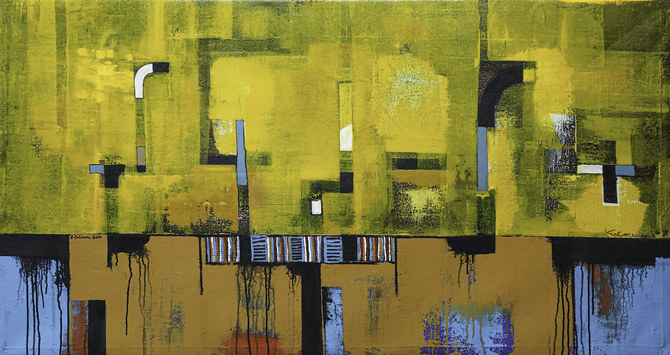
Abdulrahman Alsoliman, Memory of First Neighbourhood (al-Kut) III, 2014, Acrylic on canvas, 90 × 90 cm, Private collection. (Supplied)
The elegant volumes, each around 150 pages, offer an informal yet concise and richly detailed introduction to some of the most prominent figures of Arab art. Each book is illustrated with easy-to-follow text — perfect for those without previous knowledge or for connoisseurs in the field wishing to gain more knowledge of 20th century Middle Eastern art history.
“I’d long been keen on publishing a book on artists from our region — a series that would shed light on their work and contributions to the canon of Arab art history, but also highlight those who were or still are otherwise missing in terms of documentation and literature,” series editor Mona Khazindar told Arab News.
“I approached MiSK Art Institute because it is an organization that is dedicated to the development of Saudi and Arab art and furthering that conversation,” Khazindar, who was the first female (and first Saudi) director general of the World Arab Institute in Paris from March 2011 to March 2014, added. “As editor, I am delighted to work closely with the institute on selecting artists and respective writers and looking at the conception of exhibitions to support the book launches.”

Abdulrahman Alsoliman Solo Exhibition part of the launch of The Art Library, Misk Art Institute, Riyadh, 2021. (Supplied)
“Abdulrahman Alsoliman: Signs and Symbols” explores how the artist used to create his abstract paintings, a manner that gave rise to an intricate ornamental style influenced by local Saudi and Arab traditions and literature. Features in the book are by esteemed Arab art historians and specialists, including Roxane Zand, Farouq Youssef, and Zain AlSaie. The foreword is written by Prince Badr bin Abdullah bin Mohammed bin Farhan Al-Saud.
The other book, “Adam Henein: Charcoal Drawings,” reveals a never-before-published selection of charcoal drawings produced by the artist over the last two decades of his life. These expressive and intimate drawings were crucial to the production of his avant-garde sculptures. The book includes a foreword by Khazindar and essays by Arab art specialists Sacha Craddock, Salah Bisar, and Nayra Zaghloul.
“‘The Art Library’ responds directly to the absence of documentation and minimal literature on Saudi and Arab artists, and we are hoping that this initiative will contribute to furthering the discourse on the rich history of art practice in the Saudi and Arab worlds,” Reem AlSultan, CEO at MiSK Art Institute, told Arab News.

Adam Henein, Untitled, Paris, 1993, Natural pigments and gum Arabic on papyrus, 59.3 × 81.9 cm, Collection of the Adam Henein Museum, al-Harraneya. (Supplied)
“We are keen on telling our stories and equally keen on being the source and narrators of our own histories.”
AlSultan stressed how the celebration of work by Saudi and Arab artists is a core part of the vision behind MiSK Art Institute, which it also implements through artist residencies, staging exhibitions, the MiSK Art Grant, talks, and MiSK Art Week, among other initiatives. “‘The Art Library’ complements the institute’s mandate to support Saudi and Arab artists, and this is one of many ways in which we do,” she added.
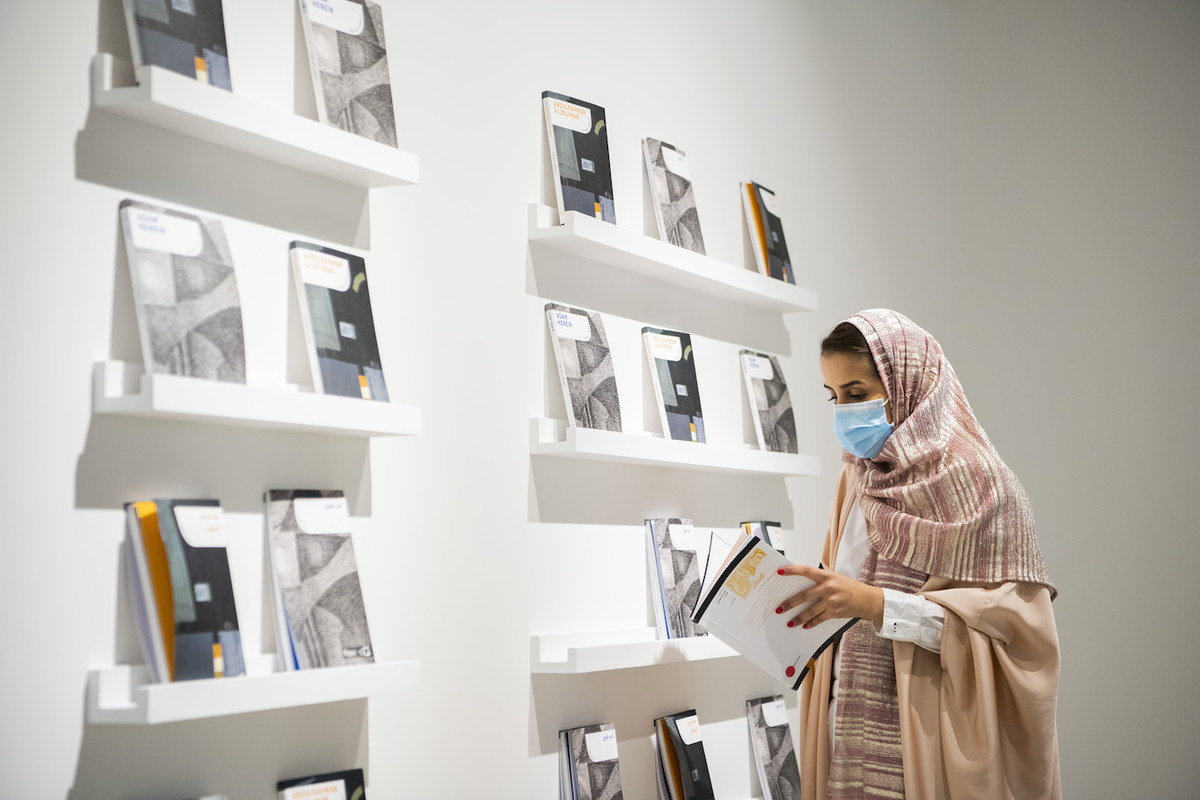
The Art Library first two volumes (AlSolaiman & Henin Books) exclusively sold at the Store of Prince Faisal bin Fahad Arts Hall, Riyadh, 2021. Image courtesy of Misk Art Institute. (Supplied)
Regardless of what happens socially or politically to a given people or place, it is the art that will be left to remember the stories of that culture. As Khazindar puts it: “Books are ultimately what remain and will tell the stories of Saudi and Arab artists, they serve as reference and educate and inspire audiences. These books will testify to a long history of art practice in the region and reflect upon the themes, movements and styles of modern and contemporary artists operating within.”
“The Art Library” is available for purchase on Amazon and from Rizzoliusa.com.


