

Afghan journalists granted access to the UK after media appeal

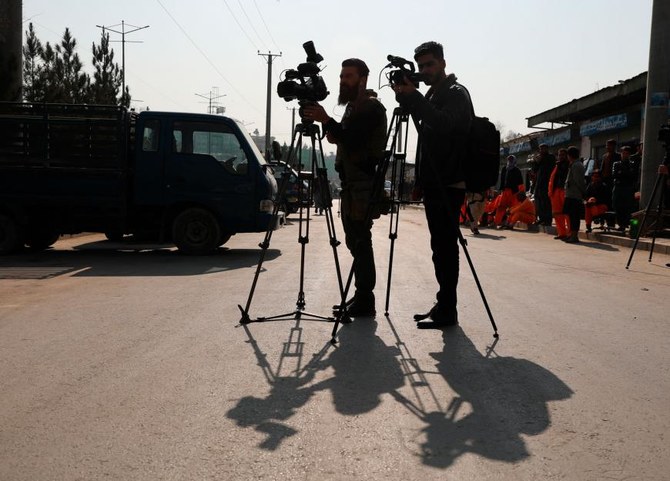
Last week, leading British media organizations and newspapers drafted an open letter to Prime Minister Boris Johnson urging him to provide protection to media workers in Afghanistan. (AP/File Photo)
Short Url
Updated 24 August 2021
Follow

Afghan journalists granted access to the UK after media appeal

  • Foreign Secretary Dominic Raab agreed to issue visa waivers for the Afghan journalists for the risks they have taken to defend human rights

LONDON: The UK government granted access to the country to over 200 Afghan journalists who worked with British media companies on Sunday, after an appeal by a coalition of top newspapers and broadcasters. 

Foreign Secretary Dominic Raab agreed to issue visa waivers for the Afghan journalists for the risks they have taken to defend human rights and pursue media freedom through their work. 

“We must protect those brave Afghan journalists who have worked so courageously to shine a light on what is really going on in Afghanistan,” Raab said. “That’s why we have granted these journalists and their media staff visa waivers to come to the UK.”

The resettlement scheme, which sits outside of current UK immigration laws, will apply to the Afghan journalists themselves and also their immediate family such as partners and dependent children under 18.

It is, however, unclear when the journalists and their families will be able to relocate to the UK given the situation in Afghanistan. 

Last week, leading British media organizations and newspapers drafted an open letter to Prime Minister Boris Johnson urging him to provide protection to media workers in Afghanistan under threat from the Taliban. 

The letter was signed by every major newspaper, including the Observer, the Guardian and the Times, plus broadcasters Sky News and ITN. 

Similar appeals emerged from the US and Germany, with major newspapers also urging their governments to provide protection for Afghan journalists and reporters who have provided essential services from Afghanistan over the past 20 years. 

German news organizations including Der Spiegel, dpa International, Deutsche Welle and Frankfurter Allgemeine Zeitung drafted an open letter addressing Chancellor Angela Merkel and Foreign Minister Heiko Maas urging them to create an emergency visa program to provide safety for Afghan journalists. 

Meanwhile on Monday, the Committee to Protect Journalists called on G7 leaders to prioritize, and take immediate action to guarantee safety for, Afghan journalists and media workers.

In an open letter, the CPJ urged the G7 to coordinate support for journalists and press freedom within the UN system, and help Afghan journalists still working in the country.


Bondi Beach attack hero says wanted to protect ‘innocent people’

Updated 30 December 2025
Follow

Bondi Beach attack hero says wanted to protect ‘innocent people’

DUBAI: Bondi Beach shooting hero Ahmed Al Ahmed recalled the moment he ran toward one of the attackers and wrenched his shotgun away, saying the only thing he had in mind was to stop the assailant from “killing more innocent people.” 

Al-Ahmad’s heroism was widely acclaimed in Australia when he tackled and disarmed gunman Sajid Akram who fired at Jewish people attending a Hanukkah event on December 14, killing 15 people and wounding dozens.

“My target was just to take the gun from him, and to stop him from killing a human being’s life and not killing innocent people,” he told CBS News in an interview on Monday.

“I know I saved lots, but I feel sorry for the lost.”

In footage viewed by millions of people, Al Ahmed was seen ducking between parked cars as the shooting unfolded, then wresting a gun from one of the assailants.

He was shot several times in the shoulder as a result and underwent several rounds of surgery.

“I jumped in his back, hit him and … hold him with my right hand and start to say a word like, you know, to warn him, ‘Drop your gun, stop doing what you’re doing’,” Al Ahmed said. 

“I don’t want to see people killed in front of me, I don’t want to see blood, I don’t want to hear his gun, I don’t want to see people screaming and begging, asking for help,” Al Ahmed told the television network.

“That’s my soul asked me to do that, and everything in my heart, and my brain, everything just worked, you know, to manage and to save the people’s life,” he said.

Al Ahmed was at the beach getting a cup of coffee when the shooting occurred.

He is a father of two who emigrated to Australia from Syria in 2007, and works as a fruit seller.  

Local media reported that the Australian government has fast-tracked and granted a number of visas for Al Ahmed’s family following his act of bravery.

“Ahmed has shown the courage and values we want in Australia,” Home Affairs Minister Tony Burke said in a statement.

One of the gunmen, Sajid Akram, 50, was shot and killed by police during the attack. An Indian national, he entered Australia on a visa in 1998.

His 24-year-old son Naveed, an Australian-born citizen, remains in custody on charges including terrorism and 15 murders, as well as committing a “terrorist act” and planting a bomb with intent to harm.

(with AFP)