

Pakistani FM leaves for Iran, Uzbekistan, other regional powers to consult on Afghanistan

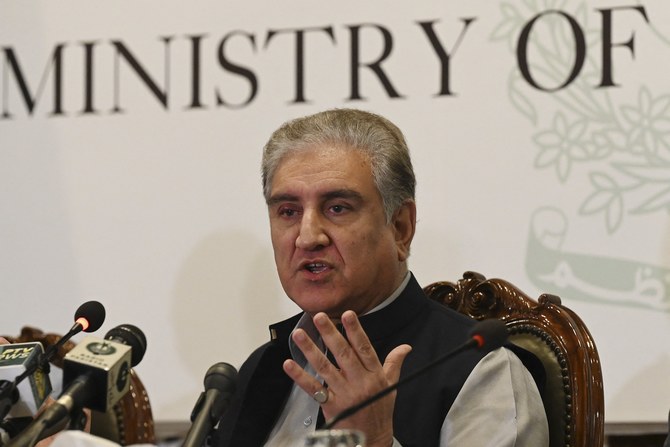
Pakistan's Foreign Minister Shah Mahmood Qureshi speaks during a press conference over the ongoing situation in Afghanistan, at the Foreign Ministry in Islamabad on August 9, 2021. (AFP)
Short Url
Updated 25 August 2021
Follow

Pakistani FM leaves for Iran, Uzbekistan, other regional powers to consult on Afghanistan

  • Qureshi will meet the leadership of Iran, Tajikistan, Uzbekistan and Turkmenistan during three-day trip
  • Neighboring countries have vital stake in the peace, security and stability of Afghanistan, foreign office says

ISLAMABAD: Pakistan’s foreign minister Shah Mahmood Qureshi left on a regional diplomacy tour today, Tuesday, which includes visits to Iran, Tajikistan, Uzbekistan and Turkmenistan, to discuss the unfolding situation in Afghanistan and present Pakistan’s perspective.

As the Taliban takes over in the strategic, landlocked nation, Pakistan, India, China and other regional powers are looking to cement their grip. Pakistan has said it desires an early and inclusive political settlement and a smooth transition of power in Afghanistan.

“Pakistan believes that the neighboring countries have a vital stake in the peace, security and stability of Afghanistan and the region,” Qureshi said in a statement about the visit from August 24-26. “It is important to coordinate closely with the neighbours to address common challenges and advance shared goals of peace, security, stability and regional connectivity.”

The foreign minister said his visit aimed to promote a coordinated regional approach as well as strengthen Pakistan’s engagement with Central and West Asia.

Pakistan has deep ties with the Taliban and has been accused of supporting the group as it battled the US-backed government in Kabul — charges denied by Islamabad. When the Taliban captured Kabul on August 15, Pakistan Prime Minister Imran Khan said Afghans had broken the “shackles of slavery.”

India, Pakistan’s old enemy, was a key supporter of the ousted regime in Kabul, but over the past year, as the Taliban emerged as a dominant force and US-brokered negotiations began in Doha, Indian diplomats have opened a line with the group.

Qureshi, in a statement on Monday, dispelled the idea that Pakistan had a problem with India’s relations with any government in Afghanistan.

“No objection to India’s good relations with Afghanistan,” his statement said, also rejecting Indian media reports that the foreign minister had traveled to Kabul recently.

“Indian media made a fuss about my going to Kabul, Indian media should confirm before speaking,” Qureshi said. “I did not go to Kabul.”



Top Pakistani clerics warn government against sending troops to Gaza to disarm Hamas

Updated 23 December 2025
Follow

Top Pakistani clerics warn government against sending troops to Gaza to disarm Hamas

  • Pakistani clerics raise alarm over reports of pressure on Muslim nations to provide troops for Gaza stabilization force under Trump peace plan
  • Islamabad has previously said that it is willing to join the international stabilization force but ‘not ready’ to play any role in disarming Hamas

ISLAMABAD: A group of Pakistan’s top religious and political leaders on Monday warned the government against sending Pakistani troops to Gaza to disarm Palestinian group Hamas, amid discussions over a proposed International Stabilization Force (ISF) for the Palestinian territory.

The representative gathering, chaired by prominent scholar Mufti Taqi Usmani, brought together leaders from Deobandi, Barelvi, Ahl-e-Hadees and Shia schools of thought, alongside leaders of the country’s main religio-political parties, Jamiat Ulema-e-Islam-Fazl (JUI-F) and Jamaat-e-Islami (JI).

The international stabilization force, which is to be composed of troops from Muslim countries, is the cornerstone of President Donald Trump’s peace plan for Gaza announced in Sept. Islamabad has previously said it is willing to join the ISF but “not ready” to play any role in disarming Hamas. Hamas’s Gaza chief Khalil Al-Hayya said this month the group had a “legitimate right” to hold weapons, while Israel has repeatedly insisted that Hamas be disarmed.

In a joint statement issued after the meeting in the port city of Karachi on Monday, Pakistani clerics raised alarm over reports that international pressure is mounting on Muslim-majority nations to provide troops for the transitional security force in Gaza, following Israel-Hamas ceasefire.

“In such circumstances, demands are being made to Muslim countries that they send their forces there to disarm Hamas,” the statement said. “Several Muslim governments have already refused this, and pressure is being increased on Pakistan.”

Last month, the United Nations Security Council approved Washington’s plan, which called for a yet-to-be-established Board of Peace as a transitional authority that Trump would head, and the stabilization force, which would be empowered to oversee borders, provide security and demilitarize the territory.

The gathering of Pakistani clerics urged Islamabad to resist any diplomatic overtures from Washington regarding troop deployment.

“This gathering, with full emphasis, demands the Government of Pakistan refrain from sending its forces to disarm Hamas and that it should not yield to any pressure in this regard,” the statement said.

The assembly expressed complete support for the liberation of Palestine and described the effort as a “duty of every Muslim.”

It said that Pakistan’s armed forces are “imbued with the spirit of jihad” and that the “notion of placing them against any sacred struggle for the liberation of Baitul Muqaddas or Palestine is impossible for the nation to accept.”

The religious leaders characterized the proposal as a “conspiracy” from which the government must “protect the country.”

Pakistani foreign office spokesperson Tahir Andrabi and the prime minister’s spokesperson for foreign media, Mosharraf Zaidi, did not respond to Arab News requests for comment on the statement.

Washington reportedly views Pakistan as a prime candidate for the ISF, given its experience in high-intensity border conflicts and internal counter-insurgency operations.

Last week, Pakistan’s foreign office said that Islamabad had not taken any decision on joining the proposed stabilization force for Gaza and had received no formal request from the US or any other country in this regard.

“I am not aware of any specific request made to Pakistan. We will inform you about any development if it takes place,” Andrabi told reporters.

He also sought to distance the government from rumors of a pending visit by Pakistan’s defense forces chief, Field Marshal Asim Munir, to the US to meet President Trump.