Key takeaways from WARC’s Future of Strategy 2021 report

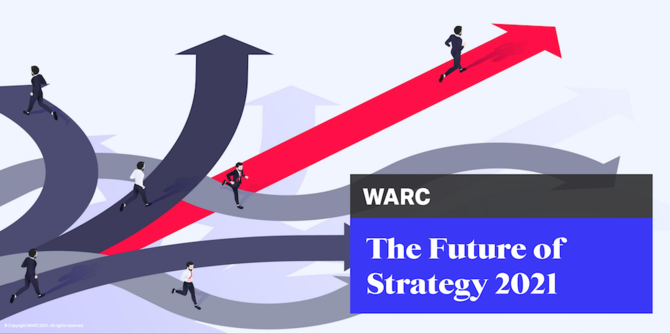
This year’s report focuses on the evolving role of marketers in light of the impact of the coronavirus disease pandemic, and the career paths young strategists can choose as they grow. (Supplied/WARC)
Short Url
Updated 24 August 2021
Follow

Key takeaways from WARC’s Future of Strategy 2021 report

  • Latest study explores the evolving role and career paths of strategists

DUBAI: The World Advertising Research Center has released The Future of Strategy 2021 report. Now in its 9th year, the annual study is based on a worldwide survey as well as in-depth interviews with marketers in agencies and brands.

This year’s report focuses on the evolving role of marketers in light of the impact of the coronavirus disease pandemic, and the career paths young strategists can choose as they grow.

Amy Rodgers, managing editor of research and rankings at WARC, said: “This year’s (report) reveals that as well as the role of the strategist being crucial to the post-pandemic recovery, there are more opportunities as the shift to upstream planning increases.”

The report presents five key takeaways. Firstly,  there has been an increase in the emphasis placed on diversity, equity and inclusion in the workplace, but there is a disconnect between discussion and action.

“With diversity proven to drive innovation and better decision-making, and with only a quarter of respondents having targets in place to hire diverse candidates, much needs to be done to drive long-term positive change,” Rodgers added.

Eighty-six percent of global strategists agreed that strategy teams need greater diversity in hiring, but less than half have a framework in place for doing so, and only 27 percent have targets in place to hire diverse candidates.

Melanie Norris, managing director and head of planning at BBDO Worldwide, said: “If we as an industry want to get to more authentic representation and to do better and more diverse work generally, and we really do want and need this, we have to start with the stories we tell, and this all starts with strategy.”

Secondly, strategists are busier and more productive than ever. The pandemic has resulted in them having to work faster and more closely with clients as they navigated crisis and recovery.

Although more than 60 percent have felt their influence increase during the pandemic, the study found that many are not satisfied with their current role and are looking for new opportunities.

Thirdly, the shift in the type and volume of work following the pandemic may accelerate a longer-term trend in shifting career paths, the study found. Young strategists are likely to continue their careers in the agency world, but mid-career strategists have a growing desire for broader experiences and new challenges.

Sixty percent of respondents agreed that their plans had changed over the last 12 months, which could signal a significant swing in the future of where strategy sits within organizations.

Fourthly, this shift is likely being compounded by declining training opportunities within agencies. However, strategists continue to feel that the best experience is on the job and in the real world. When hiring, 66 percent of managers look for an inquiring mind over specific skills. 

“We need to start to redefine our careers; from exact categorizations into expansive constellations, from skill sets trapped within the ad world to skill sets transferable into the wider one,” said Zoe Scaman, founder of Bodacious and co-founder of MCX London.

Finally, the report highlighted that there is a divergence in upstream and downstream planning, with most strategists looking upstream for opportunities to have the widest impact possible. Increasingly, they are looking to move to the client-side, consultancies, or to freelance career paths to find this opportunity. 

“What I’ve found to be a great learning experience, as someone who’s moved from agency to consultancy, is the stage that you enter with clients — especially when you’re working with the senior leadership of businesses as they plan and craft strategies (that have a significant influence on branding and creative executions down the line) rather than being handed them later as parameters and guard rails of a campaign brief,” said Abel Sim, brand and creative strategy lead at Accenture Interactive Studios.



WEF report spotlights real-world AI adoption across industries

Updated 19 January 2026
Follow

WEF report spotlights real-world AI adoption across industries

DUBAI: A new report by the World Economic Forum, released Monday, highlights companies across more than 30 countries and 20 industries that are using artificial intelligence to deliver real-world impact.

Developed in partnership with Accenture, “Proof over Promise: Insights on Real-World AI Adoption from 2025 MINDS Organizations” draws on insights from two cohorts of MINDS (Meaningful, Intelligent, Novel, Deployable Solutions), a WEF initiative focused on AI solutions that have moved beyond pilot phases to deliver measurable performance gains.

As part of its AI Global Alliance, the WEF launched the MINDS program in 2025, announcing its first cohort that year and a second cohort this week. Cohorts are selected through an evaluation process led by the WEF’s Impact Council — an independent group of experts — with applications open to public- and private-sector organizations across industries.

The report found a widening gap between organizations that have successfully scaled AI and those still struggling, while underscoring how this divide can be bridged through real-world case studies.

Based on these case studies and interviews with selected MINDS organizations, the report identified five key insights distinguishing successful AI adopters from others.

It found that leading organizations are moving away from isolated, tactical uses of AI and instead embedding it as a strategic, enterprise-wide capability.

The second insight centers on people, with AI increasingly designed to complement human expertise through closer collaboration, rather than replace it.

The other insights focus on the systems needed to scale AI effectively, including strengthening data foundations and strategic data sources, as well as moving away from fragmented technologies toward unified AI platforms.

Lastly, the report underscores the need for responsible AI, with organizations strengthening governance, safeguards and human oversight as automated decision-making becomes more widespread.

Stephan Mergenthaler, managing director and chief technology officer at the WEF, said: “AI offers extraordinary potential, yet many organizations remain unsure about how to realize it.

“The selected use cases show what is possible when ambition is translated into operational transformation and our new report provides a practical guide to help others follow the path these leaders have set.”

Among the examples cited in the report is a pilot led by the Saudi Ministry of Health in partnership with AmplifAI, which used AI-enabled thermal imaging to support early detection of diabetic foot conditions.

The initiative reduced clinician time by up to 90 percent, cut treatment costs by as much as 80 percent, and delivered a 10 time increase in screening capacity. Following clinical trials, the solution has been approved by regulatory authorities in Saudi Arabia, the UAE and Bahrain.

The report also points to work by Fujitsu, which deployed AI across its supply chain to improve inventory management. The rollout helped cut inventory-related costs by $15 million, reduce excess stock by $20 million and halve operational headcount.

In India, Tech Mahindra scaled multilingual large language models capable of handling 3.8 million monthly queries with 92 percent accuracy, enabling more inclusive access to digital services across markets in the Global South.

“Trusted, advanced AI can transform businesses, but it requires organizing data and processes to achieve the best of technology and — this is key — it also requires human ingenuity to maximize returns on AI investments,” said Manish Sharma, chief strategy and services officer at Accenture.