

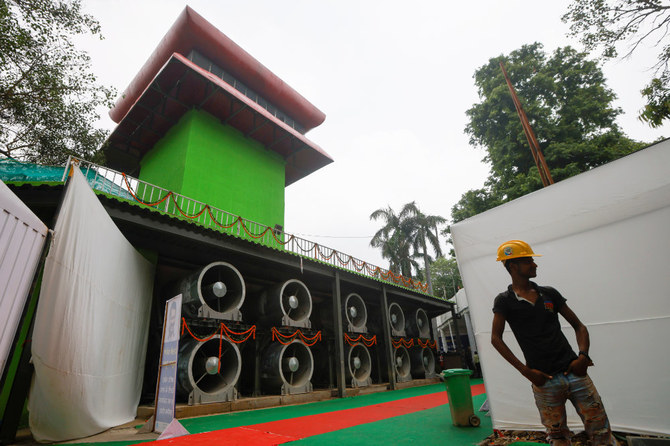

NEW DELHI: India on Monday installed a $3 million smog tower in New Delhi to fight pollution in the “world’s most polluted capital,” which has for years reported a deteriorating air quality index.
New Delhi, which boasts a population of 30 million, retained the top spot in the world’s 50 most polluted cities for the third straight year in 2020, according to IQAir, a Swiss group that measures air quality levels based on the concentration of lung-damaging airborne particles known as PM2.5.
India accounted for 35 other cities on IQAir’s World Air Quality Report, which collated data from 106 countries.
Inaugurating the 24-meter high tower in the Rajiv Chowk area of central Delhi on Monday, Chief Minister Arvind Kejriwal said it would improve air quality within a 1 km radius by purifying “1,000 cubic meters of air per second.”
“Never before in the country (has) such a technique been used and no one has attempted to clean the air this way,” Kejriwal said.
“We have imported the technique from the US. It has been installed on an experimental basis,” he added.
Built with cement and steel, the smog tower is fitted with 5,000 filters which work in a cyclical format, drawing in polluted air and releasing its purified version.
To gauge its efficacy, Kejriwal said data retrieved from the tower would be analysed by the Indian Institute of Technology in Delhi and Mumbai.
“If it is found to be effective, then many towers like this will be installed in Delhi,” Kejriwal said, adding that a second tower is scheduled to be erected in east Delhi by September.
The initiative offers a breath of fresh air for thousands of residents in the city grappling with pollution which, according to a study last year, was the leading cause for a 40 percent increase in lung cancer cases among non-smokers in the past 10 years.
Earlier this year, the Centre for Science and Environment, a New Delhi-based environmental think tank, said in its report that the seasonal average of pollution during winter in Delhi and its adjoining areas was higher in 2020/21 than in the previous cycle.
In January last year, the Supreme Court ordered the Delhi government and the Central Pollution Control Board to set up towers in two locations in the capital by April. This plan was thrown off track by the COVID-19 pandemic.
Experts, however, questioned the effectiveness of the smog towers, calling on the government to nip pollution in its bud.
“We don’t know the efficacy of the smog tower and how much it is going to address the ambient pollution,” Vivek Chattopadhyay, a senior programme manager for air pollution at the CSE, told Arab News.
“We should devote our resources to control pollution at its source. It is highly questionable, and there is no consensus among the scientific community whether a smog tower is an effective device to control pollution,” Chattopadhyay said, adding: “A smog tower can work better indoors rather than outside.”
Doctors said a smog tower might work as a makeshift solution but not as a permanent one.
“This is a damage control measure that can limit the exposure of population to a certain level but not a sureshot idea to clean up the air,” Dr. Mayank Saxena, a senior chest specialist at the Noida-based Yatharth Hospital, told Arab News.
He explained how diseases such as asthma and bronchitis are on the rise, drawing attention to the impact that a severe or worse air quality index (AQI) can have on COVID-19 patients.
“For me, the busiest days are from September to December when the pollution is high … We get lots of new patients suffering from respiratory problems, but also we see acute suffering for those who already have respiratory problems,” Dr. Saxena said.
“A study has found that the AQI also has a great impact on COVID-19 patients who have been exposed to pollution. They suffer more because of a bad AQI, and the severity of their medical condition worsens.”


