Dubai sets up special court to combat money laundering

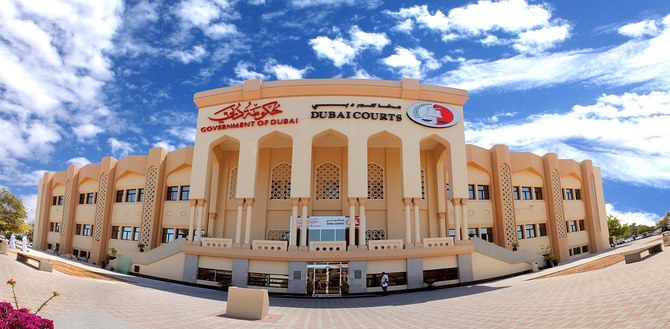
Dubai Courts announced the establishment of a specialized court, focused on combating money laundering, within the Court of First Instance and Court of Appeal. (Twitter/@DXBMediaOffice)
Short Url
Updated 22 August 2021
Follow

Dubai sets up special court to combat money laundering

  • The move is in line with the UAE’s push to strengthen the integrity of the financial system
  • The new Dubai court aims to raise the UAE and Dubai’s global competitiveness by upholding the justice and transparency

DUBAI: Dubai has established a court focused on combating money laundering, the emirate’s media office said on Sunday.
The court, which was set up upon directives from Dubai’s ruler Sheikh Mohammed bin Rashid, will be within the Court of First Instance and Court of Appeal.
The move is in line with the UAE’s push to strengthen the integrity of the financial system.
The federal government in February set up the Executive Office of Anti-Money Laundering and Counter Terrorism Financing.
The new Dubai court aims to raise the UAE and Dubai’s global competitiveness by upholding the justice and transparency, the media office said.
“The new court will support Dubai’s efforts to tackle financial crimes, including money laundering, as part of the UAE’s wider endeavor to combat crime,” it added.
Taresh Al-Mansouri, director general of Dubai Courts, said the new court is part of a commitment to improve judicial efficiency and promote excellence in the administration of justice.

“Reporting money laundering crimes is both an individual and collective responsibility, Al-Mansouri said. “Society plays a critical role in safeguarding economic and social security and strengthening the efforts of various stakeholders in responding to such crimes.”
Judge Abdullah Al-Shamsi, head of the Criminal Court at the Court of First Instance, said the new specialized court strengthened the UAE’s efforts to bring financial criminals to justice.
“This represents another step in the development of the legislative framework and helps reinforce compliance with international anti-money laundering and law-enforcement standards,” he said.


Strikes kill nine Iran-backed fighters near Iraq-Syria border: security officials

Updated 12 sec ago
Follow

Strikes kill nine Iran-backed fighters near Iraq-Syria border: security officials

  • Iraqi authorities denounced the “blatant attacks” on bases that belong to the Hashed Al-Shaabi
  • Nine fighters were killed and another 10 wounded in the strikes

BAGHDAD: Air strikes killed at least nine Iran-backed fighters in Iraq on Thursday near the Iraqi-Syrian border, two senior security officials told AFP.
Iraqi authorities denounced the “blatant attacks” on bases that belong to the Hashed Al-Shaabi, a former paramilitary group now integrated into the regular army, which also encompasses brigades from Iran-backed armed groups.
Nine fighters were killed and another 10 wounded in the strikes that targeted a base housing the US-blacklisted Harakat Ansar Allah Al-Awfiya, two security officials said.
“The base was destroyed, and the rescue teams who arrived at the site were also targeted,” one of the officials said on condition of anonymity.
The base belongs to the Hashed Al-Shaabi or the Popular Mobilization Forces (PMF) whose positions have been repeatedly targeted in attacks blamed on the United States and Israel since the start of the war.
The PMF said nine of its members were killed in Thursday’s attack.
It accused the US of striking its sites, and said that these bases “had no role in targeting US bases in Iraq or elsewhere.”
The PMF added that “all fighters killed were carrying out their official duties, and some were stationed near the borders.”
And it called the Hashed Al-Shaabi an “essential part of Iraq’s security apparatus.”
Iraq has long been a proxy battleground between the United States and Iran, with the country’s successive governments struggling to balance relations between the two rivals.
It was immediately dragged into the Middle East war triggered when the United States and Israel attacked Iran on February 28.
The Islamic Resistance in Iraq, a loose alliance of several Iran-backed groups, have been claiming daily attacks against US bases in Iraq.
Iraq’s Prime Minister Mohammed Shia Al-Sudani denounced what he called “blatant attacks” on the PMF, whose members were “performing their sacred duty within the missions of our security forces.”
“This systematic and repeated aggression, and the targeting of sites and headquarters without distinction, is not merely a military violation. It represents a desperate attempt to create confusion” and weaken Iraq’s security.