

After a decade, girls' school destroyed by militants reopens in Pakistani tribal city

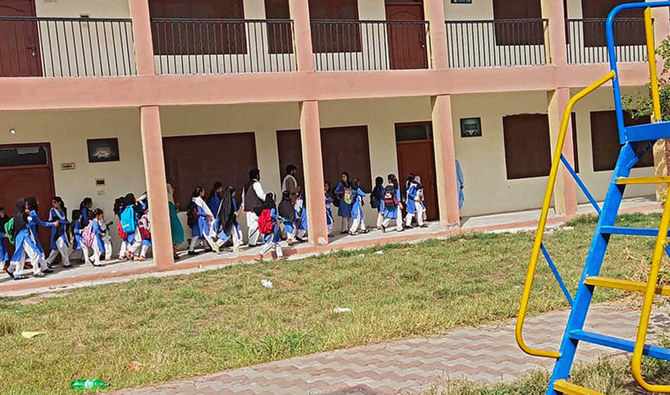
Students enter Girls High School in Miran Shah, North Waziristan, as the institute reopens on August 18, 2021. (Photo courtesy: District Education Office North Waziristan)
Short Url
Updated 23 August 2021
Follow

After a decade, girls' school destroyed by militants reopens in Pakistani tribal city

  • Girls' High School Miran Shah was rebuilt and reopened for over 250 schoolgirls last week
  • Female literacy in the volatile tribal region is about 12 percent, compared with over 50 percent in the rest of the country

PESHAWAR: After over a decade, a girls' high school destroyed by militants has reopened in Miran Shah, the district headquarters of North Waziristan in Pakistan’s northwestern tribal belt where education still suffers after years of armed conflict. 

Once known as the Federally Administered Tribal Areas, the tribal areas bordering Afghanistan were merged with Pakistan's Khyber Pakhtunkhwa province in 2018 to bring relief to the volatile area that had long endured the presence of militant groups and military operations against them.

But while the region of 5 million residents has been merged into Pakistan’s political and legal mainstream, development is slow, with many, especially women, not having access to most basic services, including education. Female literacy in the erstwhile federal territories is about 12 percent, compared with over 50 percent in the rest of the country.
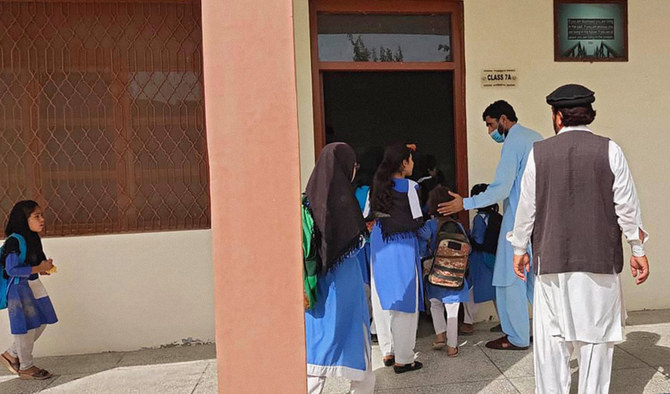


Officials welcome students entering Girls High School in Miran Shah, North Waziristan, as the institute reopens on August 18, 2021. (Photo courtesy: District Education Office North Waziristan)

The Girls' High School Miran Shah was blown up by militants in 2008. Rebuilt after years, it reopened for hundreds of girls last week.

"The lone Girls' High School Miran Shah was blown up by militants, forcing hundreds of girls to either quit their studies or get classes in another temporary building," Fida Khan Wazir, assistant education officer, told Arab News on Sunday.

"We've enrolled 250 girls on the very first day, on August 18."

With 12 female teachers employed at the school, he said, parents are more convinced to send girls to study. New students arrive every day.

"We’re getting new admission each passing day and parents are now more willing to educate their daughters."

But the region's education still needs to regain momentum.
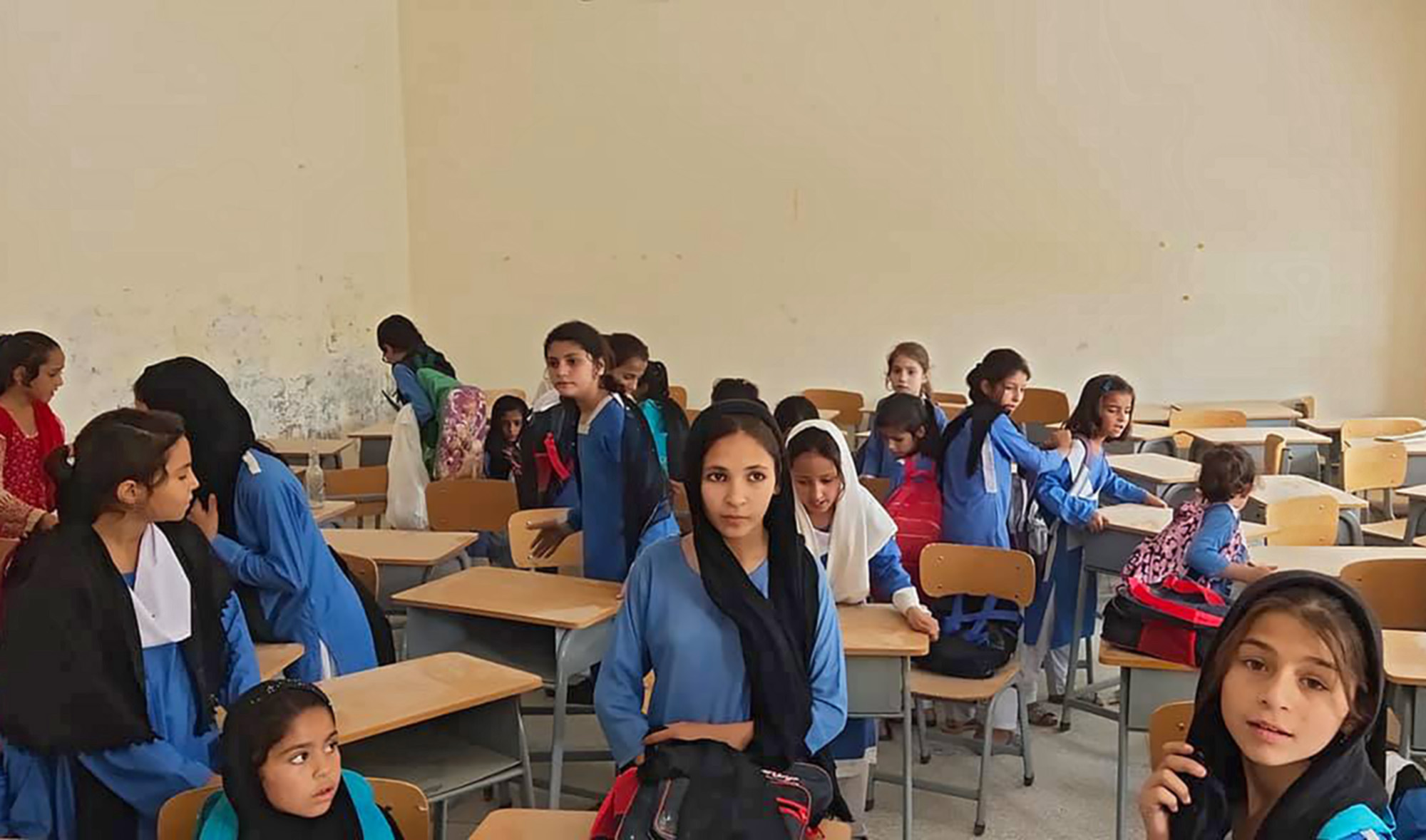


Students get ready for their first classes at Girls High School in Miran Shah, North Waziristan, as the institute reopens on August 18, 2021. (Photo courtesy: District Education Office North Waziristan)

Before the tribal areas were battered by military operations which started in the early 2000s, over 700 girl students attended the Miran Shah school, Khan said.

Locals acknowledge that the years of militancy and counterterrorism were a great setback to female education.

"When militancy started here, boy students migrated to other districts of the country and got admission in different educational institutions, but most of the girls couldn’t continue their studies because they couldn’t move to remote districts without their parents," Miran Shah resident Shakir Khan told Arab News.

The rebuild school brings some hope the situation will improve.

"The newly opened Girls High School has all the facilities such as furniture, well-equipped computer laboratory, library and a spacious auditorium for functions," Khan said.

Local elder Haji Mujtaba said parents wish more educational institutes in the region were brought back to shape.

"We appreciate the step taken by the education department," Mujtaba said. "It should upgrade the existing schools so that our daughters could get higher education."


World Bank president in Pakistan to discuss development projects, policy issues

Updated 01 February 2026
Follow

World Bank president in Pakistan to discuss development projects, policy issues

  • Pakistan, World Bank are currently gearing up to implement a 10-year partnership framework to grant $20 billion loans to the cash-strapped nation
  • World Bank President Ajay Banga will hold meetings with Pakistan Prime Minister Shehbaz Sharif and other senior officials during the high-level visit

ISLAMABAD: World Bank President Ajay Banga has arrived in Pakistan to hold talks with senior government officials on development projects and key policy issues, Pakistani state media reported on Sunday, as Islamabad seeks multilateral support to stabilize economy and accelerate growth.

The visit comes at a time when Pakistan and the World Bank are gearing up to implement a 10-year Country Partnership Framework (CPF) to grant $20 billion in loans to the cash-strapped nation.

The World Bank’s lending for Pakistan, due to start this year, will focus on education quality, child stunting, climate resilience, energy efficiency, inclusive development and private investment.

"World Bank President Ajay Banga arrives in Pakistan for a high-level visit," the state-run Pakistan TV Digital reported on Sunday. "During his stay, he will meet Prime Minister Shehbaz Sharif and other senior officials to discuss economic reforms, development projects, and key policy issues."

Pakistan, which nearly defaulted on its foreign debt obligations in 2023, is currently making efforts to stabilize its economy under a $7 billion International Monetary Fund (IMF) program.

Besides efforts to boost trade and foreign investment, Islamabad has been seeking support from multilateral financial institutions to ensure economic recovery.

“This partnership fosters a unified and focused vision for your county around six outcomes with clear, tangible and ambitious 10-year targets,” Martin Raiser, the World Bank vice president for South Asia, had said at the launch of the CPF in Jan. last year.

“We hope that the CPF will serve as an anchor for this engagement to keep us on the right track. Partnerships will equally be critical. More resources will be needed to have the impact at the scale that we wish to achieve and this will require close collaboration with all the development partners.”

In Dec., the World Bank said it had approved $700 million in ​financing for Pakistan under a multi-year initiative aimed at supporting the country's macroeconomic stability and service delivery.

It ‍followed a $47.9 ‍million World Bank grant ‍in August last year to improve primary education in Pakistan's most populous Punjab province.