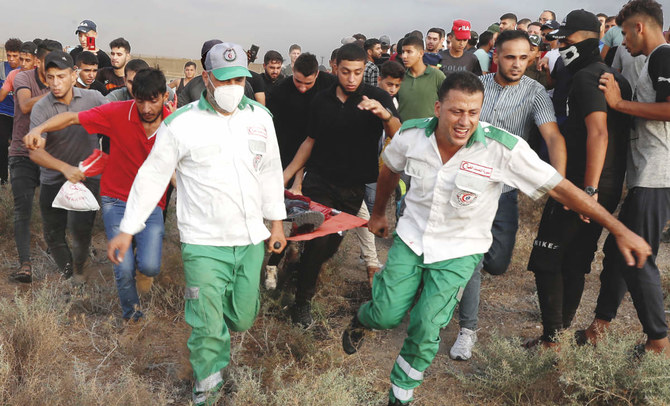

GAZA CITY: Israeli warplanes bombed Gaza after clashes between its troops and Palestinian protesters left dozens injured, including an Israeli border policeman and a 13-year-old Palestinian boy who were both critically wounded.
The Israeli military said it carried out airstrikes against four weapons sites and that it had reinforced its Gaza division with additional troops.
The escalation came exactly three months since Israel and Hamas reached a truce following their deadliest fighting in years.
Israeli troops fired at Palestinian protesters who gathered near the Gaza border wall, the army and Palestinian witnesses said.
A Palestinian gunman fired at Israeli troops through an opening in the wall and crowds of young protesters hurled explosives over the barrier and tried to scale it.
The Hamas-run Gaza Health Ministry said the injured included a 13-year-old boy left in critical condition after being hit in the head.
“Forty-one civilians were wounded with various injuries,” the ministry said in a statement, with Hamas saying “thousands” of protesters had taken part.
The Israel Border Police said a 21-year-old sniper in its undercover unit was critically wounded when he was shot by a Palestinian protester.
“His condition is critical and there is a risk to his life,” it said of the wounded officer.
Israeli police commissioner Kobi Shabtai in a statement vowed the force would “continue to act firmly and with all our might against those who want to harm us.”
#WATCH: #Israel’s military said it bombed #Palestinian militant weapons sites in the #Gaza Strip early Sunday in response to a violent demonstration on the perimeter fence that left an Israeli police officer critically injured.https://t.co/xbnMHRuUEa pic.twitter.com/XDVRDpIJrg
— Arab News (@arabnews) August 22, 2021
Defense Minister Benny Gantz had warned that “these are definitely extremely serious events that will have a response.”
Shortly after his comments, the Israeli Air Force said on Twitter that its “fighter jets struck four weapons manufacturing and storage sites belonging to the Hamas terrorist organization.”
There were no immediate reports of any casualties from the strikes.
Hamas had called a protest Saturday to mark the burning 52 years ago of Jerusalem’s Al-Aqsa Mosque.
“Al-Aqsa Mosque is a red line, and any attack on it will be met with valiant resistance from our people,” the movement said in a statement.
Late Saturday, Hamas and other groups in Gaza issued a joint statement in which they “saluted the heroic youth” who clashed with Israeli forces.
The violence is some of the worst since the May 21 ceasefire came into force.
Over 11 days in May, Israel pounded Gaza with air strikes in response to rockets fired from the occupied enclave.
Hamas said it took action after Israeli security forces stormed Al-Aqsa in May.
Reconstruction in Gaza has stalled since the ceasefire, in part because of a crippling blockade Israel has maintained on the enclave since Hamas seized power in 2007.
On Thursday, Israel announced it would allow funds from Qatar to reach impoverished Palestinians in Gaza. Other restrictions remain.
The ceasefire Egypt brokered between Hamas and Israel has largely held, although there have been flare-ups.
On Monday Israel said its “Iron Dome” missile defense system intercepted a rocket fired by militants in Gaza into Israel, the first time since the recent battle.
That came after four Palestinians were killed in the Jenin refugee camp in the occupied West Bank.
In 2018, Gazans began a protest movement demanding an end to Israel’s blockade and a right for Palestinians to return to lands they fled after the Jewish state was founded.
The Hamas-backed weekly demonstrations, often violent, sputtered as Israel killed some 350 Palestinians in Gaza over more than a year.