ISLAMABAD: A powerful bomb explosion at a procession of Shiite Muslims in central Pakistan on Thursday killed at least three people and wounded 50, media reported, quoting police and members of the minority community.
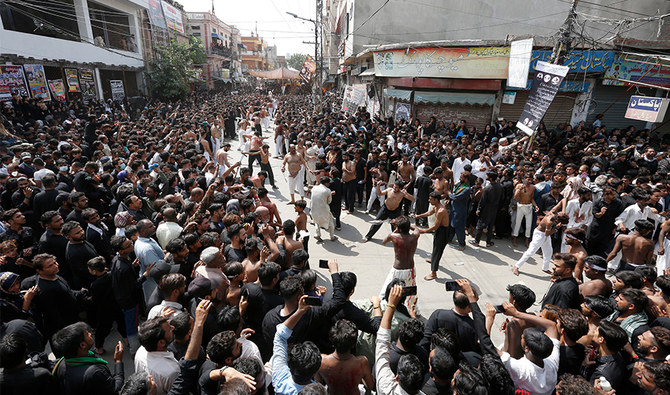
Huge crowds of Pakistani Shiites take out processions on Ashura day in the holy month of Muharram to commemorate the slaying of Imam Hussain, the grandson of the Prophet Muhammed (PBUH). In the past, militants have staged attacks on mass Ashura gatherings in Pakistan, triggering sectarian tensions.
On Thursday, hundreds of thousands of Shiite Muslims performed mourning rituals amid heightened security measures in many parts of the country to protect against militant attacks. But in Bahawalnagar in the eastern Punjab province, a roadside bombing killed three, according to the Associated Press.
“Videos circulating on social media showed police and ambulances rushing toward the site of the explosion,” AP reported. “Several wounded people were seen waiting for help along a road.”
City police officer Mohammad Asad confirmed the bombing. A Shiite leader, Khawar Shafqat, also confirmed it, saying the explosion took place when a procession was passing through a congested neighborhood called Muhajir Colony. He called on the government to further boost security at processions in other parts of the country.
Prime Minister Imran Khan’s special assistant on religious harmony and the Middle East, Tahir Mahmood Ashrafi, urged people not to spread “rumours” about the blast in Bahawalpur, saying on Twitter that "the situation is completely under control."
Ahead of Ashura, the government had shut down mobile phone services in major cities of the country, including Karachi, Quetta, Sukkur and Hyderabad to avoid any untoward incident, Geo News reported.
Across Pakistan, believers attended Ashura processions amid tight security and in the shadow of the coronavirus.
The main procession in Karachi was taken out from Nishtar Park, and will end at Imamabargah Hussainian Iranian in the Kharadar area. In Lahore, the main procession was taken out from Nisar Haveli late last night, Wednesday, and will culminate at Karbala Gamay Shah today, Thursday. The main procession in Quetta emerged from Alamdar Road, and in Rawalpindi from Imambargah Ashiq Hussain.
Last week, the government said it had set up coordination centers across the country to maintain law and order during Muharram.
“Ideal arrangements have been made for maintaining law and order in Muharram ul Haram and a quick response is ensured on any complaint received across the country to thwart any untoward situation,” Ashrafi had said in a statement last Thursday.
The National Command and Operations Center (NCOC), which oversees Pakistan’s pandemic response, has also issued a list of protocols to prevent the spread of the coronavirus during Muharram, calling on devotees to hold congregations and mourning sessions with face masks on and while keeping a physical distance of six feet.
In messages on Ashura, Pakistani leaders urged people to ensure peace and harmony as they performed their rituals.
"The nation should prepare for all kinds of sacrifices by becoming a metaphor of determination and stability for our religion and country as this path leads to success in the world and hereafter," President Dr Arif Alvi said.
PM Khan also urged Pakistanis to pay tribute to Imam Hussain by supporting truth and justice.
"Iman Hussain (RA) had become a symbol of force against falsehood and strength for all the movements fighting against tyranny in the times to come," he said, urging people not to desist even from sacrificing their lives for principles.


![]()

Bombing at procession kills three as Pakistan marks Ashura amid tight security
Short Url
https://arab.news/zbrq5
Bombing at procession kills three as Pakistan marks Ashura amid tight security
- Over 50 injured in roadside explosion in Bahawalnagar
- Tensions run high but PM’s advisor on religious harmony says situation 'completely under control'
Latest updates


Recommended


© 2026 SAUDI RESEARCH & PUBLISHING COMPANY, All Rights Reserved And subject to Terms of Use Agreement.