

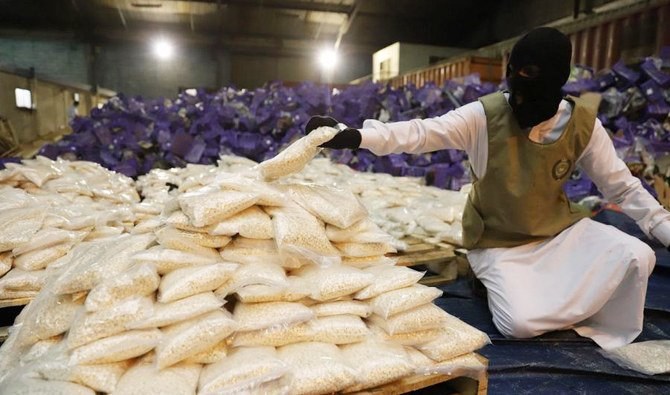
19,000 kg of banned drugs, 81,000 liters of liquor seized by Saudi customs authorities in first half of 2021

Short Url
Updated 19 August 2021
Follow

19,000 kg of banned drugs, 81,000 liters of liquor seized by Saudi customs authorities in first half of 2021

  • 9 million tons of inbound goods worth SR302 billion ($80bn) and over 36 million tons of outgoing goods worth SR128 billion ($34bn) processed

RIYADH: Saudi authorities have thwarted more than 1,000 attempts to smuggle prohibited items into the Kingdom during the first half of the year, a report by the Zakat, Tax and Customs Authority revealed on Wednesday.

Among the confiscated contraband were more than 126 million narcotic pills, and more than 19,000 kilograms of drugs such as hashish, heroin and cocaine as well as more than 60,000 bottles of wine and more than 81,000 liters of liquor, the report said.

The Authority processed more than 39 million tons of goods coming to the Kingdom with a total value of more than SR302 billion ($80 billion) and more than 36 million tons of goods exported through customs ports with a total value of more than SR128 billion.

According to the authority’s statistics, ports have completed more than 2.3 million import, export, re-export and transit transactions, in addition to completing the procedures of more than 1.1 million containers.

During the same period, customs ports processed more than 1 million departing vehicles and 1.1 million arriving vehicles.

In the same period, the authority received more than 580,000 tax and zakat declarations from all business officials subject to tax regulations, while the regulatory and inspection teams carried out 153,000 inspection visits across the Kingdom’s regions and cities.

These tours resulted in detecting more than 20,000 zakat and tax violations and answering about 9,000 communications through official reporting methods approved by the authority, most notably the VAT application and the website (zatca.gov.sa). 

As part of the authority’s efforts during the first half of 2021 to raise citizens’ awareness about its various regulations and procedures, it held some 60 workshops targeting individuals, interested people and taxpayers.


Children’s Theater Festival opens in Qassim region

Updated 27 January 2026
Follow

Children’s Theater Festival opens in Qassim region

  • To develop future ‘cultural architects,’ says CEO Khaled Al-Baz
  • ‘Nurture creativity, aesthetic awareness and sense of belonging’

BURAIDAH: The Qassim Children’s Theater Festival opened on Tuesday bringing together professionals from across Saudi Arabia and the Gulf.

The event is being held under the patronage of Prince Dr. Faisal bin Mishaal bin Saud bin Abdulaziz, governor of Qassim, at the Science Center in Unaizah governorate.

It has been Organized by the Theater and Performing Arts Association and executed by the Unaizah Theater Association, the Saudi Press Agency reported.

Running until Jan. 31, it features shows, panel discussions, as well as training workshops to develop children’s theater and strengthen professional skills in the field.

Khaled Al-Baz, CEO of the Theater and Performing Arts Association, told the SPA the festival forms part of a broader strategy to position children’s theater as a distinct cultural sector.

“Children today constitute genuine audiences — tomorrow’s cultural architects,” Al-Baz said.

Ahmed Al-Humaimidi, president of the Unaizah Theater Association, said it was an investment in young people, noting that it extends beyond performances to include cultural and educational programming.

He said the initiative aims to nurture creativity, aesthetic awareness and a sense of belonging, while also identifying emerging talent and encouraging knowledge exchange among theater practitioners.

“Our association recognizes children’s theater as foundational to cultivating aware, creative character,” he said.

The festival serves as both an artistic showcase and a platform for professional dialogue, reflecting the Kingdom’s expanding cultural landscape and growing focus on children’s theater as an educational and cultural tool, the SPA noted.

This occurs alongside support for signature initiatives and performing arts promotion as quality-of-life enhancement.