

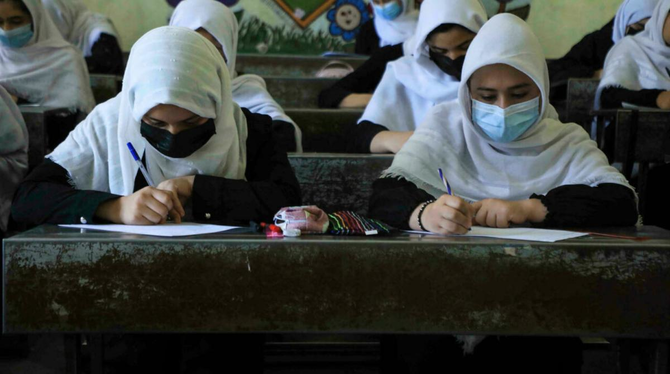
Afghan girls return to school in Herat after Taliban takeover

Schoolgirls attend class in Herat following the Taliban takeover of the city. The Taliban says it will allow the education of girls to continue. (File/AFP)
Short Url
Updated 18 August 2021
Follow

Afghan girls return to school in Herat after Taliban takeover

  • Women and girls were mostly denied education and employment under Taliban rule in the nineties
  • What lies ahead for women with the Taliban back in power remains unclear

HERAT: Girls wearing white hijabs and black tunics crammed into classrooms in the western Afghan city of Herat just days after the Taliban’s takeover.

As the school opened its doors, the students scurried down corridors and chatted in courtyards, seemingly oblivious to the turmoil that has engulfed the country in the past two weeks.

The scenes — which many feared would be banned under the Taliban — were filmed by an AFP cameraman this week, just days after fighters from the hard-line Islamist group took the city following the collapse of government forces and local militia.

“We want to progress like other countries,” said student Roqia.

“And we hope the Taliban will maintain security. We don’t want war, we want peace in our country.”

With its close proximity to the Iranian border, the ancient Silk Road city of Herat has long been a cosmopolitan exception to more conservative centers.

Women and girls walked more freely in the streets, attending schools and colleges in huge numbers in a city famed for its poetry and arts.

Its long-term future remains uncertain, however.

Under the hard-line version of sharia law that the Taliban imposed when they controlled Afghanistan in the 1990s, women and girls were mostly denied education and employment.

Full face coverings became mandatory in public, and women could not leave home without a male companion.

Public floggings and executions, including stoning for adultery, were carried out in city squares and stadiums.

What lies ahead for women with the Taliban back in power remains unclear.

Publicly, the Taliban are attempting to push the narrative that they have watered down some of their more extreme positions, with their spokesman late Tuesday announcing an official pardon for “everyone” involved in the war.

During the group’s first official press conference in Kabul since retaking power, Taliban spokesman Zabihullah Mujahid said the erstwhile insurgents were “committed to letting women work in accordance with the principles of Islam.”

Asked what the difference was between the movement ousted 20 years ago and the Taliban of today, he said: “If the question is based on ideology, and beliefs, there is no difference... but if we calculate it based on experience, maturity, and insight, no doubt there are many differences.

“The steps today will be positively different from the past steps,” he added.

Still, people have been entering public life cautiously, with women largely absent from the streets of Kabul and men trading their Western clothes for more traditional Afghan garb.

There remains massive concern globally about the Taliban’s brutal human rights record — and tens of thousands of Afghans are still trying to flee the country as the group settles into power.

After just days at the helm, it remains unclear if there is any official education policy or whether talks with schools have been held by the Taliban.

However, during an interview with Britain’s Sky News this week, another Taliban spokesman Suhail Shaheen offered assurances on the topic.

Women “can get education from primary to higher education — that means university,” he said.

Thousands of schools in areas captured by the Taliban were still operational, he added.

In Herat, school principal Basira Basiratkha expressed cautious optimism, saying she was “grateful to God” that they have been able to reopen.

“Our dear students are attending their classes in large numbers while adhering to the Islamic hijab,” she said.

“Exams are continuing.”


Rubio says technical talks with Denmark, Greenland officials over Arctic security have begun

Updated 29 January 2026
Follow

Rubio says technical talks with Denmark, Greenland officials over Arctic security have begun

  • US Secretary of State on Wednesday appeared eager to downplay Trump’s rift with Europe over Greenland

WASHINGTON: Technical talks between the US, Denmark and Greenland over hatching an Arctic security deal are now underway, Secretary of State Marco Rubio said on Wednesday.
The foreign ministers of Denmark and Greenland agreed to create a working group aimed at addressing differences with the US during a Washington meeting earlier this month with Vice President JD Vance and Rubio.
The group was created after President Donald Trump’s repeated calls for the US to take over Greenland, a Danish territory, in the name of countering threats from Russia and China — calls that Greenland, Denmark and European allies forcefully rejected.
“It begins today and it will be a regular process,” Rubio said of the working group, as he testified before the Senate Foreign Relations Committee. “We’re going to try to do it in a way that isn’t like a media circus every time these conversations happen, because we think that creates more flexibility on both sides to arrive at a positive outcome.”
The Danish Foreign Ministry said Wednesday’s talks focused on “how we can address US concerns about security in the Arctic while respecting the red lines of the Kingdom.” Red lines refers to the sovereignty of Greenland.
Trump’s renewed threats in recent weeks to annex Greenland, which is a semiautonomous territory of a NATO ally, has roiled US-European relations.
Trump this month announced he would slap new tariffs on Denmark and seven other European countries that opposed his takeover calls, only to abruptly drop his threats after a “framework” for a deal over access to the mineral-rich island was reached, with NATO Secretary-General Mark Rutte’s help. Few details of the agreement have emerged.
After stiff pushback from European allies to his Greenland rhetoric, Trump also announced at the World Economic Forum in Davos, Switzerland, last week that he would take off the table the possibility of using American military force to acquire Greenland.
The president backed off his tariff threats and softened his language after Wall Street suffered its biggest losses in months over concerns that Trump’s Greenland ambitions could spur a trade war and fundamentally rupture NATO, a 32-member transatlantic military alliance that’s been a linchpin of post-World War II security.
Rubio on Wednesday appeared eager to downplay Trump’s rift with Europe over Greenland.
“We’ve got a little bit of work to do, but I think we’re going to wind up in a good place, and I think you’ll hear the same from our colleagues in Europe very shortly,” Rubio said.
Rubio during Wednesday’s hearing also had a pointed exchange with Sen. Tim Kaine, D-Virginia, about Trump repeatedly referring to Greenland as Iceland while at Davos.
“Yeah, he meant to say Greenland, but I think we’re all familiar with presidents that have verbal stumbles,” Rubio said in responding to Kaine’s questions about Trump’s flub — taking a veiled dig at former President Joe Biden. “We’ve had presidents like that before. Some made a lot more than this one.”