Bush voices ‘deep sadness’ over Taliban takeover of Afghanistan

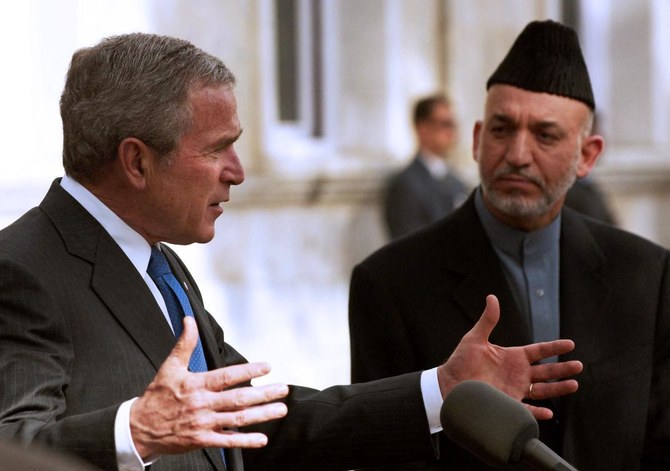
File photo of former US President George W. Bush and former Afghan President Hamid Karzai at the Presidential Palace in 2006 in Kabul. Bush said he has been watching the Taliban’s lightning takeover of Kabul “with deep sadness.” (AFP)
Short Url
Updated 17 August 2021
Follow

Bush voices ‘deep sadness’ over Taliban takeover of Afghanistan

  • Former US president George W. Bush ordered the 2001 invasion to oust the Taliban regime
  • Bush said in a letter released Monday he and former first lady Laura Bush "stand ready as Americans to lend our support and assistance"

WASHINGTON, USA: Former US president George W. Bush said he has been watching the Taliban’s lightning takeover of Kabul “with deep sadness” and has urged Washington to speed up evacuations from Afghanistan.
Bush ordered the 2001 invasion to oust the Taliban regime that sheltered Al-Qaeda leader Osama bin Laden following the group’s September 11, 2001 attacks on the United States that killed 2,977 people.
The 43rd US leader said in a letter released late Monday that he and former first lady Laura Bush “stand ready as Americans to lend our support and assistance,” after the Taliban overran Kabul, declaring they were back in power.
Tens of thousands of people have tried to flee the hard-line Islamist rule expected under the Taliban, many fearing retribution for siding with the US-backed government that ruled for the past two decades.
Evacuation flights from Afghanistan descended into chaos during the takeover as large crowds mobbed Kabul airport’s runways, some clinging to a US military aircraft as it taxied for take-off.
“Laura and I have been watching the tragic events unfolding in Afghanistan with deep sadness,” Bush said.
“Our hearts are heavy for both the Afghan people who have suffered so much and for the Americans and NATO allies who have sacrificed so much.”
Bush voiced confidence that the evacuation would be effective but urged President Joe Biden to cut red tape and speed up the removal of Afghans and Americans threatened by the Taliban.
“We have the responsibility and the resources to secure safe passage for them now, without bureaucratic delay,” he said.
The Bush administration was berated for turning its focus away from Afghanistan in the early years of the conflict to invade Iraq, allowing the fight with the Taliban to drag on with no clear purpose.
But the former president argued that the Afghan conflict had not been in vain, saying US troops had taken out “a brutal enemy” while building schools and providing medical care.
He said the armed forces had “kept America safe from further terror attacks, provided two decades of security and opportunity for millions and made America proud.”


India hosts AI summit as safety concerns grow

Updated 3 sec ago
Follow

India hosts AI summit as safety concerns grow

  • Modi will on Monday afternoon inaugurate the five-day AI Impact Summit, which aims to declare a “shared roadmap for global AI governance and collaboration”

NEW DELHI: A global artificial intelligence summit kicks off in New Delhi on Monday with big issues on the agenda, from job disruption to child safety, but some attendees warn the broad focus could diminish the chance of concrete commitments from world leaders.
While frenzied demand for generative AI has turbocharged profits for many tech companies, anxiety is growing over the risks that it poses to society and the environment.
Prime Minister Narendra Modi will on Monday afternoon inaugurate the five-day AI Impact Summit, which aims to declare a “shared roadmap for global AI governance and collaboration.”
“This occasion is further proof that our country is progressing rapidly in the field of science and technology,” and it “shows the capability of our country’s youth,” he said in an X post on Monday.
It is the fourth annual gathering addressing the problems and opportunities posed by AI, after previous international meetings in Paris, Seoul and Britain’s wartime code-breaking hub Bletchley.
Touted as the biggest edition yet, the Indian government is expecting 250,000 visitors from across the sector, including 20 national leaders and 45 ministerial-level delegations.
Also in attendance will be tech CEOs including Sam Altman of OpenAI and Google’s Sundar Pichai, although unforeseen circumstances have reportedly led Jensen Huang, head of US chip titan Nvidia, to cancel his planned appearance.
Modi will seek to “strengthen global partnerships and define India’s leadership in the AI decade ahead” in talks with the likes of France’s Emmanuel Macron and Brazil’s Luiz Inacio Lula da Silva, organizers say.
But whether they will take meaningful steps to hold AI giants accountable is in doubt, Amba Kak, co-executive director of the AI Now Institute, told AFP.
Industry commitments made at previous events “have largely been narrow ‘self regulatory’ frameworks that position AI companies to continue to grade their own homework,” said Kak, a former AI adviser to the US Federal Trade Commission who is taking part in the summit.

AI safety

The Bletchley gathering, held in 2023 — a year after ChatGPT stunned the world — was called the AI Safety Summit.
The meetings’ names have changed as they have grown in size and scope, and at last year’s AI Action Summit in Paris, dozens of nations signed a statement calling for efforts to flank AI tech with regulation to make it “open” and “ethical.”
But the United States did not sign, with Vice President JD Vance warning that “excessive regulation... could kill a transformative sector just as it’s taking off.”
The Delhi summit has the loose themes of “people, progress, planet” — dubbed three “sutras.”
AI safety remains a priority, including the dangers of misinformation such as deepfakes.
Last month saw a global backlash over Elon Musk’s Grok AI tool because it allowed users to produce sexualized pictures of real people, including children, using simple text prompts.
“Child safety and digital harms are also moving up the agenda, particularly as generative AI lowers the barrier to harmful content,” AI Asia Pacific Institute director Kelly Forbes told AFP.
“There is real scope for change” although it might not happen fast enough, said Forbes, whose organization is researching how Australia and other countries are requiring platforms to confront the issue.

AI for ‘the many’

Organizers highlight this year’s AI summit as the first to be hosted by a developing country.
“The summit will shape a shared vision for AI that truly serves the many, not just the few,” India’s IT ministry has said.
Last year India leapt to third place — overtaking South Korea and Japan — in an annual global ranking of AI competitiveness calculated by Stanford University researchers.
But despite plans for large-scale infrastructure and grand ambitions for innovation, experts say the country still has a long way to go before it can rival the United States and China.
Seth Hays, author of the Asia AI Policy Monitor newsletter, said talk at the summit would likely center around “ensuring that governments put up some guardrails, but don’t throttle AI development.”
“There may be some announcements for more state investment in AI, but it may not move the needle much — as India needs partnerships to integrate on the international scene for AI,” Hays told AFP.