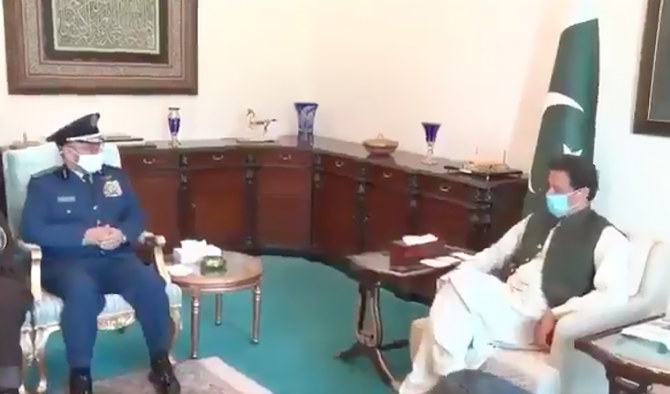
Saudi chief of general staff calls on Pakistani PM

The Chief of General Staff of the Armed Forces of Saudi Arabia, General Fayyadh bin Hameed Al-Rowailly (left) calls on Pakistan Prime Minister Imran Khan in Islamabad on August 16, 2021. (Photo courtesy: PMO Office)
Short Url
Updated 16 August 2021
Follow

Saudi chief of general staff calls on Pakistani PM

  • Acknowledges “excellent collaboration” between the two nations’ armies
  • PM sends his regards to Saudi king, crown prince 

ISLAMABAD: General Fayyadh bin Hameed Al-Rowailly, the Chief of General Staff of the Armed Forces of Saudi Arabia, called on Prime Minister Imran Khan today, Monday, and acknowledged the “excellent collaboration” between the two nations’ armies.
Khan welcomed the general and his delegation and conveyed his warm regards to Saudi King Salman Bin Abdulaziz Al Saud and Crown Prince Mohammad bin Salman, saying the people of Pakistan always accorded “special reverence” to the Saudi leadership.
“Reaffirming the close fraternal ties between the two countries, Prime Minister Imran Khan underscored Pakistan’s commitment and support for the sovereignty and territorial integrity of the Kingdom of Saudi Arabia,” his office said in a statement. 
“The Prime Minister underlined the importance attached by Pakistan to further deepening and broadening mutual cooperation and strengthening people-to-people linkages with the Kingdom. He hoped that the recently established Saudi-Pakistan Supreme Coordination Council (SPSCC) would play a catalytic role in fostering enhanced bilateral cooperation in all fields.”
The PM expressed satisfaction at the “robust defense relationship” between the two countries and hoped that bilateral defense cooperation would grow in the future. 
General Al-Rowailly acknowledged the “excellent collaboration” between the armies of Pakistan and Saudi Arabia and appreciated the professionalism of the Pakistani armed forces.


Air pollution cuts average Pakistani life expectancy by 3.9 years — report

Updated 5 sec ago
Follow

Air pollution cuts average Pakistani life expectancy by 3.9 years — report

  • Pakistan’s first city-level emissions mapping links smog to transport and industry
  • Lahore residents could gain up to 5.8 years of life with cleaner air, report says

ISLAMABAD: Air pollution is shortening the lives of millions of Pakistanis, reducing average life expectancy by almost four years and up to six years in smog-choked cities like Lahore, according to a new national assessment.

The study, titled Unveiling Pakistan’s Air Pollution and published by the Pakistan Air Quality Initiative (PAQI) this week, includes Pakistan’s first multi-sector, city-level emissions mapping, ending years of speculation over what drives the country’s chronic smog. 

Researchers identified transport, industry, brick kilns, power generation and crop burning as Pakistan’s largest contributors of PM2.5, which is hazardous fine particulate matter less than 2.5 micrometers wide that penetrates deep into the lungs and bloodstream, increasing the risk of heart disease, lung cancer and early death. The dominant sources varied by city, giving a data-based picture of pollution patterns for the first time.

The report calls particulate pollution the country’s most damaging environmental hazard. 

“Pollution reduces the life expectancy of an average Pakistani by 3.9 years,” the report states, noting the impact is more severe than food insecurity. 

“Particulate pollution is the greatest external threat to life expectancy in the country. While particulate pollution takes 3.3 years off the life expectancy of an average Pakistani resident, child and maternal malnutrition, and dietary risks reduce life expectancy by 2.4 and 2.1 years, respectively.”

The report findings suggest major health gains would follow even modest pollution cuts. 

“In Lahore, the country’s second most populous city, residents could gain 5.8 years of life expectancy,” it notes, if air quality met global safety standards.

Beyond health, the study frames smog as an economic and governance crisis. Researchers argue that Pakistan’s response has focused on optics like temporary shutdowns, anti-smog “sprays” and road-washing rather than long-term emissions control, vehicle regulation or industrial monitoring.

The assessment characterises pollution as an invisible national burden: 

“Poor air quality is Pakistan’s most universal tax, paid by every child and elder with every breath.”

Pakistan regularly ranks among the world’s most polluted countries, with Lahore, Karachi, Peshawar and Faisalabad repeatedly classified as high-toxicity zones during winter. The new mapping highlights how industrial output, diesel trucking, unregulated kiln firing, and seasonal stubble burning drive smog cycles, knowledge the authors say should guide enforceable policy rather than short-term bans.

The report concludes that reducing PM2.5 remains the single most powerful health intervention available to Pakistan, with improvements likely to deliver life expectancy gains faster than nutrition, sanitation or infectious-disease efforts.