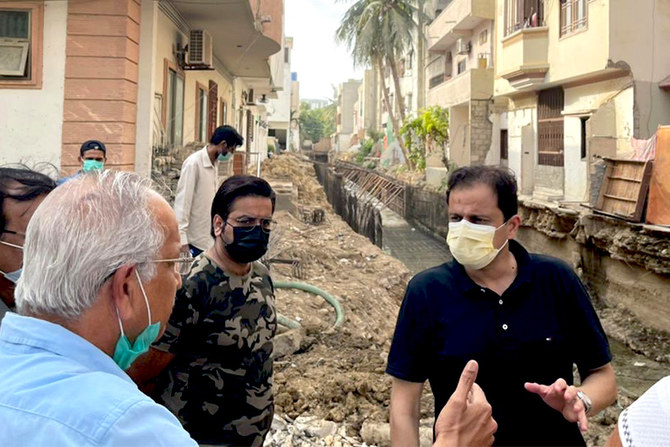
KARACHI: Murtaza Wahab Siddiqui, the newly appointed administrator of the megacity of Karachi, the capital of Pakistan’s southern Sindh province, said he was ready to work closely with Prime Minister Imran Khan’s government to solve multiple governance issues plaguing the country’s largest city and financial hub.
A law graduate from the University of London, Siddiqui, 38, is a practicing lawyer, an adviser to the chief minister of Sindh, a spokesperson for the provincial government and a member of Sindh’s ruling Pakistan Peoples Party (PPP).
Earlier this month, he was appointed administrator of the Karachi Metropolitan Corporation’s (KMC), a governing body that provides municipal services in Karachi, including overseeing the management of waste — one of the main problems of the country’s most populated city.
“I will play the role of a bridge between KMC and the government of Sindh, KMC and federal entities as well,” Siddiqui told Arab News in an interview last week. “The Sindh government is serious, KMC is serious, we want to work, to help people out. And if the federal government wants to work with us, wants to genuinely support us in solving the problem, let us work together.”
Waste was a “major problem” for Karachi, he said, and solving it his top priority.
Karachi — with a core population of over 13 million and at least another four million living on its outskirts — has always struggled to keep its streets clean. According to a study published in C40 Cities, up to 16,000 tons of solid waste is generated in Karachi per day.
Largely uncollected, the waste pollutes and chokes the city’s waterways, regularly leading to urban flooding and fueling the spread of disease.
Coupled with bad air quality, congestion and daily traffic jams, the metropolis, which in the 1960s was known as Pakistan’s “city of lights,” is now regularly on lists of the world’s least liveable cities.
Its peculiar politics are part of the problem.
Sindh province is governed by one party, the PPP, but Karachi’s elected government is run by a faction of the Muttahida Qaumi Movement (MQM), while most of its legislators in the National Assembly belong to a third party — Pakistan Tehreek-e-Insaf (PTI) of Imran Khan, which rules the country at the center.
A total of 19 federal, provincial, and local land-owning agencies, corporate sector interests, formal and informal developers, international capital, and military cantonments control tracts of the city. No one entity has municipal authority over the entire city.
Then there is the added problem of district municipal corporations (DMCs), which do not work in coordination, Siddiqui said.
In 2018, a Supreme Court-appointed commission on water and sewerage said half of DMC workers didn’t turn up for work, and about a tenth of the 13,000 employees were “ghost employees.”
“I’ve been engaging very closely with the management of solid waste, and the DMCs to make sure that we achieve a high level of deliverance with regard to solid waste,” Siddiqui said, adding that there had been “friction” in the past between DMCs of different areas of Karachi.
“We are now trying to create a uniform mechanism for all seven districts so that there is no shifting of blame,” he said. “We are working in tandem, that’s part of my target.”
Siddiqui’s second target, he said, was fixing the city’s transportation crisis.
Karachi has one of the worst public transportation systems in the world, with commuters mostly relying on decades-old, overcrowded buses navigating roads filled with potholes and dysfunctional traffic signals.
Some respite is expected due to the Green Line project, a bus rapid transit line funded mainly by the federal government and scheduled for completion in October.
“The issue of transport buses will hopefully be resolved in the next six to seven months,” Siddiqui said. “The government has been very kind and allocated an amount of money for those buses, and new buses can be brought into the city.”
The next challenge is water supply.
Karachi needs about 1,200 million gallons per day of water to meet the demand of its population but officials say its two main water sources only provide the city with about 580 million gallons per day. Some of the water is lost due to dilapidated infrastructure and water theft, while experts say climate change and dams built upstream by India also reduce water supplies. Water companies and tankers now increasingly supply residents.
“I feel as of now, the demand and supply gap of water is so huge, that immediate relief cannot be provided,” Siddiqui said. “However, the issue can be addressed,” he added, pointing to the city’s seacoast location and possible ways of making saltwater suitable for human consumption.
“We have a big coastal belt where water can be extracted from the coastline. It can be turned into sweet water and made consumable for the humans,” he said. “Desalination is a reality all over the world, the entire Middle East is functioning on desalination.”
But desalination is not cheap and will increase water bills for the city’s residents.
“Just like we pay the price for electricity, pay the price for gas, they [Karachi residents] need to pay the price for water as well,” Siddiqui said. “Unfortunately, if you look toward the past, we don’t have the concept of paying the water bill.”
“I’m trying to create this awareness, I’m trying to convince the people as well that yes, water problems can be resolved by way of desalination. But that is an area where the public needs to support the government, the public needs to cooperate with the government.”
Siddiqui knows the task will not be easy.
“It is a difficult task, but it is not impossible,” he said. “When I start to do something, I don’t look at the difficulties. I look at the opportunities, I look at the deliverables, I look at the areas where things can happen.”


![]()

New administrator invites central government to ‘work together’ to solve Karachi’s problems
Short Url
https://arab.news/gnzfm
New administrator invites central government to ‘work together’ to solve Karachi’s problems
- Murtaza Wahab Siddiqui is new administrator of Karachi Metropolitan Corporation, governing body that provides municipal services
- He says waste, transportation, water his three main challenges, hopes KMC can work in coordination with district-level bodies
Latest updates


© 2026 SAUDI RESEARCH & PUBLISHING COMPANY, All Rights Reserved And subject to Terms of Use Agreement.