Palestinians protest Israeli ‘violation’ of Hebron heritage site

1 / 2
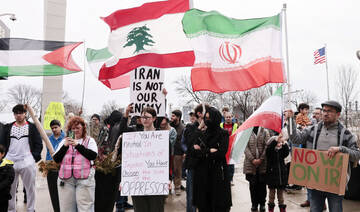
Israeli security forces argue with Palestinian worshippers during a demonstration in Hebron following Friday prayers at the Ibrahimi mosque. (AFP)
2 / 2
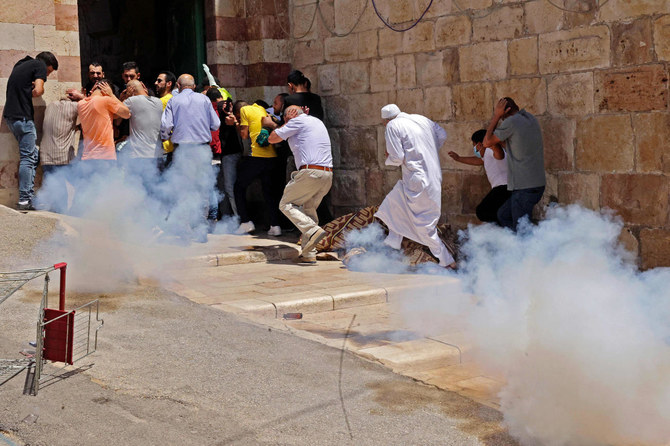
Palestinian worshippers speed away to avoid tear gas amid clashes with Israeli security forces in the divided city of Hebron in the Israeli-occupied West Bank on August 13, 2021. (AFP)
Short Url
Updated 16 August 2021
Follow

Palestinians protest Israeli ‘violation’ of Hebron heritage site

  • Construction near ancient mosque is ‘illegal and racist,’ Knesset member tells Arab News

AMMAN: Protests against Israeli plans to construct near Hebron’s Ibrahimi Mosque have escalated after Israeli army-protected contractors worked on the mosque in order to install a nearby electric elevator.

Palestinian members of the Israeli Knesset made a supportive visit to Hebron on Saturday and vowed to back Palestinian efforts to preserve the UNESCO-protected heritage site.

UNESCO, the UN cultural organization, declared the ancient and hotly contested core of Hebron in the Israel-occupied West Bank as “in danger,” despite a concerted diplomatic effort by Israel and the US to change the verdict.

Knesset Member Sami Abu Shehadeh told Arab News that a delegation of the Joint Arab List was hosted by the city’s mayor, waqf officials, as well as the Chamber of Commerce.

“The changes that they are trying to carry out near the mosque are illegal and racist,” he said.

He added that Israelis were claiming that the changes are to help the disabled.

“But even this so-called benevolent act is not available to disabled Palestinians because it is being created in an area that is restricted only to Jewish settlers.”

Abu Shehadeh and others experienced for themselves the difficulties that normal Palestinian worshipers face in reaching their own mosque.

“Even as members of the Knesset — who cannot be disrupted by the army — we had a hard time crossing so many checkpoints. Imagine what it is like for ordinary Palestinians,” he said.

Even as members of the Knesset — who cannot be disrupted by the army — we had a hard time crossing so many checkpoints. Imagine what it is like for ordinary Palestinians.

Sami Abu Shehadeh

Abu Shehadeh added that what he saw in a single square kilometer was “the ugliest site of the Israeli settlement racist enterprise.”

The delegation of the Joint Arab List was stopped on Hebron’s Shuhada Street, which has been closed since 1994, causing business losses to the tune of $1.2 billion for 1,800 Palestinian shops in the heart of the old city.

But on a positive note, Abu Shehadeh said that the delegation was “pleasantly surprised” to see many Palestinian citizens of Israel from Al-Fahm and Jaffa, who had come to show solidarity.

Dana Mills, director of development and external affairs at Peace Now, told Arab News that the issue of the mosque is “not a matter of accessibility,” but rather a “performance of sovereignty.”

Through the “excuse of accessibility,” Mills said that Israel was constructing an elevator and a bridge at one of the holiest sites in both Islam and Judaism.

Mills added that improving accessibility requirements “should have been done with full coordination and the consent of the Muslim waqf.

“It is still not too late to stop this project and we call upon the Israeli government to immediately end the work.”

On Friday, Palestinians unilaterally closed all mosques in the Hebron area and encouraged worshipers to visit the Ibrahimi Mosque in a peaceful act of protest.

But many who traveled to the holy site have claimed they were met with violence from the Israeli side.

Tareq Salmi, a spokesman of Islamic Jihad, said that Israeli actions are aimed at “having control of the mosque.

“The new plan of the settlement enterprise is to create a separate corridor and an electric elevator which will allow settlers to reach the roof of the mosque.”

These actions are aimed at “changing the historic Islamic site which is part of Arab and Islamic heritage in the city of Hebron,” Salmi said.

Sami said that the 44th session of the World Heritage Sites meeting in Fuzhou, China, in July decided that “the status of Hebron old town on the endangered World Heritage list remains unchanged.”

UNESCO deplored “the ongoing Israeli excavations which are illegal under international law and harmfully affect the authenticity and integrity of the site.”

The organization also “took note of reports regarding new planned projects, including an electric elevator.”


As Iran conflict spills over, Iraq’s Kurds say ‘this war is not mine’

Updated 08 March 2026
Follow

As Iran conflict spills over, Iraq’s Kurds say ‘this war is not mine’

  • The Kurds, an ethnic minority with a distinct culture and language, are rooted in the mountainous region spread across Turkiye, Syria, Iraq and Iran
  • “This isn’t my war,” said 58-year-old Satar Barsirini

SORAN, Iraq: On a deserted road not too far from the border between Iran and Iraqi Kurdistan, Satar Barsirini looked up at the sky, now streaked with jets and drones.
Iraq’s Kurdish region has found itself caught in the crossfire of a regional war triggered by US and Israeli attacks on the Islamic republic.
Dressed like the Kurdish fighters he once served alongside, Barsirini still wears the khaki shalwar, fitted jacket and scarf wrapped around his waist.
Though recently retired, he refuses to give up his peshmerga uniform as he tills his small plot of land.
The rumble of jets and hum of drones “come from everywhere. Especially at night,” he told AFP in the hamlet of Barsirini, dozens of kilometers from the border.
He described the “shiver in our flesh” as the drones hit the ground outside.
“I feel bad for the people, because we have paid a lot in blood to liberate Kurdistan... We just want to live.”
Irbil, the autonomous region’s capital, and the valleys leading to the border have been targeted by Tehran and the Iraqi armed groups it supports.
American bases there have come under fire, as have positions held by Iranian Kurdish parties — the same ones US President Donald Trump said it would be “wonderful” to see storm Iran.
But Iran warned on Friday it would target facilities in Iraqi Kurdistan if fighters crossed into its territory.
“This isn’t my war,” said 58-year-old Barsirini.
He recalled the brutal repression and flight into the snowy mountains after the 1991 Kurdish uprising that followed the first Gulf War.

- ‘Dangerous people’ -

The uprising was repressed, leading to an exodus of two million Kurds to Iran and Turkiye.
“When we fled the cities for our lives, we went to Iran. They helped us, they gave us shelter and food,” he said.
The Kurds would not forget that, Barsirini stressed, adding that they could not just “turn against them” now to support the US and Israel.
“I don’t trust (Americans). They are dangerous people,” he said.
The Kurds, an ethnic minority with a distinct culture and language, are rooted in the mountainous region spread across Turkiye, Syria, Iraq and Iran.
They have long fought for their own homeland, but for decades suffered defeats on the battlefield and massacres in their hometowns.
They make up one of Iran’s most important non-Persian ethnic minority groups.
A week of war has gripped daily life in Iraqi Kurdistan, residents told AFP.
“People are afraid,” said Nasr Al-Din, a 42-year-old policeman who, as a child, lived through the 1991 exodus — “thrown on a donkey’s back with my sister.”
“This generation is different from the older ones” that have seen “seen fighting.”
Now, he said, you could be “sitting down in your home... and all of a sudden a drone hits your house.”
“We may have to go into town or somewhere safer,” said Issa Diayri, 31, a truck driver waiting in a roadside garage, his lorry idle for lack of deliveries from Iran.

- ‘Shouldn’t get involved’ -

Soran, a small town of 3,000 people about 65 kilometers (40 miles) from the border, was hit Thursday by a drone that fell in the middle of a street.
There, baker Yussef Ramazan, 42, and his three apprentices, hurriedly made bread before breaking their fast.
But, living so close to the Iranian border, he said “people are afraid to come and buy it.”
He told AFP he did not think it was a good idea “for the Kurdish region to get involved in this war.”
“We are not even an independent country yet. We would like to become one, but we are nothing for now, so we shouldn’t get involved in these situations.”
Across the street, Hajji watched from his empty dry cleaning shop as the road cleared.
Before the war, the town was crowded as evening fell, he said, declining to give his full name.
“But after the drone explosion, no one was here. In five minutes, everyone left the street and no one was out.”