

Taliban take control of Kabul, storm presidential palace

1 / 2
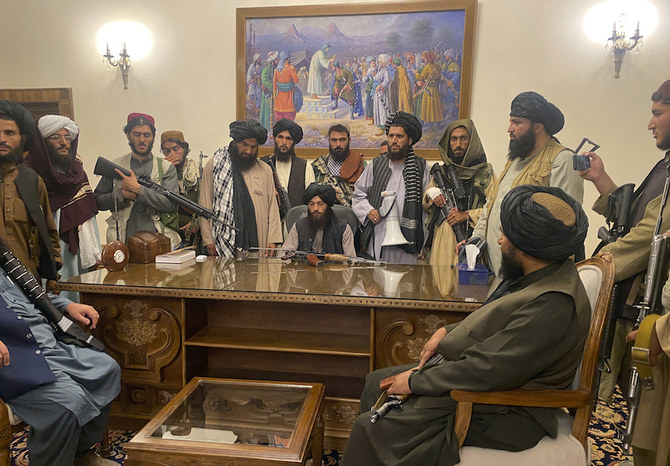
Taliban fighters take control of Afghan presidential palace after the Afghan President Ashraf Ghani fled the country, in Kabul, Afghanistan, Sunday, Aug. 15, 2021. (AP)
2 / 2
Taliban fighters take control of Afghan presidential palace after the Afghan President Ashraf Ghani fled the country, in Kabul, Afghanistan, Sunday, Aug. 15, 2021. (AP)
Short Url
Updated 16 August 2021
Follow

Taliban take control of Kabul, storm presidential palace

  • US embassy staff airlifted out in echoes of Vietnam
  • Ashraf Ghani flees the country, branded ‘a coward’

KABUL: Taliban insurgents entered Kabul and regained control of Afghanistan on Sunday, 20 years after the US-led invasion that ousted them.

In chaotic scenes reminiscent of the fall of Saigon in 1975 at the end of the Vietnam war, American diplomatic staff were airlifted by helicopter from the US Embassy in the fortified Wazir Akbar Khan district of the Afghan capital.


 A US Chinook helicopter flies over the US Embassy in Kabul, Afghanistan, Sunday, Aug. 15, 2021. (AP)

As Taliban fighters took over the presidential palace, President Ashraf Ghani fled the country and was thought to be in Tajikistan. Afghans on social media branded him a “coward.”

Ghani said he left to “prevent a flood of bloodshed” and that “countless patriots would be martyred and the city of Kabul would be destroyed” if he had stayed behind.
"The Taliban have won with the judgement of their swords and guns, and are now responsible for the honor, property and self-preservation of their countrymen," he said in a Facebook post.

He did not say where he had travelled to, but leading Afghan media group Tolo news suggested he had gone to Tajikistan.


Kabul’s streets were choked with cars and people trying to reach the airport. “Some people have left their keys in the car and have started walking to the airport,” one resident said

Hundreds of Afghans, some of them government ministers and government employees, along with civilians including many women and children, crowded into the terminal building at Kabul airport waiting for flights out.
“The airport is out of control ... the Afghan government just sold us out,” one official in the building said. A NATO official said the alliance was helping to secure the airport and that a political agreement was “now more urgent than ever.”

A Kabul hospital said it was treating more than 40 people wounded in clashes on the outskirts of the city, but the Taliban takeover appeared to be largely bloodless and there was no major fighting.

The Taliban said it was waiting for the government to surrender peacefully. “Taliban fighters are on standby atall entrances to Kabul until a peaceful and satisfactory transfer of power is agreed,” spokesman Zabihullah Mujahid said.


The government’s acting interior minister, Abdul Sattar Mirzakawal, said power would be handed over to a transitional administration. “There won’t be an attack on the city, it is agreed that there will be a peaceful handover,” he said.
Another Taliban spokesman, Suhail Shaheen, said a transfer of power was expected in days. “We assure the people, particularly in the city of Kabul, that their properties, their lives are safe,” he said.
The speed of the Taliban advance in the past two weeks has stunned Western powers, as city after city fell to the insurgents with little resistance from Afghan government forces, trained and equipped by the US and others at a cost of billions of dollars.

President Joe Biden has faced mounting criticism for adhering to his predecessor Donald Trump’s plan to end the US military mission in Afghanistan by Aug. 31. “An endless American presence in the middle of another country’s civil conflict was not acceptable to me,” Biden said.

- With agencies


‘A den of bandits’: Rwanda closes thousands of evangelical churches

Updated 22 December 2025
Follow

‘A den of bandits’: Rwanda closes thousands of evangelical churches

  • A 2018 law introduced new rules on health, safety, and financial disclosures, and requires all preachers to have theological training
  • Observers say the real reason for the closures comes down to control, noting that even those who complied with the law had been shut down 
  • President Kagame has described the church as a relic of the colonial period, a chapter of its history with which the country is still grappling


KIGALI: Grace Room Ministries once filled giant stadiums in Rwanda three times a week before the evangelical organization was shut down in May.
It is one of the 10,000 churches reportedly closed by the government for failing to comply with a 2018 law designed to regulate places of worship.
The law introduced new rules on health, safety, and financial disclosures, and requires all preachers to have theological training.
President Paul Kagame has been vocal in his criticisms of the evangelical churches that have sprouted across the small country in Africa’s Great Lakes region.
“If it were up to me I wouldn’t even reopen a single church,” Kagame told a news briefing last month.
“In all the development challenges we are dealing with, the wars... our country’s survival — what is the role of these churches? Are they also providing jobs? Many are just thieving... some churches are just a den of bandits,” he said.
The vast majority of Rwandans are Christian according to a 2024 census, with many now traveling long and costly distances to find places to pray.
Observers say the real reason for the closures comes down to control.
Kagame’s government is saying “there’s no rival in terms of influence,” Louis Gitinywa, a lawyer and political analyst based in Kigali, told AFP.
The ruling party “bristles when an organization or individual gains influence,” he said, a view also expressed to AFP by an anonymous government official.

‘Deceived’ 

The 2018 law requires churches to submit annual action plans stating how they align with “national values.” All donations must be channelled through registered accounts.
Pastor Sam Rugira, whose two church branches were shut down last year for failing to meet fire safety regulations, said the rules mostly affected new evangelical churches that have “mushroomed” in recent years.
But Kagame has described the church as a relic of the colonial period, a chapter of its history with which the country is still grappling.
“You have been deceived by the colonizers and you let yourself be deceived,” he said in November.
The closure of Grace Room Ministries came as a shock to many across the country.
Pastor Julienne Kabanda, had been drawing massive crowds to the shiny new BK Arena in Kigali when the church’s license was revoked.
The government had cited unauthorized evangelical activities and a failure to submit “annual activity and financial reports.”
AFP was unable to reach Kabanda for comment.

‘Open disdain, disgust’ 

A church leader in Kigali, speaking to AFP on condition of anonymity, said the president’s “open disdain and disgust” for churches “spells tough times ahead.”
“It is unfair that even those that fulfilled all requirements are still closed,” he added.
But some say the clampdown on places of worship is linked to the 1994 Rwandan genocide in which around 800,000 people, mostly ethnic Tutsis, were slaughtered.
Ismael Buchanan a political science lecturer at the National University of Rwanda, told AFP the church could sometimes act as “a conduit of recruitment” for the Democratic Forces for the Liberation of Rwanda (FDLR), the Hutu militia formed in exile in DR Congo by those who committed the genocide.
“I agree religion and faith have played a key role in healing Rwandans from the emotional and psychological wounds after the genocide, but it also makes no sense to have a church every two kilometers instead of hospitals and schools,” he said.
Pastor Rugira meanwhile suggested the government is “regulating what it doesn’t understand.”
It should instead work with churches to weed out “bad apples” and help them meet requirements, especially when it comes to the donations they rely on to survive, he said.