

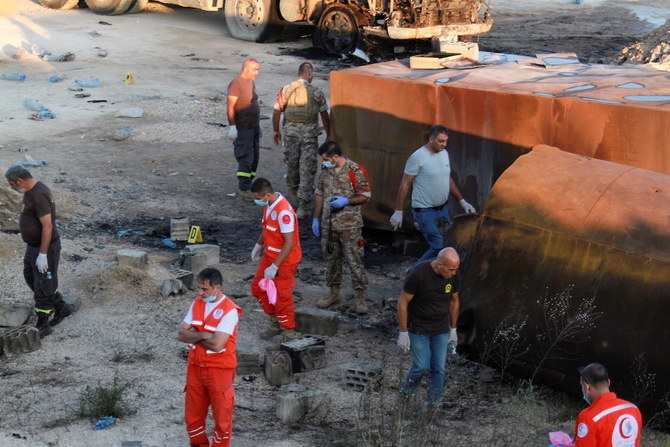
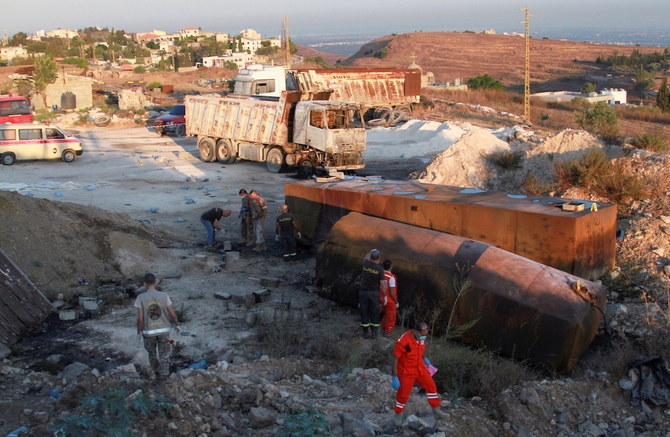
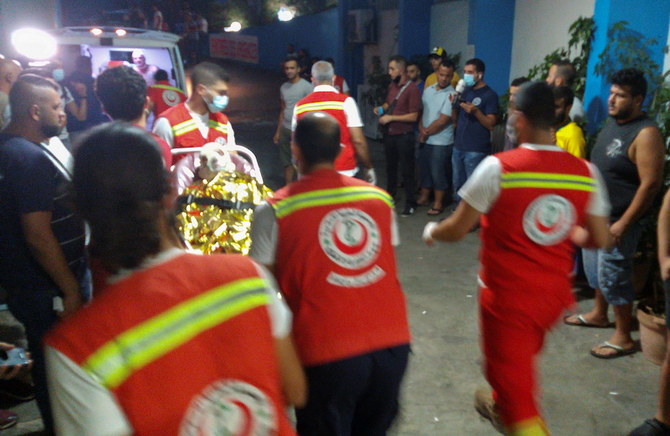
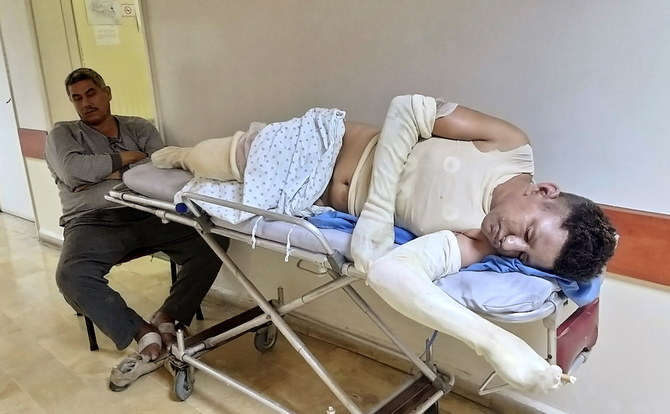


BEIRUT: At least 28 people were killed in an horrific gas tanker explosion in Lebanon early on Sunday morning, overwhelming hospitals and prompting emergency appeals for blood donations.
The incident took place at around 2 a.m. in Akkar, one of the poorest areas in northern Lebanon, and around 80 people were injured.
About 200 were nearby when the tank exploded, with Lebanese soldiers among the casualties.
The tragedy heaps fresh misery on a nation already beset by a severe economic crisis and fuel shortages that have crippled hospitals and caused lengthy power cuts.
On Saturday, the army had seized the tank, which contained 18,000 liters of subsidized gasoline, and was in the process of handing out fuel to residents.
There were appeals to the international community to help treat the wounded. Health Minister Hamad Hassan said the burns were “more than what the Lebanese hospitals can handle.”
Jordan, Egypt, Qatar, Iraq and Turkey responded to the appeal to send emergency health aid or to receive the injured at their local hospitals.
Maj. Gen. Mohamed Kheir, secretary-general of the Higher Relief Committee, called on NGOs and international organizations in Lebanon to provide hospitals with “all the medicine, IV fluds, and medical supplies to treat 2nd and 3rd degree burns.”
There are different accounts about what caused the explosion.
Altalil town, where the seized tank was hidden, is over 40 km away from the illegal Al-Qasr border crossing in northern Bekaa, on the Lebanese-Syrian border. It was hidden on land belonging to Georges Rashid Ibrahim.
BACKGROUND
The tragedy heaps fresh misery on a nation already beset by a severe economic crisis and fuel shortages that have crippled hospitals and caused lengthy power cuts.
Some survivors said people had rushed to get free gasoline from the tank and, as a result of the chaos and overcrowding, an angry man ignited a lighter.
“The soil was covered with gasoline, which caused a massive explosion that blew people tens of meters away.”
Other survivors said that, seeing people take all the fuel, “Ibrahim’s son got very angry ... he fired shots near the tank, which caused a fire and led to this disaster.”
Some families took the injured to hospitals on motorcycles. Video clips on social media showed people set alight by the explosion.
Critical cases were taken by helicopter to specialist hospitals in Tripoli and Beirut.
Angry residents in Akkar gathered near the fuel tank owner’s house and torched the vehicles parked outside. They also threatened to burn down the house of Assaad Dergham, a Free Patriotic Movement (FPM) MP.
Dergham’s house is 500 meters away from Ibrahim’s house. But the lawmaker denied knowing the landowner and any ties that connected him to the FPM.
Some information indicated that Ibrahim was connected to a resident from Wadi Khaled called Ali Al-Faraj, who helped him to smuggle the subsidized gasoline into Syria.
“What we know in the area and are sure of is that Georges Rashid Ibrahim is close to Ali Al-Faraj, who is known for his smuggling operations into Syria and deals on the black market, and who was arrested by the security bodies three months ago over these operations,” Wadi Khaled’s Ahmed Al-Sayyed told Arab News.
“Ibrahim operates under the pretext of transporting pebbles and sand from his rock drill factory near his house, via trucks and other vehicles, to Wadi Khaled, which is located 20 km from Altalil.
“He unloads the diesel and gasoline shipments from the vehicles, leaving Al-Faraj the task to transport them to Al-Qasr border crossing in Al-Hermel. Al-Qasr is an illegal border crossing located 20 kilometers away from Wadi Khaled. Families from the Bekaa Valley, covered by Hezbollah, handle their smuggling into Syria, for large sums of money.”
Al-Sayyed confirmed Ibrahim’s ties with the FPM.
“I know him very well. During the latest electoral campaign, he came to Wadi Khaled and met with us and said he was ready to give free bags of pebbles and sand to those who vote for the FPM’s candidate, Assaad Dergham. And this is exactly what happened. Smuggling operations are not carried out through the northern borders because, during the Talkalakh battle, the area was planted with landmines.
“Also, due to the large river there, the area cannot be crossed by car, in addition to an army checkpoint on the entrance of Wadi Khaled, which prevents any vehicle carrying large quantities of gasoline and diesel from passing. That is why the smuggling is done through the border crossings of Hermel.”
The Akkar disaster revealed the state’s inability to provide medical supplies and healthcare, while also providing an opportunity for politicians to point fingers at one another about Lebanon’s deteriorating condition.
President Michel Aoun said he had presented a report to the Higher Defense Council about activities of extremist groups “aiming to create chaos and destabilize the security.”
Former Prime Minister Saad Hariri, who had a months-long dispute with the president about the failure to form a new government, hit back.
He said: “How does the president allow himself to jump over people’s pain to talk about extremist groups’ activities aiming to destabilize security in the north? How does his son-in-law Gebran Bassil accuse Akkar of becoming outside the state due to fuel gangs and claim that Akkar should be declared a military zone?”
He also addressed the president directly: “No. Akkar is not Kandahar and is not outside the state. You have become outside the state and a president of the republic of the Aounist movement.”


