


Google marks Pakistan's Independence Day with Derawar Fort doodle

Google's special doodle on the occasion of Pakistan's Independence Day featuring the iconic medieval Derawar Fort, a large square fortress in the Cholistan Desert, south of Bahawalpur. (Photo courtesy: Google)
Short Url
Updated 14 August 2021
Follow

Google marks Pakistan's Independence Day with Derawar Fort doodle

  • On Aug. 14, 1947, Pakistan achieved independence from British colonial rule
  • Derawar Fort is a large square fortress in Cholistan Desert, Punjab, Pakistan.

ISLAMABAD: Google marked Pakistan's Independence Day on Saturday with a doodle featuring the iconic medieval Derawar Fort, a large square fortress in the Cholistan Desert, south of Bahawalpur.
On Aug. 14, 1947, Pakistan achieved independence from British colonial rule when Britain partitioned the country into two independent dominions, Muslim Pakistan and majority Hindu India.
"Today’s Doodle celebrates Pakistan Independence Day, a public holiday commemorating the day on which the nation became a sovereign republic. Pakistanis across the subcontinent join to celebrate their freedom and honor the centuries of history that comprise its cultural foundation," Google said in a statement on Saturday.
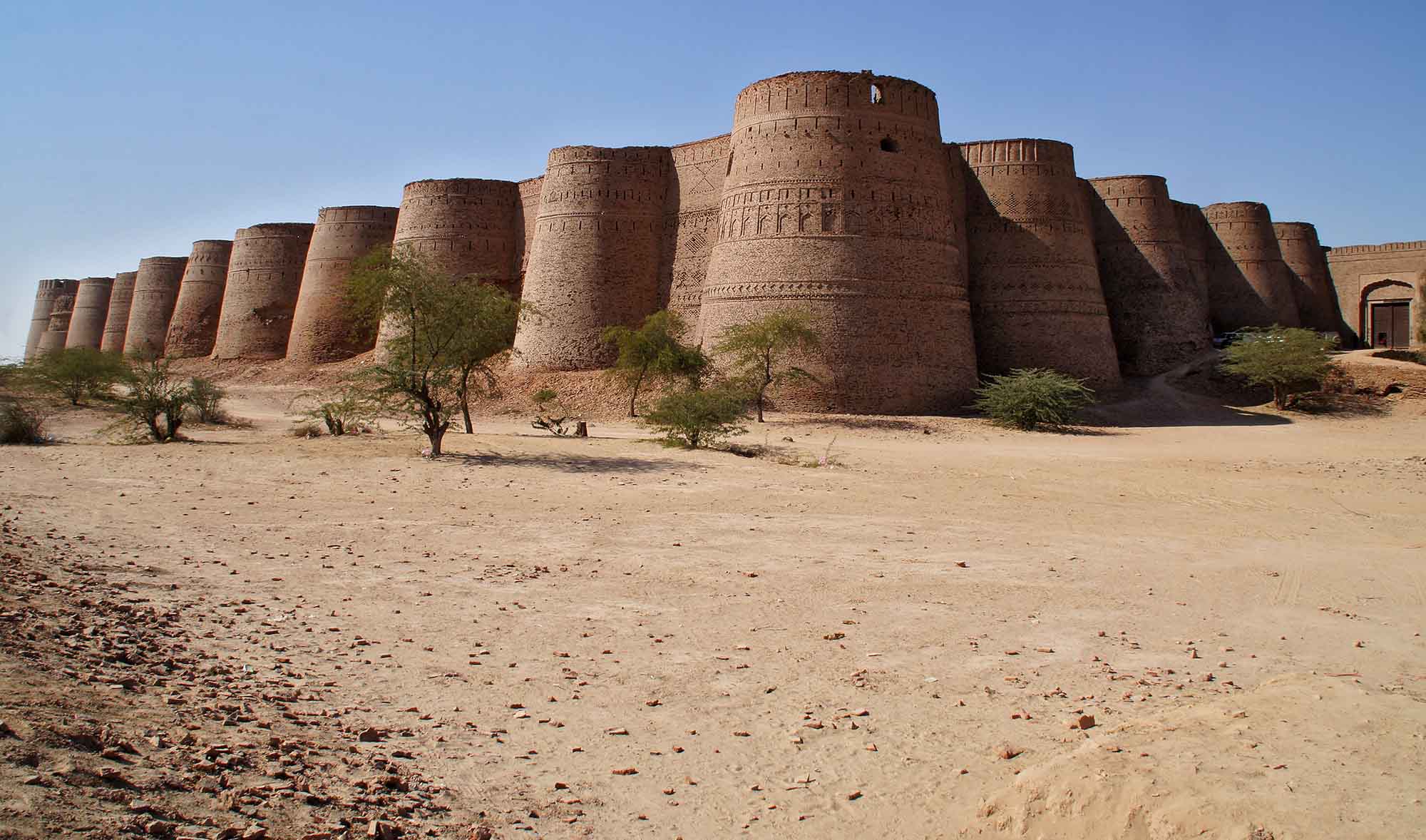


This undated file photo shows the historical Derawar Fort in the Cholistan Desert, south of Bahawalpur, Pakistan. (Shutterstock/File)

The massive fortress is a square structure built with clay bricks, consisting of 40 forty circular bastions, ten on each side, which stand 30 meters high and are visible across the desert for many miles. Its walls have a perimeter of 1,500 meters.
It was built in the 9th century by a Hindu Rajput ruler Rai Jajja Bhatti. In the 18th century, it was taken over and rebuilt by Muslim Nawabs of Bahawalpur, with whom it remained until the 1970s.
"The Mughal-style forts once facilitated trade and transportation in a largely inhospitable environment. The forts served as critical infrastructure for both the protection and nourishment of desert caravans on their journeys across Central Asia to the Indian subcontinent," Google said.
"Happy Independence Day, Pakistan!"


Pakistan seeks operationalization of World Bank’s $20 billion framework to advance reform priorities

Updated 5 sec ago
Follow

Pakistan seeks operationalization of World Bank’s $20 billion framework to advance reform priorities

  • Pakistan’s finance chief meets World Bank Country Director Bolormaa Amgaabazar in the capital
  • The Bank’s 10-year Country Partnership Agreement for Pakistan was approved in January last year

ISLAMABAD: Pakistan’s Finance Minister Muhammad Aurangzeb on Wednesday called for the operationalization of the World Bank Country Partnership Framework (CPF) to advance the government’s key reform priorities during a meeting with the Bank’s country director, according to a statement.

The Bank’s Board of Directors approved a 10-year CPF deal with Pakistan, indicating $20 billion in financing for Pakistan under the framework. The amount will include public and private financing from the World Bank Group, with roughly half expected to come from private-sector operations led by the International Finance Corporation (IFC).

“The Finance Minister emphasized the importance of effective operationalization of the CPF, particularly in priority areas such as population management and climate change,” the finance ministry said in a statement after Aurangzeb’s meeting with the Bank’s Country Director Bolormaa Amgaabazar.

“He underscored the need for strong coordination between federal and provincial governments to ensure coherence in policy design and implementation.”

Discussions focused on population, human capital development, climate resilience, agricultural reform and energy sector sustainability, it added.

The ministry said both sides exchanged views on enhancing institutional coordination, improving transparency in project design and strengthening monitoring mechanisms to deliver intended outcomes. It highlighted that the World Bank expressed readiness to continue supporting agricultural transformation efforts in collaboration with the IFC.

“Both sides agreed to continue technical-level engagements to explore feasible solutions in line with Pakistan’s reform agenda and fiscal framework,” the finance ministry added.

Climate resilience and population control are major concerns for policymakers in Pakistan, a country whose population exceeds 241 million, making it the world’s sixth-most populous country. Limited infrastructure, health care, and educational opportunities place added strain on public services, contributing to unemployment and poverty.

The South Asian nation is also among the countries most affected by climate change. Unusually heavy monsoon rains in 2022 killed more than 1,700 people and caused over $30 billion in damages. Torrential rains and floods since late June last year have claimed more than 1,000 lives, as authorities continue surveys to assess the full extent of the destruction.