Turkey: Flood deaths rise to at least 51 as rescuers push on

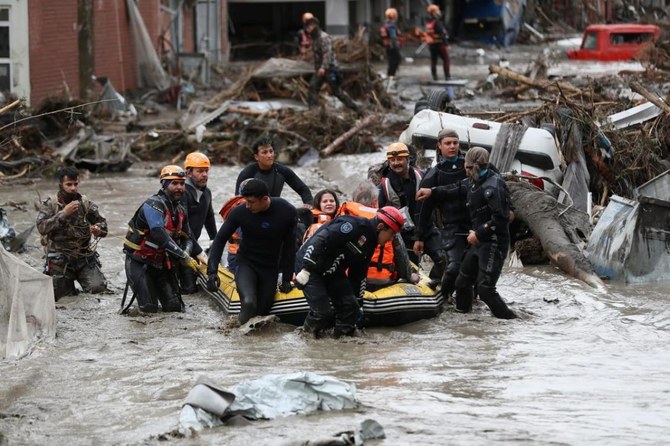
Search and rescue team members evacuate locals during flash floods which have swept through towns in the Turkish Black Sea region, in Bozkurt, a town in Kastamonu province, Aug. 12, 2021. (File/Reuters)
Short Url
Updated 14 August 2021
Follow

Turkey: Flood deaths rise to at least 51 as rescuers push on

  • Nine people remained hospitalized
  • Rescue teams and sniffer dogs kept up the painstaking task of trying to locate residents

ISTANBUL: The death toll from severe floods and mudslides along Turkey's Black Sea coast has climbed to at least 51, the country's emergency and disaster agency said Saturday, as authorities disputed reports that hundreds of people were missing.
Torrential rains that pounded the Black Sea provinces of Bartin, Kastamonu and Sinop on Wednesday caused flooding that demolished homes, severed at least five bridges, swept away cars and rendered numerous roads unpassable. Turkish disaster agency AFAD said 43 people were killed in Kastamonu, seven in Sinop and one in Bartin.
Nine people remained hospitalized, according to the agency.
Some residents in Kastamonu said on social media that there are hundreds more missing, a statement also made by an opposition lawmaker. But the provincial governor's office said that reports about 250 unidentified bodies were untrue. It did not specifically address how many people could be missing in the flooding.
Rescue teams and sniffer dogs kept up the painstaking task of trying to locate residents. AFAD said 5,820 personnel, 20 rescue dogs, 20 helicopters and two search planes were at the disaster spots.
About 2,250 people were evacuated across the region amid the floods, scores of them lifted from rooftops by helicopters. Many are being temporarily housed in student dormitories.
Climate scientists unequivocally say that climate change is leading to more extreme weather events as the world warms because of the burning of coal, oil and natural gas.
Experts in Turkey, however, said interference with rivers and improper construction also contributed to the massive flood damage.
Geologists say that construction narrowed the river bed and the surrounding alluvial flood plain of the Ezine stream in Kastamonu’s Bozkurt district, where the damage was most severe, from 400 meters (1,312 feet) wide to 15 meters (49 feet). Residential buildings were also built along the waterfront.
During severe rains, the constricted stream can only overflow. Videos posted by residents showed water rushing downstream in Bozkurt as buildings and roads flooded. One geologist, Ramazan Demirtas, explained the river bed narrowing on Twitter and said humans were to blame for this week's disaster.
In Sinop, floodwaters almost completely wiped out the village of Babacay, leaving toppled homes, damaged bridges and rubble in their wake. A five-story apartment building constructed on a riverbed was destroyed. Turkish broadcaster CNN Turk showed only an entrance door and wall remaining.
Across the Black Sea, days of heavy rain also produced flooding in broad areas of southern Russia. Authorities in the Krasnodar region said Saturday that more than 1,400 houses flooded following storms that swept the area this week. About 108,000 residents of 11 settlements were left without power.
The regional Russian emergency headquarters said over 1,530 people have been evacuated. The Black Sea resort city of Anapa was among the worst affected. Officials have warned that heavy rain was expected for another two days.
The floods struck on the heels of wildfires in southern Turkey that devastated forests in the seaside provinces of Mugla and Antalya, which are popular with tourists. At least 16 people died in those wildfires — including eight emergency workers as their firefighting plane crashed Saturday — and thousands of residents and tourists were forced to flee.


WEF panel told grassroots aid workers keep Sudan afloat even as conflict puts them at risk 

Updated 11 sec ago
Follow

WEF panel told grassroots aid workers keep Sudan afloat even as conflict puts them at risk 

  • Speakers warned that without urgent action to protect humanitarian access and support local responders, Sudan’s crisis will continue to deepen and destabilize the wider region

LONDON: Grassroots Sudanese aid groups are filling critical humanitarian gaps left by limited international access, but their volunteers are facing hunger, arrest and deadly risks as the conflict enters its fourth year, speakers warned at the World Economic Forum in Davos on Wednesday. 

More than 20 million people in Sudan are facing acute hunger, while more than 11 million have been displaced, making it the largest displacement crisis in the world. As fighting continues and access for international agencies tightens, community-led networks have become a primary lifeline for civilians across the country. 

“We need to strengthen local capacity and support community-led solutions like Emergency Response Rooms and mutual aid groups, with a more localized and decolonized humanitarian response,” said Hanin Ahmed, a Sudanese activist and Emergency Response Room leader. 

Ahmed described how volunteers were delivering food, medical support and protection services in areas that international organizations struggled to reach. However, she warned that these efforts came at immense personal cost.

Volunteers are often displaced themselves, facing food insecurity, arrest, kidnapping, and in some cases, killing by the warring parties. Famine, she said, was no longer confined to traditionally affected regions.

“There is famine not only in Darfur, but also in Khartoum, the capital,” Ahmed told the panel, pointing to widespread unemployment, disease outbreaks, and rising cases of gender-based violence across multiple states. 

Despite the scale of the crisis, Ahmed emphasized that Sudanese communities retained both the willingness and capacity to recover if adequately supported.

“Sudanese people are willing to resolve this war if supported,” she said. 

Panelists stressed that hunger in Sudan was not driven by a lack of aid, but by deliberate barriers to its delivery. 

“The story of Sudan’s war is a story of impunity,” said David Miliband, president and chief executive officer of the International Rescue Committee.

“To tackle impunity, we need to challenge restrictions on humanitarian access, end sieges, and address the profiteering that fuels the conflict,” he added.  

Miliband said that while humanitarian funding remained critically low, access constraints were the primary factor preventing life-saving assistance from reaching civilians. Only 28 percent of the UN humanitarian appeal for Sudan had been funded, he said, compounding the effects of obstruction on the ground. 

Meanwhile, where assistance was available, needs continued to outstrip capacity. Barham Salih, the UN High Commissioner for Refugees, described visiting refugee-hosting areas along Sudan’s borders, where people arrived after experiencing extreme violence, deprivation and trauma.

“Ten liters of water per person per day is far below emergency standards,” Salih said.

“Only 16 percent of those who need mental health support are receiving it, and only one in three families in need of shelter actually have access,” he added.  

Salih stressed that statistics failed to capture the scale of human suffering. “Behind every number is a human life,” he said, recounting testimonies of abuse, rape and killings from refugees who had crossed the border only hours earlier. 

As humanitarian systems inside Sudan continue to falter, the consequences are increasingly felt beyond its borders.

Neighboring countries including Chad, Kenya, Egypt and Uganda are hosting large numbers of Sudanese refugees despite limited infrastructure and resources. 

“What starts in Sudan does not stay in Sudan,” Miliband said. “This is a crisis with regional implications.”  

While host governments have kept borders open and adopted inclusive policies that allow refugees access to services and livelihoods, panelists warned that generosity alone could not sustain the response without stronger international support. 

The discussion in Davos highlighted that Sudan’s humanitarian crisis was shaped not by a lack of solutions, but by who is allowed to deliver aid, where, and under what conditions.