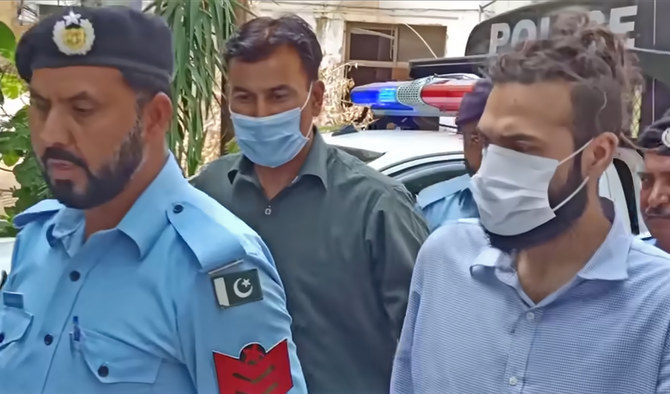

ISLAMABAD and LAHORE: DNA tests conducted on clothes, the weapon of offense and other material collected from the crime scene in last month’s gruesome murder of Noor Mukadam had confirmed that Zahir Zakir Jaffer was the killer, an investigation officer said on Friday.
Mukadam was found beheaded at a residence in Islamabad’s upscale F-7/4 sector on July 20 in a case that has sparked public outrage and grabbed media attention unlike any other recent crime against women. The victim was the daughter of Shaukat Mukadam, Pakistan’s former ambassador to South Korea and Kazakhstan.
Jaffer was arrested from the crime scene, his home, on the day of the murder and remained in police custody on physical remand until last week, when he was sent on 14-day judicial remand to Adiala Jail in Islamabad’s twin city of Rawalpindi. He is to be presented before a judicial magistrate on August 16.
“The DNA tests on samples collected from the clothes of both Zahir and Noor, and the weapon of offense, have confirmed the fingerprints of the principal accused in this case,” Inspector Abdul Sattar, who is investigating the case, told Arab News.
Police had last month submitted all evidence gathered from the crime scene, including CCTV footage from the Jaffer house, to the Punjab Forensic Science Agency in Lahore for analysis. Noor’s heart, lung, stomach, liver, spleen, nail scraping and vaginal swabs were also sent to the Agency for chemical examination.
A forensic report by the Agency confirmed that the CCTV footage was original and had not been edited, and the people in it were Jaffer and Mukadam, Sattar said.
“The accused has verbally accepted during police investigation that he sexually assaulted the victim before beheading her,” the inspector said. “But we will get a final scientific report on this from the forensic agency in a couple of days.”
Police are also scheduled to submit a detailed charge-sheet (challan) of the case in a district court in Islamabad on August 16, though the investigation officer said his department was yet to get all the required scientific reports to complete the challan.
“We haven’t received a complete report of the victim’s post-mortem yet,” Sattar said, adding that the decision regarding the submission of a complete or interim charge sheet in the court next week was still pending.
A top official at the Punjab Forensic Science Agency’s DNA section told Arab News on condition of anonymity that the victim’s blood and the accused’s fingerprints had been found on the weapon believed to have been used to commit the murder.
“It’s a match,” he said, declining to be named as he was not authorized to speak to the media about the details of the forensic report.
The official said the victim’s blood was also found on the clothing of the suspect.
On the question of whether Mukadam was subjected to sexual assault by Jaffer, the official said though the tests had confirmed that blood and semen found on the victim’s clothing and body belonged to Jaffer, “we cannot confirm whether it was a rape or intercourse with mutual consent, or how long the intercourse had happened before Noor’s beheading.”
“Our job is to determine whether the material brought for forensic analysis has semen on it or not, and that we have determined, that there is semen,” he said. “Analysis of traces of the blood is crucial for identifying the perpetrator and to help investigators piece together enough information to zero in on the culprit.”
He said the analysis of the postmortem report was ongoing and a report had not yet been issued.
In the footage obtained from the suspect’s house, Mukadam could be seen jumping from a balcony before Jaffer chased her and dragged her back into the house, the official, who had examined the video, said.
Asked whether Jaffer had taken a polygraph test when he was brought to Lahore on July 30, the official said police had not asked the forensic agency to carry out the test.
Aftab Bajwa, a lawyer, said courts would accept evidence gathered “through modern devices” under Article 164 of the Law of Evidence, though he added that the defense lawyers were likely to challenge it.
“The DNA reports could serve as pieces of corroborative evidence, but the conviction of an accused solely on their basis would be difficult,” Bajwa told Arab News. “The facts will have to be established in the trial court through cross-examination of witnesses and material evidence collected by the prosecution for a conviction.”