

Lebanon’s prime minister rejects president’s call for fuel crisis meeting

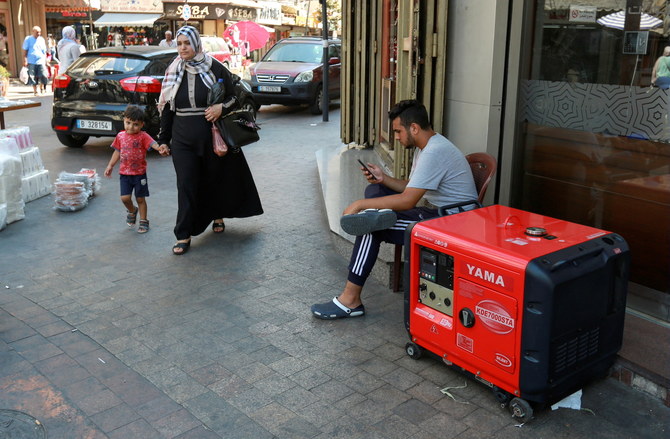
A woman with a child walk past a portable generator, which provides electricity, in Sidon, Lebanon, August 11, 2021. (Reuters)
Short Url
Updated 13 August 2021
Follow

Lebanon’s prime minister rejects president’s call for fuel crisis meeting

  • Importers warned of a huge shortage of already scarce fuel
  • The central bank announced on Wednesday it would only offer lines of credit at the market price

BEIRUT: Lebanon's prime minister Hassan Diab rejected President Michel Aoun's call to convene the cabinet to discuss the country's fuel crisis, saying such a meeting fell outside the caretaker cabinet's constitutional duties, Diab said in a statement.

Meanwhile, Lebanon’s oil directorate said on Friday that oil importers and facilities must supply the quantities of fuel they had already purchased before the central bank announced the effective lifting of subsidies on Wednesday night.
Lebanon’s government has objected to the central bank’s move, leading to a stalemate at the lowest point of a two-year financial crisis that has seen the Lebanese pound lose 90 percent of its value and driven more than half the population into poverty.
Importers warned of a huge shortage of already scarce fuel, and demanded that the same exchange rate must be used for buying and selling fuel.
The central bank announced on Wednesday it would only offer lines of credit at the market price for the Lebanese pound, which is more than 20,000 pounds to the dollar, much higher than the official rate of 1,500 and the most recent rate of 3,900 offered to importers beginning in June.
The quantities sold at that price must be sold while importers await the new exchange rate announcement from the central bank, the directorate said.
It also “called on all to assume their responsibilities in ensuring the necessary lines of credit in order to secure fuel supply,” it said.
That supply was in crisis on Friday, as extended blackouts continued across Lebanon, and those petrol stations that still had a fuel supply saw hours-long lines.
Local media reported the hijacking of a fuel tanker and a shooting at a station, incidents which have recurred over the past week.


Houthis, Yemen government to exchange nearly 3,000 prisoners: officials

Updated 12 sec ago
Follow

Houthis, Yemen government to exchange nearly 3,000 prisoners: officials

MUSCAT: Yemen’s Iran-backed Houthi rebels and its internationally-recognized government have agreed to a prisoner swap that includes nearly 3,000 people in total, including seven Saudis, officials from both sides said Tuesday.
The deal came after nearly a fortnight of discussions between Yemeni officials from both sides in Muscat, the capital of neighboring Oman, a key mediator in the conflict that has lasted for over a decade.
Majed Fadhail, a member of the government delegation for the prisoner swap talks, said they had agreed with the Houthis on a new exchange that would see “thousands” of war prisoners released.
Abdulqader Al-Mortada, an official with the Houthi delegation, said in a statement on X that “we signed an agreement today with the other party to implement a large-scale prisoner exchange deal involving 1,700 of our prisoners in exchange for 1,200 of theirs, including seven Saudis and 23 Sudanese.”
United Nations Special Envoy for Yemen Hans Grundberg in a statement welcomed the agreement as “a positive and meaningful step that will hopefully ease the suffering of detainees and their families across Yemen.”
He added that its “effective implementation will require the continued engagement and cooperation of the parties, coordinated regional support and sustained efforts to build on this progress toward further releases.”