

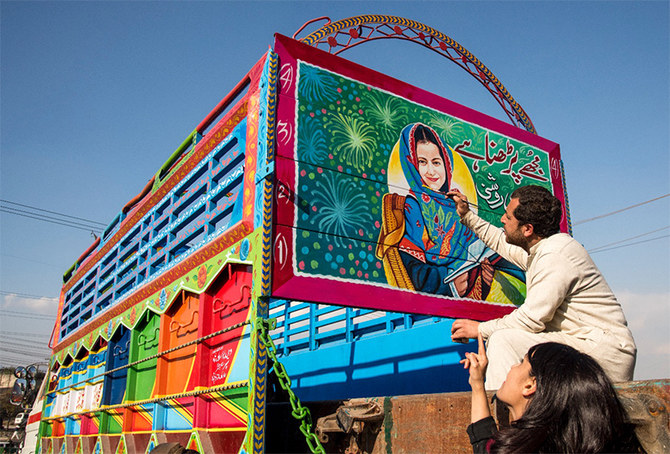
In Pakistan, truck art helps bring missing children home

A truck artist paints a portrait of a missing child for the Truck Art Child Finder project of Roshni Helpline and Berger Paints in Karachi, Pakistan, 2019. (Photo courtesy: Samar Minallah)
Short Url
Updated 13 August 2021
Follow

In Pakistan, truck art helps bring missing children home

  • Thousands of children go missing in Pakistan every year, many abducted for ransom or trafficked into slavery
  • Seven children have been found through the Truck Art Child Finder initiative of Roshni Helpline 

RAWALPINDI: In Pakistan, where truck art brings color and humorous messages to the landscape of roads, some drivers have replaced the traditionally vivid paintings on their vehicles with realistic portraits of missing children, hoping to bring them home.
The campaign, the Truck Art Child Finder, uses the popular art medium to spread awareness on how to report such crimes and seek help. It was launched in 2019 by the Roshni Helpline and multinational paint producer Berger Paints. Seven children have been recovered through the program so far.
According to the Roshni Helpline 1138, over 3,000 children are reported missing in Pakistan every year. Many are abducted to be sold to childless families, put on the streets to beg, or trafficked into sexual slavery.
The idea to use truck art to find missing children came from filmmaker and rights activist Samar Minallah, who believed the familiar art form would have more outreach than missing person posters that attract scant attention.
“Truck art is a strong medium that is loved and owned by Pakistanis,” Minallah told Arab News. “In the case of missing children, the ‘talaash-i-gumshuda’ messages painted on random walls are not enough to spread the word.”
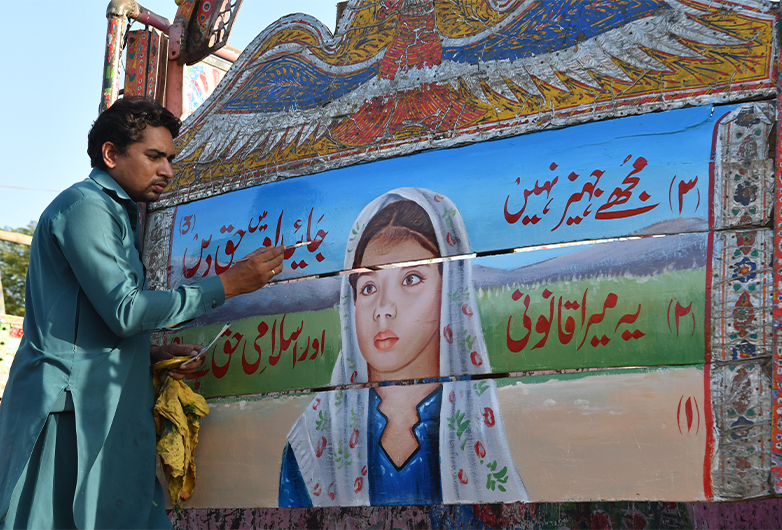


A truck artist paints a portrait of a missing child for the Truck Art Child Finder project of Roshni Helpline and Berger Paints in Karachi, Pakistan, 2019. (Photo courtesy: Samar Minallah)

“We teamed up and painted not just the information and helpline of missing children but also got their portraits made on the trucks. The pictures were provided by the families of the missing children to Roshni. The trucks became mobile billboards that were moving from one part of Pakistan to another.”
There now are 20 such trucks covering different routes across the country.
The most challenging part of the project, Minallah said, was convincing the drivers to use their vehicles for the unconventional purpose.
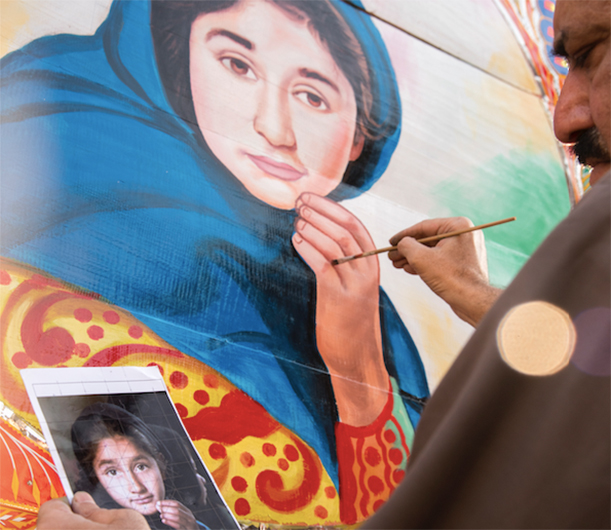


A truck artist paints a portrait of a missing girl from a photo provided to Roshni Helpline by her family for the Truck Art Child Finder project in Karachi, Pakistan, 2019. (Photo courtesy: Samar Minallah)

“For them a truck is a valued possession which must be decorated in the best possible manner,” she said. “A missing child’s picture and message went against the usual brightly colored images and quirky messages that trucks have.”
All the materials for the campaign were provided by multinational paint company, Berger Paints, which told Arab News in a statement it was “thankful” to Roshni Helpline for the “opportunity to work with them and assist them in this tremendous endeavor.”
For Amna Baig, assistant superintendent of Islamabad Police Kohsar, the campaign has brought much needed publicity to the problem of missing children. Pakistan has no central database for such cases, she said.
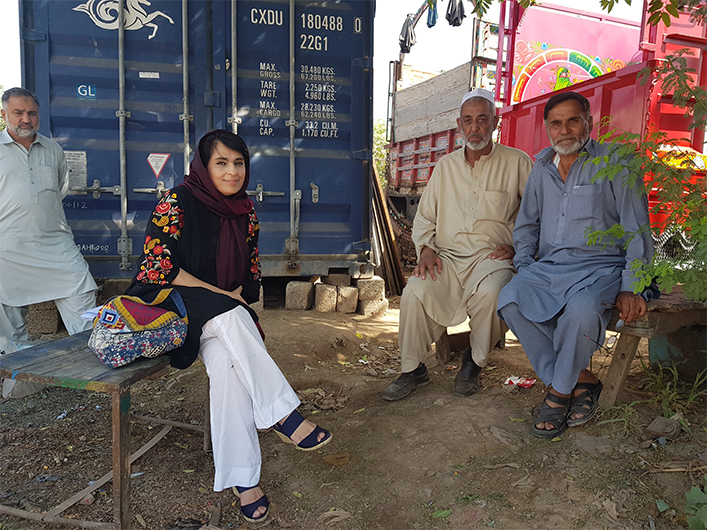


Activist Samar Minallah sits with artists involved in the Truck Art Child Finder project in Karachi, Pakistan, 2019. (Photo courtesy: Samar Minallah)

“So, it is at times hard to get the word out about these cases,” Baig said. “Campaigns like this, I can only imagine how much visibility they bring. The trucks, you can see them on the roads, across so many commercial hubs. I think it’s brilliant and it should be continued.”
Since its founding in 2016, Roshni Helpline has recovered 5,200 missing children.
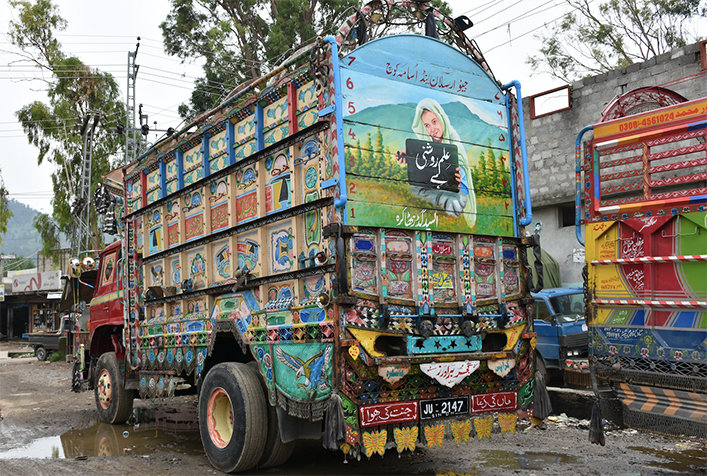


A truck painted with portraits of missing children for the Truck Art Child Finder is seen in Karachi, Pakistan, 2019. (Photo courtesy: Samar Minallah)

“When we started with these 20 cases, the public response was amazing,” Roshini Helpline founder Muhammad Ali told Arab News. “The interest of the people was great — they would look at a truck, take pictures, share it on social media.”
“These trucks are moving all over Pakistan, so we were receiving calls from everywhere,” he said. “We will continue the next phase of the campaign after Muharram.”

Pakistan opposition rallies in Khyber Pakhtunkhwa to demand release of Imran Khan

Updated 07 December 2025
Follow

Pakistan opposition rallies in Khyber Pakhtunkhwa to demand release of Imran Khan

  • PTI-led gathering calls the former PM a national hero and demands the release of all political prisoners
  • Government says the opposition failed to draw a large crowd and accuses PTI of damaging its own politics

ISLAMABAD: Pakistan’s opposition led by the Pakistan Tehreek-e-Insaf (PTI) party demanded the release of jailed former prime minister Imran Khan at a rally in the northwestern Khyber Pakhtunkhwa province on Sunday, describing him as a national hero who continues to command public support.

The gathering came days after a rare and strongly worded briefing by the military’s media chief, Lt. Gen. Ahmed Sharif Chaudhry, who dismissed Khan as “narcissistic” and “mentally ill” on Friday while responding to the former premier’s allegations that Pakistan’s chief of defense forces was responsible for undermining the constitution and rule of law.

He said that Khan was promoting an anti-state narrative which had become a national security threat.

The participants of the rally called for “civilian supremacy” and said elected representatives should be treated with respect.

“We, the people of Pakistan, regard Imran Khan as a national hero and the country’s genuinely elected prime minister, chosen by the public in the February 8, 2024 vote,” said a resolution presented at the rally in Peshawar. “We categorically reject and strongly condemn the notion that he or his colleagues pose any kind of threat to national security.”

“We demand immediate justice for Imran Khan, Bushra Bibi and all political prisoners, and call for their prompt release,” it added, referring to Khan’s wife who is also in prison. “No restrictions should be placed on Imran Khan’s meetings with his family, lawyers or political associates.”

Addressing the gathering, Sohail Afridi, the chief minister of Khyber Pakhtunkhwa, denied his administration was not serious about security issues amid increased militant activity. However, he maintained the people of his province had endured the worst of Pakistan’s conflict with militancy and urged a rethinking of long-running security policies.

The resolution asked the federal government to restore bilateral trade and diplomatic channels with Afghanistan, saying improved cross-border ties were essential for the economic stability of the region.

The trade between the two neighbors has suffered as Pakistan accuses the Taliban administration in Kabul of sheltering and facilitating armed groups that it says launch cross-border attacks to target its civilians and security forces. Afghan officials deny the claim.

The two countries have also had deadly border clashes in recent months that have killed dozens of people on both sides.

Some participants of the rally emphasized the restoration of democratic freedoms, judicial independence and space for political reconciliation, calling them necessary to stabilize the country after years of political confrontation.

Reacting to the opposition rally, Information Minister Attaullah Tarrar said the PTI and its allies could not gather enough people.

“In trying to build an anti-army narrative, they have ruined their own politics,” he said, adding that the rally’s reaction to the military’s media chief’s statement reflected “how deeply it had stung.”

“There was neither any argument nor any real response,” he added, referring to what was said by the participants of the rally.